
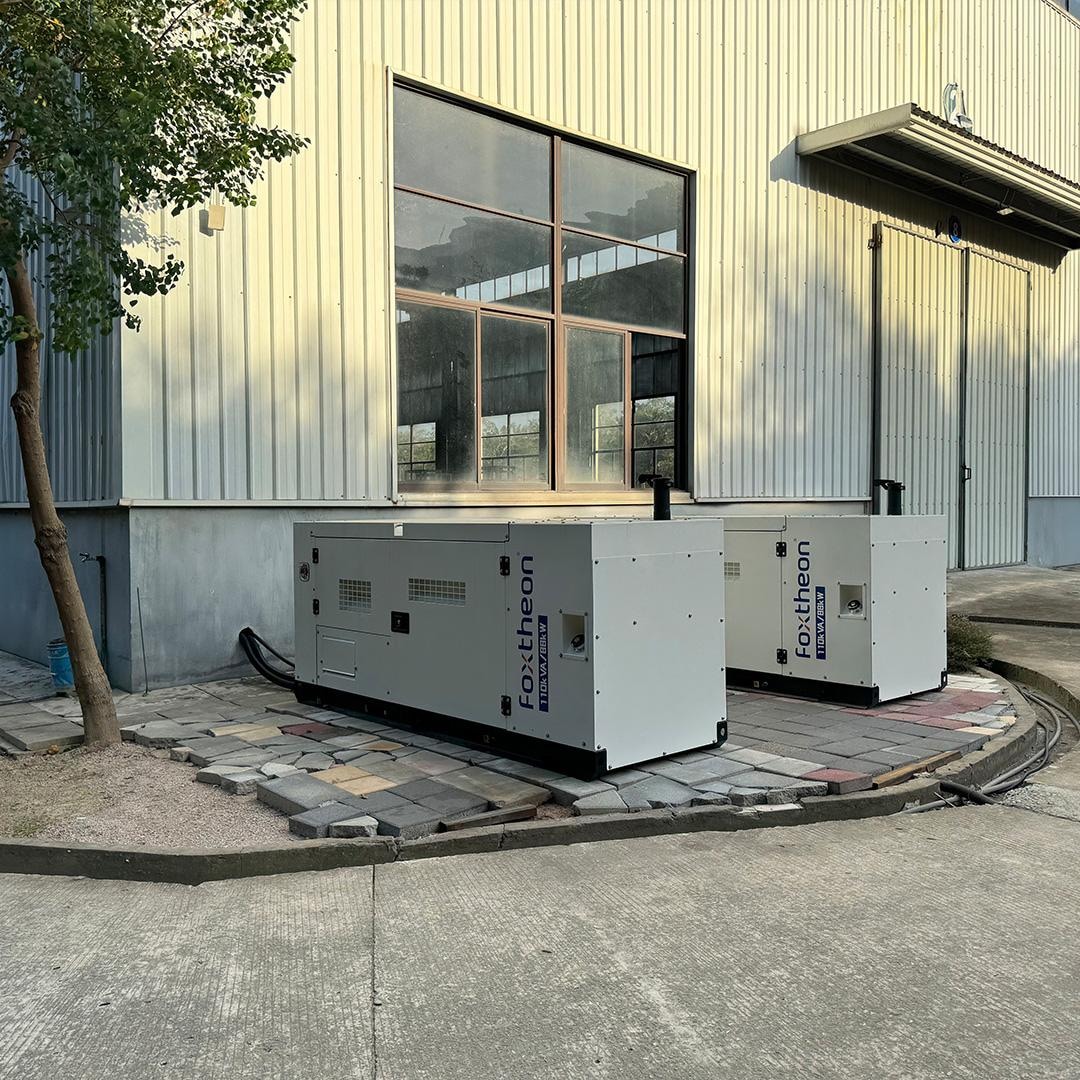
The equipment rental industry is shifting. For decades, providing temporary cooling meant dropping off a chiller and a diesel generator. It was a simple transaction, but it was rarely an efficient one. Clients today are demanding more. They face pressure to reduce carbon footprints, cut fuel costs, and minimize noise pollution on job sites and event grounds.
For rental companies, the old way of doing business is becoming less competitive. The solution lies in hybridization. When you add BESS to chiller rental fleet inventories, you are not just offering a battery; you are offering a smarter power solution. Companies like Foxtheon are leading this transition, helping fleet managers integrate intelligent energy storage to solve the inherent inefficiencies of traditional temporary cooling.
This shift isn’t just about being “green.” It is about operational physics and financial margins. Here is why integrating Battery Energy Storage Systems (BESS) is the smartest move for modern rental operations.
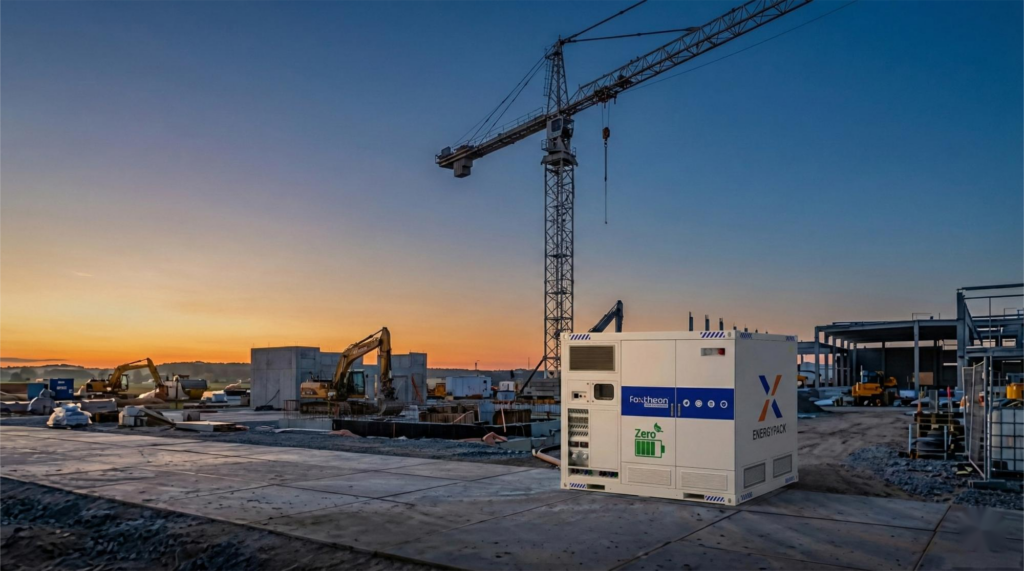
The Inherent Problem with Generators and Chillers
To understand the value of batteries, we have to look at how chillers behave. An industrial chiller does not consume power at a flat rate. It has a massive spike in power demand when the compressors start—known as inrush current—and then the load drops significantly once the target temperature is reached.
Generators, however, are static machines. You have to size the generator to handle that massive startup spike. This means that for 90% of the day, the generator is running at a fraction of its capacity. Diesel engines are designed to run hard and hot. When they run at low loads (light loading), they burn fuel inefficiently and suffer from mechanical issues.
This mismatch between the variable load of a chiller and the fixed capacity of a generator is where money is lost.
1. Massive Reductions in Fuel Consumption
The most immediate impact when you add BESS to chiller rental fleet packages is fuel economy. In a standard setup, the generator runs 24/7, even when the cooling demand is low, such as at night or during cooler days.
With a hybrid setup, the battery handles the low loads. The generator only turns on when the battery needs recharging or when the cooling load peaks. Once the battery is topped up, the generator shuts down completely.
Field data has shown that this “cycling” method can reduce generator runtime by 40% to 60%. For a client renting a unit for a month, this translates to thousands of dollars saved in diesel costs. Being able to promise these savings makes your rental quote much more attractive than a competitor offering a standard generator.
2. Eliminating Wet Stacking and Maintenance Costs
Rental fleet managers know that “wet stacking” is a silent killer of profits. This occurs when a diesel engine runs below 30% of its rated capacity. Unburned fuel accumulates in the exhaust system, creating a wet, black sludge.
This leads to reduced engine life, frequent filter changes, and expensive load-banking tests to clean out the system.
By introducing a battery, you ensure the generator never runs at a low load. When the generator is on, it runs at its optimal efficiency (usually 80-90% load) to charge the battery quickly. This keeps the engine hot, burns the fuel completely, and prevents wet stacking. Your equipment lasts longer, and your maintenance intervals are extended.
3. The Ability to Downsize Generators
One of the most strategic moves you can make is downsizing the generator required for a job. Traditionally, if a chiller requires 200 amps to start but only 80 amps to run, you have to rent a generator capable of delivering 200 amps.
When you add BESS to chiller rental fleet solutions, the battery can handle that momentary 200-amp inrush current. This allows you to pair the chiller with a much smaller generator that matches the running load, not the starting load.
A smaller generator is cheaper to buy, cheaper to transport, and burns less fuel. This improves the profit margin on the rental asset itself.
4. Silent Operation for Noise-Sensitive Sites
Construction sites might tolerate noise, but movie sets, weddings, corporate events, and urban residential projects will not. The drone of a diesel generator can ruin an event or violate city noise ordinances.
A hybrid system allows the cooling to run on pure battery power during critical times. For an event, the generator can run during setup to charge the system, and then stay silent during the speeches or performances.
Offering “Silent Cooling” as a premium service allows rental companies to charge higher rates while solving a major pain point for event organizers.
5. Meeting Sustainability and ESG Goals
Major construction firms and corporate clients have strict Environmental, Social, and Governance (ESG) targets. They are actively tracking the CO2 emissions of their supply chain.
A standard diesel setup is a carbon bomb. By reducing generator runtime, you directly reduce CO2 and NOx emissions.
Foxtheon specializes in compact, intelligent storage units that provide transparent data on emissions saved. When you can provide a client with a report showing exactly how much carbon they avoided by using your hybrid system, you become a partner in their sustainability goals, not just a vendor.
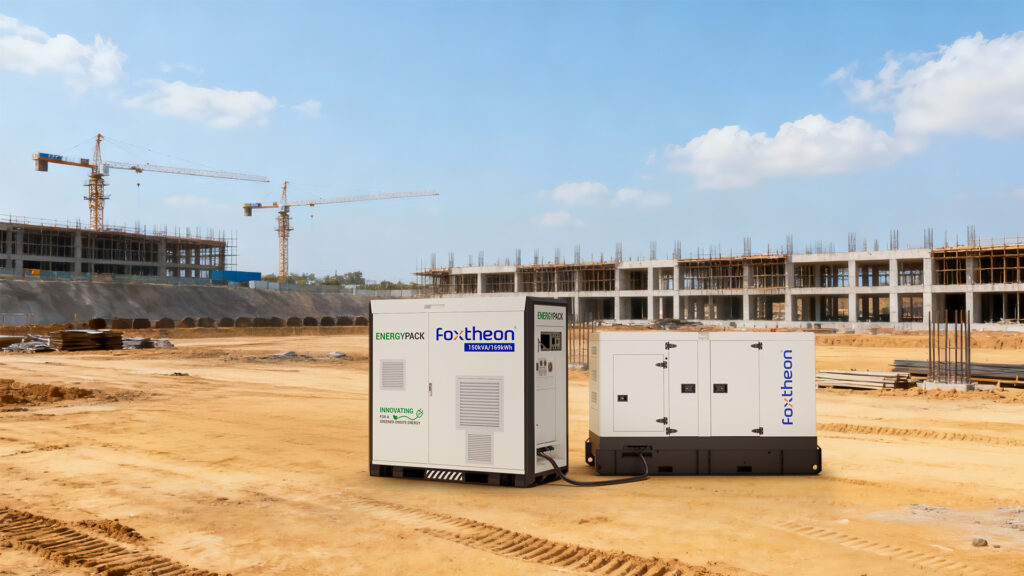
Strategic Considerations When You Add BESS to Chiller Rental Fleet
Integrating batteries requires a shift in logistics and technical planning. It is not as simple as plugging in a toaster, but modern tech is making it easier.
Understanding Load Profiles
You must understand the load profile of the HVAC equipment. Is it a steady load or does it cycle frequently? BESS units excel at handling variable loads. If the load is constant and near the peak capacity of the generator, the battery offers fewer benefits.
Voltage and Compatibility
Most industrial chillers operate on 480V (in the US) or 400V (in Europe/Asia) 3-phase power. The BESS units you add to your fleet must feature inverters capable of matching these specific voltages.
The Role of Intelligent Software
Hardware is only half the battle. The software controlling the flow of power is critical. The Energy Management System (EMS) decides when to start the generator and when to switch to battery.
This is where manufacturers like Foxtheon stand out. Their systems are designed to be “plug-and-play” for rental applications. The software automatically detects the load and manages the power sources without requiring a technician to sit there and flip switches.
6. Competitive Differentiation in a Crowded Market
The equipment rental market is commoditized. Everyone has the same Trane or Carrier chillers. Everyone has the same CAT or Cummins generators. Price wars are common.
However, few competitors have fully embraced hybrid power. By being an early adopter, you differentiate your brand. You are no longer selling a commodity; you are selling an engineered solution.
Marketing your fleet as “High-Efficiency Hybrid Cooling” positions your company as a technological leader. It attracts higher-tier clients who prioritize reliability and sustainability over the lowest daily rental rate.
7. Handling Poor Grid Connections
Not all rental jobs rely on generators. sometimes, a site has shore power, but it is insufficient.
Imagine a construction site in a city center where the grid connection is weak or unstable. The building needs temporary cooling, but the grid cannot support the inrush current of the chiller.
If you add BESS to chiller rental fleet options, you can use the battery for “peak shaving.” The battery charges from the weak grid connection slowly and then discharges high power to start the chiller. This avoids tripping the site’s breakers and eliminates the need to bring in a generator, saving the client even more money.
Financial Analysis: OPEX vs. CAPEX
For rental companies, buying BESS units is a Capital Expenditure (CAPEX). The concern is always ROI. How fast does it pay for itself?
While batteries are an investment, the return comes from two avenues:
Premium Rental Rates: You can charge more for a hybrid system because it saves the client money on fuel. The client’s total project cost goes down, even if your rental rate goes up.
Asset Longevity: By protecting your generators from wet stacking and overuse, you extend their lifespan and resale value.
Furthermore, many governments offer tax incentives for purchasing energy storage equipment, which can offset the initial purchase price.
Preparing Your Team for the Shift
Transitioning to hybrid fleets involves people, not just machinery. Your sales team needs to know how to sell the value of fuel savings. Your technicians need to understand basic battery safety and high-voltage connections.
Training is essential. A sales rep who can look at a client’s project scope and say, “I can save you $5,000 in fuel this month if we use this hybrid setup,” will close more deals than one who just hands over a price list.
The era of the “dumb” generator is fading. Efficiency, data, and environmental responsibility are the new metrics for success in the temporary power and cooling industry.
When you add BESS to chiller rental fleet inventories, you solve the fundamental mismatch between power generation and cooling demand. You save your clients money, you protect your own equipment, and you open doors to noise-sensitive and eco-conscious projects.
Brands like Foxtheon are making this transition accessible with rugged, rental-ready battery systems designed for the harsh reality of job sites. The question is no longer if you should hybridize your fleet, but how quickly you can do it to secure your place as a market leader.
Frequently Asked Questions (FAQ)
Q1: Will adding a BESS make the setup more complicated for the customer?
A1: No. From the customer’s perspective, the operation remains largely the same. The BESS and generator work automatically via the Energy Management System. The customer simply sets the thermostat on the chiller, and the hybrid system manages the power source in the background.
Q2: How much space does a BESS unit take up on a job site?
A2: Modern BESS units are quite compact. A unit capable of supporting a standard industrial chiller often has a footprint similar to or smaller than the generator it pairs with. They are designed to be dense and easily transportable via forklift or crane.
Q3: Can I retrofit my existing generators to work with BESS?
A3: Yes. BESS units are designed to be agnostic to the generator brand. They connect via standard power cables. However, the generator needs to have a remote start capability (two-wire start) so the battery system can automatically turn it on and off as needed.
Q4: What happens if the battery runs out of power?
A4: The system is designed with redundancy. If the battery reaches a low state of charge, the generator automatically kicks in to take the load and recharge the battery. If the battery were to fail completely, the system has a bypass mode to run the chiller directly from the generator.
Q5: Is it safe to transport these batteries?
A5: Yes, but they must be handled according to regulations. Rental-grade BESS units, such as those from reputable manufacturers, are built with Lithium Iron Phosphate (LFP) chemistry, which is chemically stable and safe. They are housed in ruggedized containers designed to withstand transport vibration and impact.