
Urban density is steadily increasing worldwide, bringing infrastructure projects into closer proximity with residential zones, hospitals, and commercial districts. Consequently, municipal authorities are enforcing stringent acoustic standards to protect public health and maintain the quality of urban life. For contractors and project managers, maintaining operational efficiency while adhering to noise pollution regulations construction codes requires an analytical, data-driven approach to site management.
Acoustic compliance is no longer a secondary consideration; it is a fundamental pillar of project viability. Failing to manage decibel levels effectively can lead to severe financial penalties, stop-work orders, and significant reputational damage. Fortunately, advances in hybrid energy solutions, acoustic engineering, and digital monitoring provide project leaders with robust tools to mitigate sound emissions. By optimizing existing equipment fleets and implementing strategic site planning, engineering teams can maintain continuous progress without violating local ordinances.
This comprehensive analysis examines the technical aspects of acoustic compliance, detailing proven methodologies to manage site acoustics, integrate smart power systems, and optimize heavy machinery operations.
1. Understanding the Technical Framework of Acoustic Compliance
Before implementing mitigation strategies, project managers must thoroughly understand the specific metrics and thresholds dictated by local authorities. Acoustic regulations are rarely uniform; they vary significantly based on zoning classifications, time of day, and the duration of the sound emitted.
- Equivalent Continuous Sound Level (LAeq): This metric represents the average sound energy over a specific period. Most urban municipalities use LAeq to measure long-term acoustic exposure, preventing sites from generating sustained high decibels over an entire shift.
- Maximum Sound Level (LAmax): This measures the highest instantaneous peak of sound. Activities like pile driving or steel dropping trigger high LAmax readings. Regulatory bodies often set strict limits on these sudden acoustic spikes to prevent immediate auditory distress in nearby communities.
- Time-of-Day Thresholds: Daytime operational limits typically hover around 70 to 75 dBA at the site boundary. However, nighttime limits often drop drastically to 50 or 55 dBA. Managing this nocturnal drop is a primary challenge for projects requiring 24/7 security, lighting, and dewatering pumps.
Navigating noise pollution regulations construction frameworks requires project planners to map out anticipated decibel levels across the entire project lifecycle, ensuring that every operational phase aligns with municipal limits.
2. Identifying and Profiling High-Decibel Operational Sources
Effective acoustic management begins with a granular audit of all site equipment. By categorizing sound sources, engineers can apply targeted mitigation strategies rather than wasting resources on broad, ineffective measures.
Transient noise sources, such as excavators, bulldozers, and impact hammers, produce loud, intermittent sounds. While highly disruptive, these activities are generally restricted to daytime hours when municipal decibel allowances are more forgiving.
Conversely, continuous noise sources present a more complex challenge. Equipment such as ventilation fans, dewatering pumps, and particularly stationary diesel generators often operate around the clock. During the day, the continuous hum of a generator might blend into the ambient urban background. However, at night, when the ambient sound floor drops, the low-frequency rumble of combustion engines becomes highly prominent. This continuous nocturnal operation is frequently the primary cause of community complaints and regulatory violations.
3. Optimizing Power Assets with Hybrid Energy Storage
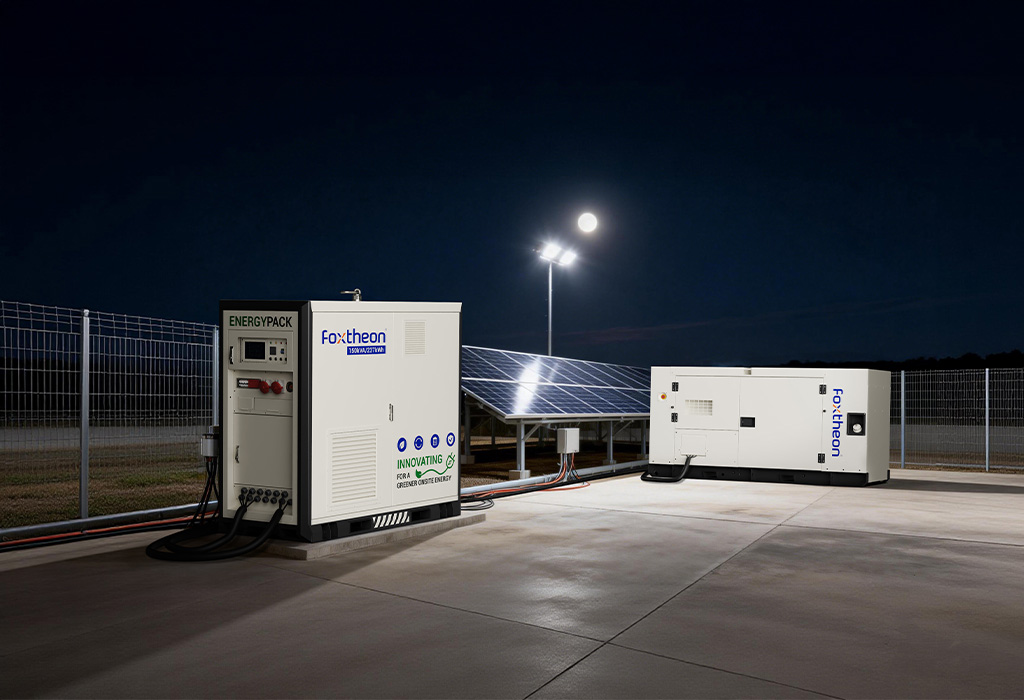
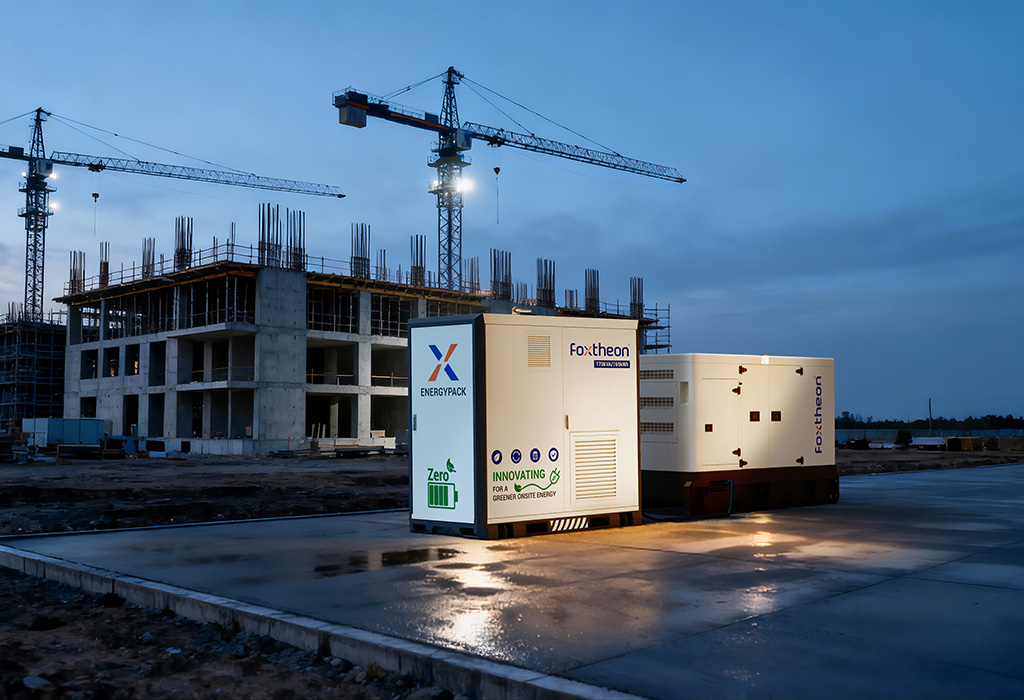
To address overnight acoustic limits, modern engineering teams are adopting hybrid power architectures. This strategy involves integrating intelligent Energy Storage Systems (ESS) with existing diesel generator fleets. This synergistic approach does not render current equipment obsolete; rather, it maximizes the efficiency and compliance capability of the assets you already own.
During daytime operations, site power demands are high. The diesel generator runs at its optimal load capacity (typically 70% to 80%), powering heavy machinery, cranes, and site offices, while simultaneously charging the connected ESS. Operating an internal combustion engine at optimal load ensures complete fuel combustion, reducing carbon emissions and preventing mechanical issues like wet stacking.
As the shift ends and nighttime noise pollution regulations construction mandates take effect, the site’s power demand drops significantly, limited to security systems, ambient lighting, and baseline monitoring. Instead of running a large generator inefficiently and loudly to meet this minor load, the hybrid system automatically shuts down the engine. The ESS takes over, providing continuous, zero-emission, and entirely silent power throughout the night.
Leading innovators in intelligent energy systems, such as Foxtheon, design high-capacity energy storage units specifically engineered to interface smoothly with traditional power generation assets. By integrating these systems, channel partners and fleet operators can vastly expand their service capabilities, offering acoustically compliant solutions that protect their existing capital investments in diesel technology.
4. Implementing Acoustic Barriers and Spatial Planning
While optimizing power generation mitigates a significant portion of continuous sound, physical sound attenuation remains a necessary component for overall site compliance. The physics of sound control rely on two primary principles: sound absorption (reducing sound energy within an enclosed space) and sound insulation (preventing sound from passing through a barrier).
- Engineered Acoustic Enclosures: For stationary power plants and large pumping stations, custom-fitted acoustic enclosures utilize mass-loaded vinyl and dense mineral wool to absorb low-frequency vibrations. These enclosures can reduce sound propagation by 15 to 25 dBA, depending on their Sound Transmission Class (STC) rating.
- Perimeter Acoustic Blankets: Temporary fencing can be upgraded with specialized acoustic blankets. These are highly effective for mitigating high-frequency noises generated by cutting tools and metalwork, deflecting the sound waves back into the site rather than allowing them to escape into residential areas.
- Strategic Spatial Layout: The inverse square law of acoustics dictates that sound intensity drops by approximately 6 decibels every time the distance from the source doubles. By intelligently mapping the site, planners can position the loudest continuous equipment—such as generators and compressors—at the absolute center of the footprint, utilizing distance as a natural acoustic buffer.
5. Deploying IoT Sensors for Data-Driven Compliance
Relying on manual decibel readings is an outdated methodology that leaves projects vulnerable to regulatory breaches. Today, maintaining strict adherence to noise pollution regulations construction standards requires continuous, automated monitoring utilizing the Internet of Things (IoT).
Installing Class 1 environmental sound level meters along the site perimeter provides project managers with real-time, highly accurate acoustic data. These sensors continuously measure LAeq and LAmax, transmitting the data to centralized cloud dashboards.
This proactive technology allows engineering teams to set custom threshold alerts. If an activity begins to push the decibel levels within 5 dBA of the legal limit, site managers receive immediate notifications via mobile devices. This provides a crucial window of opportunity to power down specific machinery, adjust workflows, or deploy additional acoustic shielding before a violation occurs. Furthermore, maintaining a secure digital log of sound data provides irrefutable proof of compliance should neighboring properties file unfounded nuisance complaints.
6. Maximizing Operational Economics Through Acoustic Management
A common misconception in the industry is that acoustic compliance strictly represents a financial burden. In reality, the strategies utilized to meet rigorous sound regulations often yield substantial operational cost savings, improving the overall profitability of the project.
Consider the hybrid power topology discussed earlier. By utilizing equipment provided by specialists like Foxtheon to handle overnight base loads, contractors drastically reduce the running hours of their internal combustion engines. This reduction yields three distinct economic benefits:
- Fuel Consumption Reduction: Generators running at low loads overnight are highly inefficient, burning significant amounts of diesel to produce minimal electricity. Shifting this load to a battery system eliminates this wasted fuel expenditure.
- Extended Maintenance Intervals: Diesel engines require servicing (oil changes, filter replacements) based on total running hours, typically every 250 to 500 hours. By turning the engine off for 12 hours a night, the calendar time between required maintenance intervals is effectively doubled, reducing labor and parts costs.
- Asset Longevity: Reducing unnecessary wear and tear extends the total lifecycle of your existing fleet, maximizing the long-term return on investment for capital equipment.
When viewed through this analytical lens, adhering to noise pollution regulations construction codes transforms from a regulatory hurdle into a catalyst for operational excellence and fleet optimization.
7. Fostering Transparent Community Relations
While technical solutions form the backbone of sound mitigation, transparent communication with the surrounding community acts as a vital secondary defense against regulatory friction. Local authorities are far more likely to issue fines when they receive high volumes of complaints from residents.
Implementing a proactive community outreach program establishes goodwill. Project managers should provide residents with clear schedules detailing when high-decibel activities (like foundation piling) will occur. Establishing a direct line of communication, such as a dedicated hotline, allows residents to voice concerns directly to site management rather than immediately contacting municipal code enforcers.
When stakeholders understand that the project team is actively utilizing advanced hybrid technologies and real-time monitoring to protect their acoustic environment, tolerance for unavoidable daytime operational sounds increases significantly.
As municipal authorities continue to tighten environmental standards, mastering acoustic management is an indispensable skill for modern contractors. Successfully navigating noise pollution regulations construction frameworks relies on a combination of strategic site planning, digital monitoring, and the intelligent integration of hybrid power systems.
By leveraging advanced energy storage technologies to complement existing fleets, projects can achieve silent overnight operations, reduce fuel expenditures, and significantly decrease mechanical maintenance costs. Collaborating with authoritative technology providers like Foxtheon empowers channel partners and site operators to build cleaner, quieter, and highly efficient project sites that meet the rigorous demands of modern urban development.
Frequently Asked Questions (FAQ)
Q1: What are the standard decibel limits for urban development sites?
A1: While limits vary by jurisdiction, daytime urban limits generally range from 70 to 85 dBA measured at the site boundary. Nighttime limits are strictly enforced and usually drop to between 50 and 55 dBA to prevent sleep disturbance in nearby residential zones.
Q2: How does energy storage help comply with noise pollution regulations construction codes at night?
A2: Energy storage systems capture and store electricity generated during the day. At night, the primary combustion engine shuts down, and the battery system releases stored energy to power site security, lighting, and small pumps. This provides the necessary base load power completely silently, ensuring compliance with strict nighttime decibel limits.
Q3: Do hybrid power systems require me to discard my current diesel generators?
A3: Absolutely not. Hybrid architectures are designed to complement and optimize your existing fleet. The battery systems work in tandem with your current generators, ensuring the engines run only at peak efficiency during the day, which actually extends their operational lifespan and improves your return on investment.
Q4: What is the difference between sound insulation and sound absorption?
A4: Sound insulation (or sound transmission loss) refers to a material’s ability to block sound from passing through it, typically achieved using heavy, dense materials like mass-loaded vinyl. Sound absorption involves reducing the reflection of sound waves within a space, usually utilizing porous materials like mineral wool to convert acoustic energy into trace amounts of heat.
Q5: How can site managers track acoustic emissions accurately?
A5: The most accurate method is deploying IoT-enabled Class 1 sound level meters along the site perimeter. These devices provide continuous, real-time data on LAeq and LAmax levels directly to a cloud dashboard, allowing managers to monitor acoustic output and receive automated alerts before legal