
For industrial sectors operating autonomously from the central electrical grid, the financial viability of a project is heavily tethered to power generation costs. Whether powering a remote mining extraction site, an offshore drilling platform, or a large-scale commercial construction project, internal combustion engines remain a primary source of baseload and standby power. However, operational expenditure (OPEX) analysis consistently reveals that fuel procurement, transportation, and storage constitute up to 70% of a traditional power system’s lifecycle costs.
As global fuel markets exhibit unprecedented price volatility and regulatory bodies enforce stricter carbon emission parameters, site engineers and fleet managers must implement rigorous, data-driven strategies to reduce diesel generator fuel consumption. Achieving this requires moving beyond basic maintenance and adopting a holistic approach that encompasses load profiling, thermodynamic efficiency optimization, and the integration of advanced hybrid energy storage architectures.
Understanding the Thermodynamics of Fuel Inefficiency
To mathematically optimize fuel usage, operators must first understand the mechanical constraints of internal combustion engines. Generators are engineered to operate most efficiently within a highly specific thermal and mechanical window.
Brake Specific Fuel Consumption (BSFC) and the Asynchronous Penalty
Brake Specific Fuel Consumption (BSFC) is the engineering metric used to measure fuel efficiency in reciprocating engines. It calculates the mass of fuel consumed per unit of mechanical energy produced (measured in grams per kilowatt-hour, g/kWh).
Traditional synchronous alternators must maintain a constant engine speed—typically 1500 RPM for 50Hz grids or 1800 RPM for 60Hz grids—to maintain the correct electrical frequency, regardless of the electrical load applied. Consequently, when an engine operates at a 20% load, internal friction, pumping losses, and thermal dissipation remain nearly identical to when it operates at an 80% load. This disproportionate energy waste means the fuel consumed per kilowatt-hour spikes dramatically during low-load conditions.
The Detrimental Impact of “Wet Stacking”
A direct consequence of prolonged low-load operation (typically below 30% of the prime power rating) is “wet stacking.” When an engine operates without sufficient resistance, cylinder temperatures fail to reach the threshold required for complete combustion. Unburned fuel and carbon particles accumulate in the exhaust manifold, turbocharger, and diesel particulate filters (DPF).
This carbon buildup restricts exhaust flow, reduces engine compression, and severely degrades the air-to-fuel ratio. An engine suffering from wet stacking will experience a drastic drop in thermal efficiency, thereby demanding more fuel to produce the same electrical output. Therefore, ensuring optimal load management is the most immediate way to reduce diesel generator fuel consumption.
Strategic Engineering Protocols to Optimize Fuel Efficiency
Site engineers can deploy several mechanical and operational protocols to flatten the fuel consumption curve and stabilize OPEX.
1. Rigorous Load Profiling and Equipment Right-Sizing
The most common engineering error in off-grid power deployment is oversizing the prime mover. Engineers frequently size equipment based on the maximum transient load—such as the massive inrush current required to start a large induction motor or a tower crane—rather than the continuous baseload.
To counteract this, operators must utilize power quality analyzers to log the site’s apparent power (kVA), active power (kW), and reactive power (kVAR) over a standard operational cycle. By mapping the exact load profile, equipment can be sized so that the prime mover operates consistently within its optimal efficiency band of 70% to 85% capacity.
2. Motor Soft Starters and Variable Frequency Drives (VFD)
Direct-on-line (DOL) motor starting pulls a surge current up to six times the motor’s full-load running current. This necessitates massive power reserves. By installing Variable Frequency Drives (VFDs) or soft starters on heavy inductive loads (such as industrial water pumps, HVAC compressors, and conveyor belts), the inrush current is throttled. Lowering the transient peak demand allows engineers to deploy a smaller, more fuel-efficient primary power source.
3. Implementing Power Management Systems (PMS) for Paralleling
For sites with highly variable power demands, relying on a single large-capacity prime mover guarantees inefficiency. A superior approach involves installing multiple smaller units synchronized through an automated Power Management System (PMS).
As the site load increases, the PMS automatically synchronizes and parallels additional units to the common busbar. As demand decreases (such as during night shifts), the PMS systematically shuts down excess engines. This ensures that the active engines always run near peak thermal efficiency, providing a highly effective method to reduce diesel generator fuel consumption.
The Hybridization Revolution: Integrating Battery Energy Storage Systems
The most profound technological advancement in off-grid fuel optimization over the last decade is the integration of high-capacity Lithium Iron Phosphate (LiFePO4) Battery Energy Storage Systems (BESS). Transitioning from a purely mechanical setup to a hybrid microgrid fundamentally alters site economics.
Eliminating Low-Load Inefficiencies via Peak Shaving
A commercial BESS sits between the power source and the load, acting as an electrical buffer. During high-demand periods, the BESS discharges stored energy simultaneously with the mechanical engine to handle transient spikes—a process known as peak shaving. Because the inverter system handles the instantaneous surge, the primary engine can be aggressively downsized.
Baseload Management and Engine-Off Operations
Overnight or during weekends, industrial site loads often drop to minimal levels, powering only security lighting, server racks, and basic telemetry. Running a 500kVA engine to supply a 20kW load is financially ruinous. By utilizing a hybrid architecture, the mechanical engine can be programmed to shut down completely once the heavy operations cease. The BESS then seamlessly assumes the baseload, providing silent, zero-emission power until the batteries require recharging.
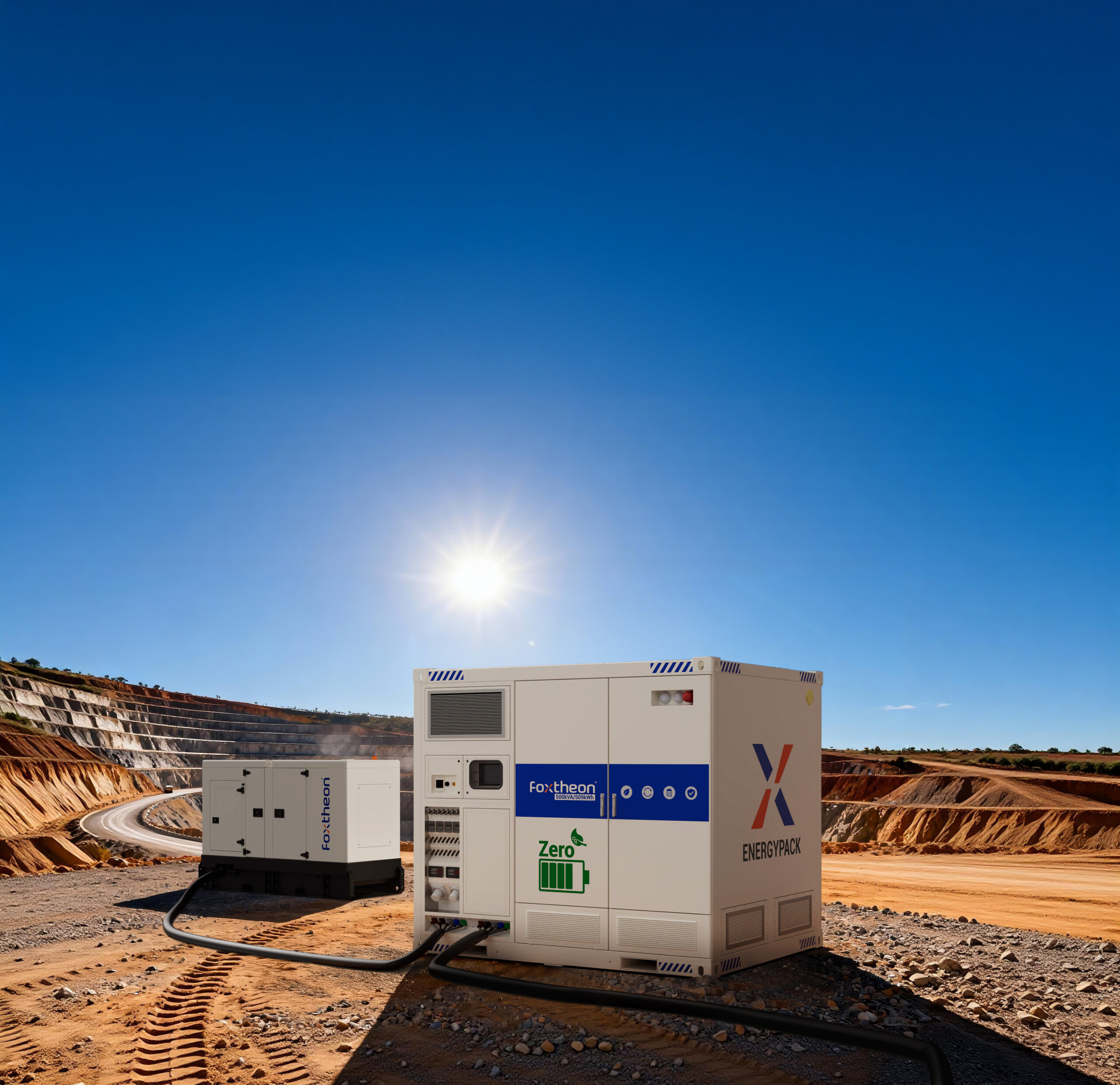
Industry leaders like Foxtheon design and manufacture robust, high-density energy storage systems specifically engineered to interface with heavy industrial equipment. By integrating intelligent BESS units into a site’s electrical topology, operators can cut engine runtimes by up to 60%. Reducing runtime not only slashes fuel procurement costs but also extends the operational intervals between oil changes, filter replacements, and engine overhauls.
Solar-Hybrid Microgrid Topologies
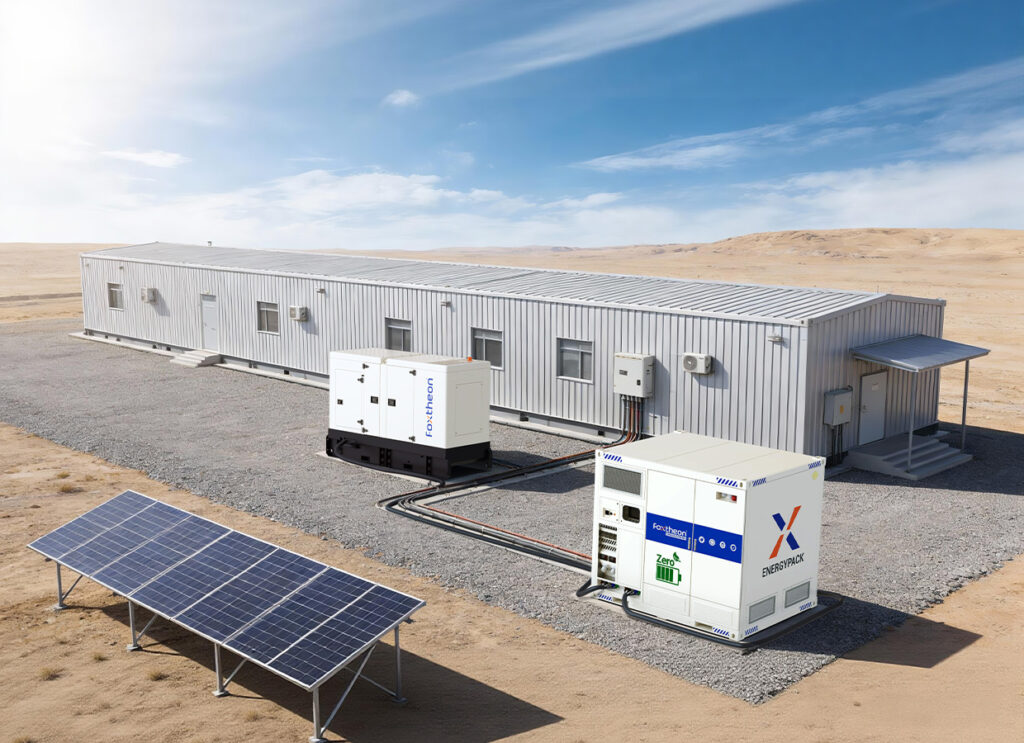
To further reduce diesel generator fuel consumption, a BESS can be coupled with deployable solar photovoltaic (PV) arrays. Advanced Maximum Power Point Tracking (MPPT) charge controllers route solar energy directly into the battery banks. In an optimized solar-hybrid microgrid, the mechanical engine is demoted from the primary power source to a secondary backup, triggering automatically only when battery State of Charge (SoC) drops below a predetermined threshold due to heavy cloud cover or abnormal load spikes.
Hardware Maintenance and Fuel Quality Assurance
Even the most accurately sized and hybridized power systems will suffer efficiency losses if foundational maintenance protocols are ignored.
Fuel Filtration and Injector Spray Patterns
Modern Tier 4 Final and Stage V engines utilize High-Pressure Common Rail (HPCR) fuel injection systems. These systems atomize fuel at extreme pressures to maximize combustion efficiency. However, HPCR injectors are highly susceptible to microscopic particulate contamination and water ingress.
If fuel quality degrades during storage—through microbial growth, oxidation, or water condensation—the precise spray pattern of the injectors becomes distorted. Poor atomization leads to incomplete combustion, directly increasing the BSFC. Installing multiphase fuel polishing systems and water separators is non-negotiable for maximizing the volumetric energy density of the fuel.
Intake Air Density and Thermal Regulation
Combustion is a chemical reaction requiring precise ratios of oxygen and hydrocarbons. Industrial environments, such as quarries or cement plants, possess high ambient dust levels that rapidly clog air intake filters. A restricted air intake forces the turbocharger to work harder, altering the air-to-fuel ratio and causing the engine to run “rich” (consuming excess fuel).
Furthermore, ambient temperature impacts air density. Operating in extremely hot climates reduces the oxygen density of the intake air. Utilizing advanced intercoolers and ensuring proper enclosure ventilation maintains optimal volumetric efficiency, thereby acting as a passive mechanism to reduce diesel generator fuel consumption.
The Future of Industrial Power Analytics
The transition toward sustainable off-grid operations relies heavily on digital twin technology and telemetry. Modern Power Conversion Systems (PCS) and intelligent controllers continuously log parameters including real-time fuel flow rates, exhaust gas temperatures, and load profiles.
By running this operational data through cloud-based analytics, fleet managers can identify microscopic anomalies in engine performance before they lead to catastrophic mechanical failures or severe fuel degradation.
Partnering with technological innovators like Foxtheon allows industrial operators to leverage proprietary algorithms that autonomously manage the dispatch of mechanical and battery power. This automated energy arbitration guarantees that every drop of fuel is converted into maximum mechanical and electrical output.
In conclusion, attempting to reduce diesel generator fuel consumption purely by limiting operational hours is an obsolete strategy. Modern industrial power management requires a complex synthesis of thermodynamic optimization, rigorous load-profile analysis, and the deployment of solid-state hybrid energy storage systems. By treating power generation as a dynamic, data-driven ecosystem rather than a static mechanical process, enterprises can achieve profound reductions in LCOE while simultaneously meeting stringent global decarbonization targets.
Frequently Asked Questions (FAQ)
Q1: Why does a generator consume disproportionately more fuel per kilowatt at loads below 30%?
A1: Internal combustion engines must run at a constant RPM to maintain grid frequency (e.g., 1500 RPM for 50Hz). The mechanical friction, valvetrain operation, and internal pumping losses remain constant whether the engine is producing 10kW or 100kW. Therefore, at low loads, a massive percentage of the fuel is burned simply to overcome the engine’s own internal parasitic drag, leading to terrible thermal efficiency.
Q2: How exactly does integrating a Battery Energy Storage System (BESS) save fuel on a construction site?
A2: Construction sites experience massive, brief load spikes (like lifting a tower crane) followed by long periods of low load. Instead of running a massive engine all day just to be ready for the crane, a hybrid system handles the steady low loads and uses the BESS inverter to instantly dispatch stored energy to cover the high-amperage crane spikes. This allows operators to run a much smaller, highly efficient engine, or turn the engine off entirely during off-peak hours.
Q3: What is “wet stacking” and how does it relate to OPEX?
A3: Wet stacking occurs when an engine operates at low loads, resulting in cylinder temperatures that are too low to completely burn the injected fuel. This unburned fuel mixes with soot to form a thick, black substance that coats the exhaust valves, turbochargers, and emissions filters. It drastically reduces fuel efficiency and requires expensive, forced load-bank testing to burn off the carbon deposits.
Q4: Will using premium synthetic oils or aftermarket fuel additives significantly improve my fuel consumption rates?
A4: While high-quality synthetic lubricants reduce internal friction and proper biocides prevent fuel degradation in storage tanks, their direct impact on fuel consumption is marginal (typically under 2%). The most mathematically significant way to optimize fuel consumption is by addressing the site’s electrical load profile and preventing low-load operation through hybridization.
Q5: What is the ideal operating load to achieve maximum fuel efficiency?
A5: For standard industrial prime-power engines, the Brake Specific Fuel Consumption (BSFC) curve is optimal when the engine is loaded between 70% and 85% of its rated continuous capacity. Maintaining the load within this parameter ensures optimal cylinder temperatures, complete fuel atomization, and peak thermodynamic efficiency.