
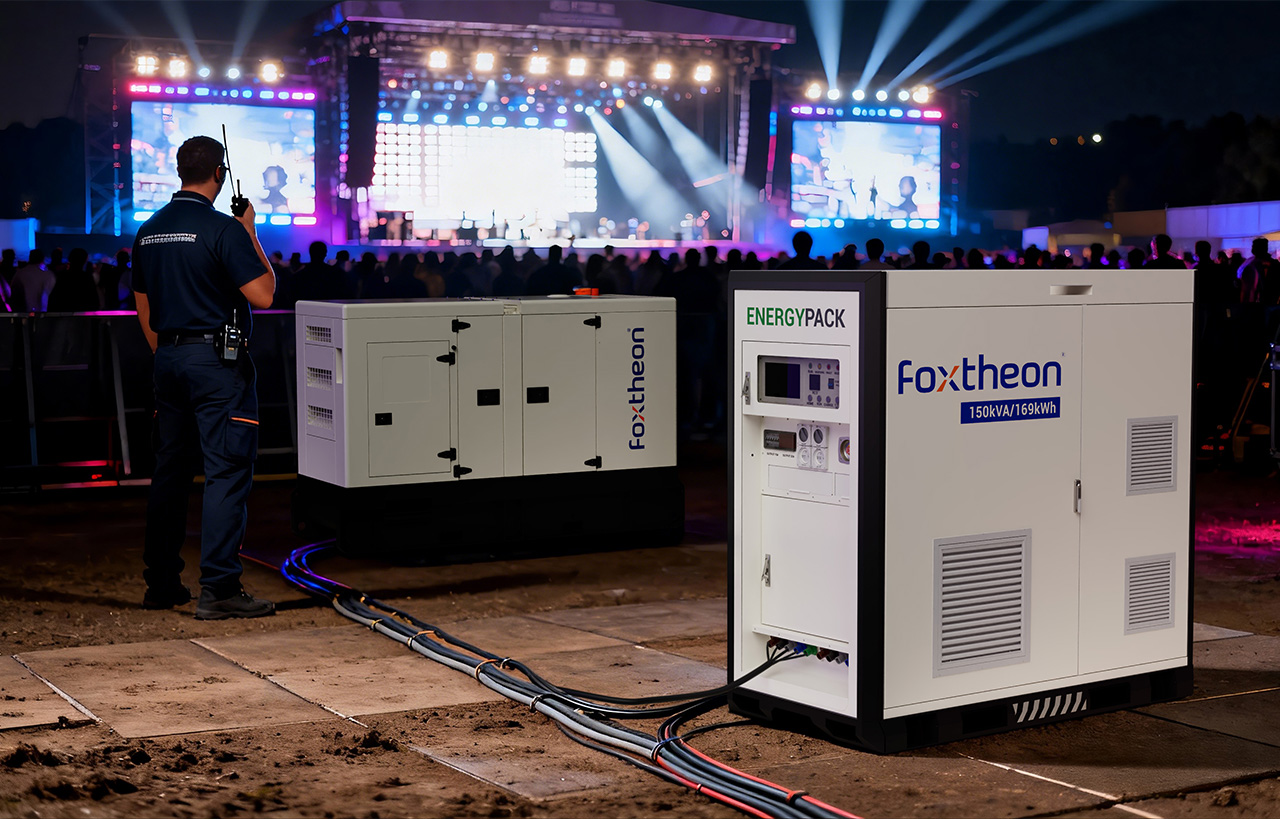
Managing power on remote sites has always been a balancing act between reliability and cost. For decades, the construction and mining sectors relied heavily on diesel generators. While reliable, they are inefficient when running at low loads and require constant maintenance. As industries move toward cleaner operations, the demand for international intelligent energy solutions has spiked.
This is where the Foxtheon M300 enters the conversation. It represents a shift in how project managers approach off-grid energy. It is not just a battery; it is a hybrid energy storage system designed to work alongside existing power infrastructure. By handling load fluctuations and integrating renewables, it addresses the core inefficiencies of traditional generators.
Below, we explore the technical architecture, operational benefits, and economic logic behind deploying this system in the field.
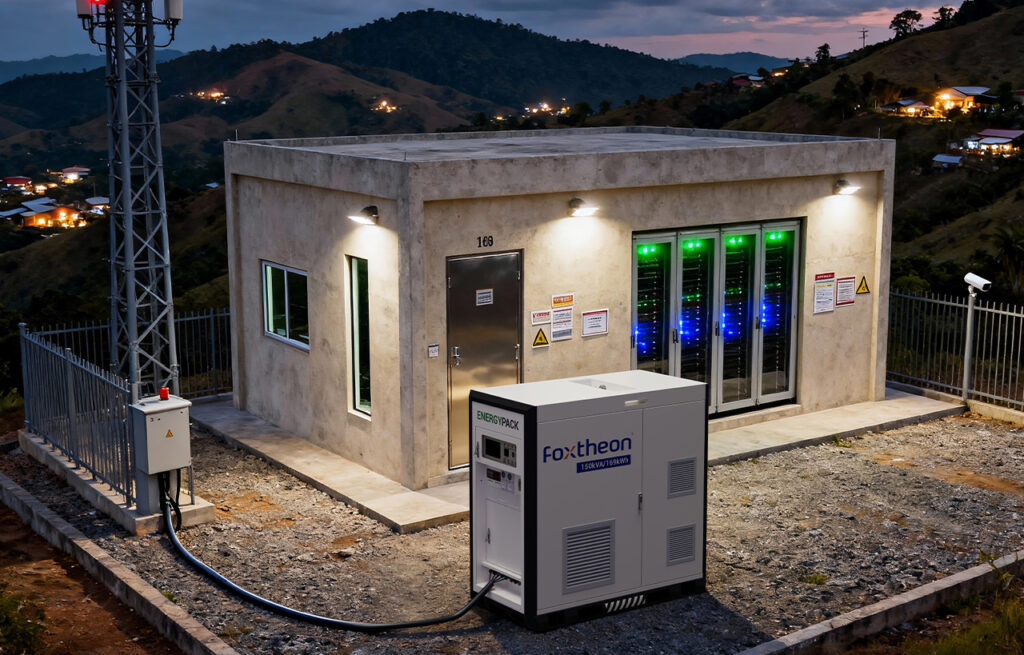
The Architecture of the Foxtheon M300
To understand the value of this unit, one must look at its internal logic. Most generators run at a fixed speed to maintain frequency, regardless of how much power is actually being used. This results in “wet stacking” and wasted fuel during low-demand periods.
The Foxtheon M300 acts as a buffer. It stores energy during periods of excess generation or from solar inputs and releases it when demand peaks. This allows the diesel generator to turn off completely during low loads or run at its most efficient curve (typically 80% load) to recharge the battery.
Lithium Iron Phosphate Technology
The choice of battery chemistry is critical for industrial applications. The M300 utilizes Lithium Iron Phosphate (LiFePO4) cells. Unlike the lithium-ion batteries found in consumer electronics, LiFePO4 is chosen for thermal stability.
Safety is paramount in construction zones. These cells are far less prone to thermal runaway. Furthermore, they offer a significantly longer cycle life. A typical lead-acid setup might survive 500 deep cycles, whereas the technology inside this unit is rated for thousands of cycles, ensuring the asset remains viable for years of operation.
Modular Design and Scalability
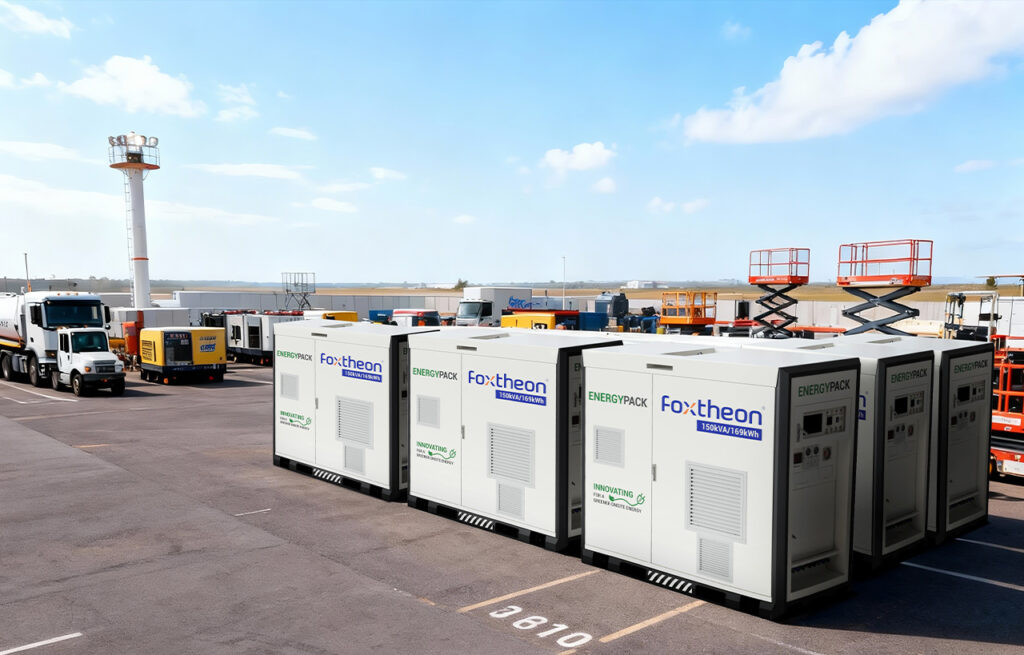
Project requirements change. A site might need 50kWh today and 200kWh next month. The system is designed with modularity in mind. Users can parallel multiple units to increase capacity without overhauling the entire power grid. This flexibility is a hallmark of modern energy planning, allowing Foxtheon to adapt to specific site needs without custom engineering.
Operational Efficiency in Harsh Environments
Equipment meant for international intelligent energy solutions must survive the elements. A battery system sitting in a climate-controlled server room is very different from one deployed in a dusty quarry or a humid tropical worksite.
The Foxtheon M300 is built with a ruggedized enclosure. It resists dust ingress and moisture, which are the two biggest killers of power electronics. This durability ensures that the transition to hybrid power does not come at the cost of reliability.
tackling the “Start-Up” Spike
One of the hardest tasks for a generator is handling the in-rush current from heavy machinery. When a large crane or compressor starts, it draws a massive spike of power for a few seconds.
Traditionally, operators had to oversize their generators just to handle these few seconds of peak demand. With the M300, the battery handles that instantaneous spike. The generator can then be sized for the average load rather than the peak load. This often allows companies to downgrade from a 100kVA generator to a 40kVA generator, resulting in immediate capital savings.
Reducing Noise Pollution
Urban construction sites face strict regulations regarding noise. In many European and North American cities, running a diesel engine at night is prohibited. This effectively stops work or forces companies to pay for expensive grid connections.
Because the Foxtheon M300 can sustain low loads using only battery power, it operates silently. This capability allows for night-time security lighting, cameras, and office power to remain active without the hum of an engine. For film sets and events, this silence is not just a regulatory compliance tool; it is an operational necessity.
Economic Analysis: OPEX vs. CAPEX
The initial purchase price of hybrid systems is higher than standalone generators. However, the financial argument for the M300 relies on Operational Expenditure (OPEX) reduction.
Fuel Consumption Analysis
Data from field deployments suggests that hybridizing a diesel generator can reduce fuel consumption by 40% to 60%. When a generator runs 24/7, it burns fuel even when powering a single lightbulb. By switching the generator off and letting the M300 handle the night load, fuel burn drops to zero for long durations.
With global diesel prices remaining volatile, this reduction provides a predictable hedge against rising operational costs.
Maintenance Intervals
Generators require service based on run-hours. A standard service interval might be every 250 or 500 hours. If a generator runs continuously, it needs service every few weeks.
By using the battery system to handle base loads, the generator runtime is drastically reduced. A generator that runs only 4 hours a day to recharge the battery (instead of 24 hours) will last six times longer between service intervals. This reduces the cost of filters, oil, and the labor required for mechanics to visit remote sites.
Integration with Renewables
The term “Hybrid” also refers to the ability to accept solar input. The Foxtheon M300 is equipped with solar charge controllers.
In sunny regions like Australia or the Middle East, it is possible to run a site almost entirely on solar power during the day. The solar array charges the M300, which then powers the site. The diesel generator acts merely as a backup for cloudy days. This is the ultimate goal of international intelligent energy solutions: minimizing carbon footprints while maintaining uptime.
Plug-and-Play Connectivity
Complexity is the enemy of deployment. Site electricians do not have time to learn proprietary software or complex wiring diagrams. The unit features standard industrial connectors. It integrates into existing distribution boards with minimal downtime.
Foxtheon has focused on making the user interface intuitive. Operators can monitor the state of charge (SOC), input voltages, and load data from a simplified panel. This reduces the training burden on staffing agencies and contractors.
The Role of Data in Energy Management
Modern efficiency is driven by data. You cannot save what you cannot measure. The system provides detailed analytics on power usage.
Project managers can see exactly when their peak loads occur. They can identify if equipment is being left on unnecessarily. This data transparency allows for better logistics planning. Instead of scheduling fuel deliveries based on guesswork, managers know exactly how much fuel is being saved and when the next refill is actually needed.
Sustainability and Corporate Goals
Pressure from investors and governments to reduce Scope 1 emissions is real. Companies bidding for government infrastructure projects are often scored on their environmental management plans.
Deploying a Foxtheon M300 is a visible commitment to sustainability. It provides concrete metrics on CO2 reduction. Unlike carbon offsets, which can be abstract, the fuel saved by a hybrid system is a tangible, audit-ready statistic. This can be a deciding factor in winning contracts in environmentally sensitive regions.
Durability and Transport
Logistics is a major component of remote operations. The unit is designed to be transported easily. Whether via flatbed truck or shipping container, the form factor adheres to standard logistics dimensions.
Internal components are shock-mounted to withstand the vibrations of transport on unpaved roads. This attention to mechanical engineering ensures that the unit arrives at the site ready to work, rather than requiring repairs upon delivery.
Future-Proofing Operations
The energy landscape is changing. Regulations on diesel emissions are tightening. The availability of green power solutions is increasing. Investing in hybrid technology now is a way to future-proof fleet assets.
The Foxtheon M300 serves as a bridge technology. It works with the dirty infrastructure of today while being ready for the clean infrastructure of tomorrow. As battery costs continue to stabilize and density improves, the reliance on the backup generator will decrease further.
For companies looking to stay competitive, the shift to hybrid power is not optional; it is inevitable. The efficiency gains, coupled with the extended lifespan of equipment, make the business case clear.
The transition to cleaner industrial power does not happen overnight. It requires practical, robust tools that can withstand the rigors of the real world. The Foxtheon M300 offers precisely that balance.
It delivers the silence and efficiency of a battery with the reliability required for heavy industry. By cutting fuel costs, reducing maintenance, and enabling solar integration, it pays for itself over its service life.
As the market for international intelligent energy solutions matures, systems like this will become the standard on construction sites and remote operations globally. Foxtheon continues to refine this technology, ensuring that power is available wherever and whenever it is needed, without the heavy environmental cost of the past.
Frequently Asked Questions
Q1: What is the primary advantage of using the Foxtheon M300 over a standard diesel generator?
A1: The primary advantage is efficiency through “peak shaving” and hybrid operation. The M300 handles low loads and peak power spikes, allowing the diesel generator to run less often and only at its most fuel-efficient setting. This significantly reduces fuel consumption, engine noise, and maintenance costs.
Q2: Can the M300 be charged using solar panels directly?
A2: Yes, the system is designed with renewable integration in mind. It typically includes an MPPT (Maximum Power Point Tracking) solar controller, allowing you to connect solar arrays directly to the unit to charge the batteries, further reducing reliance on fossil fuels.
Q3: Is the Foxtheon M300 suitable for extremely cold climates?
A3: While lithium batteries can experience reduced performance in freezing temperatures, the M300 is generally engineered with thermal management systems to regulate battery temperature. However, for extreme arctic conditions, it is always recommended to consult the specific operating temperature guidelines in the user manual to ensure optimal performance.
Q4: How long does the battery last before it needs to be replaced?
A4: The unit uses LiFePO4 (Lithium Iron Phosphate) chemistry, which is known for longevity. These batteries are typically rated for 3,000 to 6,000 charge cycles depending on the depth of discharge. In a typical daily cycle application, this can translate to a service life of 10 years or more.
Q5: Is it complicated to install the M300 on an existing construction site?
A5: No, the design emphasizes ease of use. It utilizes standard industrial power connections and is designed to be “plug-and-play.” It can be inserted between the power source (grid or generator) and the load (equipment) with minimal disruption to the site’s existing electrical setup.