
Running heavy industrial equipment requires reliable power. However, you often face a situation where the available power source seems insufficient for the job. You press the start button, the engine roars, the lights dim, and suddenly the breaker trips. This is a classic scenario for site managers and engineers.
Understanding how to start large motor with small generator units is a critical skill in the international smart energy solution sector. It is not just about having a bigger engine; it is about physics, smart management, and using the right technology.
Brands like Foxtheon have recognized this gap. They provide intelligent energy storage and hybrid solutions that help bridge the power deficit during startup. But before you buy new hardware, you need to understand the mechanics at play.
This article provides a comprehensive look at overcoming inrush currents. We will explore technical methods, calculation strategies, and modern equipment to keep your operations running smoothly.
The Physics of Motor Starting
To solve the problem, you must first understand why it exists. An electric motor does not consume power evenly. When it is sitting still, it acts almost like a short circuit.
Understanding Inrush Current
When you apply voltage to a stopped motor, it demands a massive surge of current to build its magnetic field. This is called “Locked Rotor Amps” (LRA).
The Surge: LRA can be 6 to 8 times the rated full-load current.
The Duration: This spike lasts only for a few seconds or milliseconds.
The Result: Your generator sees this massive demand and the voltage collapses.
If the generator cannot supply this instant peak, the magnetic field in the motor collapses. The motor stalls, and the generator protection relays trip the system to prevent damage.
Voltage Dip and Generator Reaction
Generators are sensitive to sudden load changes. A large voltage dip causes the solenoids and contactors to chatter or open.
If the voltage drops below 70% or 80%, the motor torque drops drastically. The motor cannot accelerate to full speed. It gets stuck in a high-current state, which overheats the windings and eventually kills the generator engine. Learning how to start large motor with small generator setups effectively means managing this specific voltage dip.
How to Start Large Motor with Small Generator: Proven Methods
There are several standard engineering methods to reduce the starting current. Reducing the current requirement allows a smaller generator to handle the startup phase without tripping.
1. Variable Frequency Drives (VFDs)
The most effective way to solve this issue is using a Variable Frequency Drive (VFD). A VFD converts the incoming AC power to DC, and then reconstructs it back to AC.
Zero Inrush: A VFD ramps up the frequency and voltage gradually.
Linear Acceleration: The motor starts at 0 Hz and slowly increases speed.
Generator Friendly: The generator never sees a current spike higher than the motor’s full load amps (FLA).
Using a VFD is the gold standard when determining how to start large motor with small generator power sources. It eliminates the mechanical shock to the equipment and the electrical shock to the generator.
2. Soft Starters
If a VFD is too expensive or complex for your needs, a soft starter is a strong alternative. These devices use thyristors to control the voltage supplied to the motor during startup.
They do not control frequency, only voltage. By reducing the voltage, you reduce the current.
Current Reduction: Typically limits starting current to 300% or 400% of FLA.
Torque Control: Note that reducing voltage also reduces starting torque.
Application: Best for fans or pumps where the load is light at startup.
3. Star-Delta Starters
This is an older, electromechanical method. It connects the motor windings in a “Star” configuration first, then switches to “Delta.”
Star Mode: Reduces voltage across windings by roughly 58%.
The Switch: After a set time, it clicks over to Delta for full power.
Limitations: There is a current spike during the transition. It is better than Direct On Line (DOL) starting, but not as smooth as a VFD.
Sizing Your System Correctly
You cannot cheat physics entirely. Even with a VFD, you need a generator that handles the base load. However, correct sizing prevents oversizing, saving fuel and rental costs.
The Rule of Thumb
Historically, engineers used a simple ratio. For Direct On Line (DOL) starting, you often need a generator capacity (kVA) that is 2.5 to 3 times the motor’s horsepower (HP).
However, when asking how to start large motor with small generator units using assist devices, the ratio changes:
With DOL: 1 HP Motor requires ~2.5 kVA Generator.
With Star-Delta: 1 HP Motor requires ~1.5 kVA Generator.
With Soft Starter: 1 HP Motor requires ~1.25 kVA Generator.
With VFD: 1 HP Motor requires ~1.0 kVA Generator (plus a small headroom).
Calculating kW vs. kVA
Generators are rated in kVA (kilo-volt-amperes), but motors perform work in kW (kilowatts). You must account for the power factor (PF).
Motor PF: Usually around 0.8 during running but much lower during starting (0.3 – 0.5).
Generator PF: Typically rated at 0.8.
When you size the system, ensure the generator’s engine (kW) can handle the real power load, and the alternator (kVA) can handle the reactive power needed to magnetize the motor coils.
The Role of Hybrid Energy Solutions
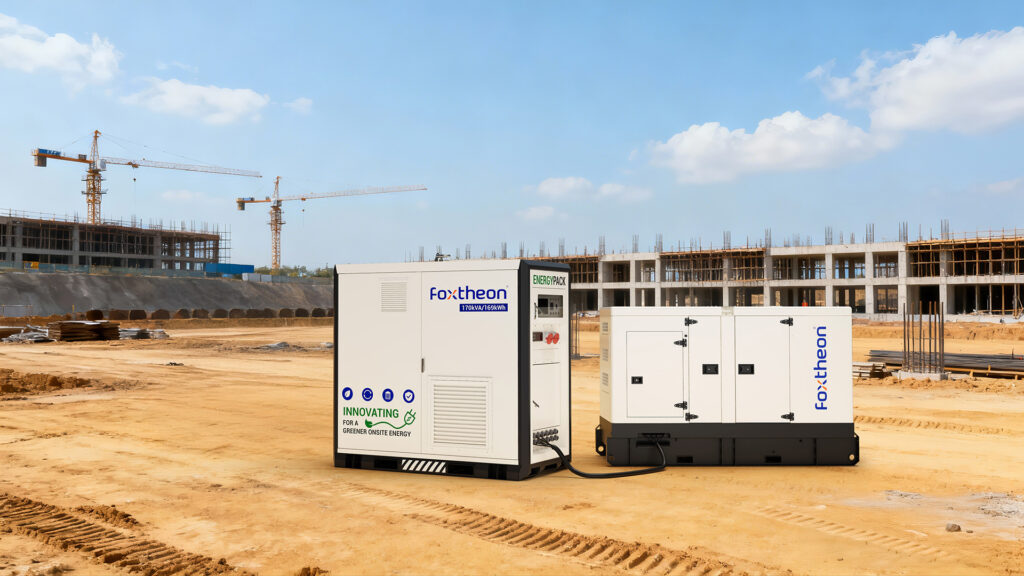
This is where modern innovation enters the picture. Companies like Foxtheon are redefining mobile power. Sometimes, the “small generator” is actually part of a larger hybrid ecosystem.
Battery Assistance
A hybrid generator system includes a battery bank and an inverter. When the motor tries to start, the intelligent system detects the spike.
Peak Shaving: The batteries provide the instant burst of energy needed for the inrush.
Steady Engine: The diesel engine continues running at its optimal load, charging the batteries slowly.
Reduced Size: You can use a significantly smaller generator because it only needs to support the average running load, not the peak starting load.
Integrating a Foxtheon hybrid unit is often the smartest answer when figuring out how to start large motor with small generator efficiently. It reduces fuel consumption and maintenance costs.
Practical Steps for Site Managers
Beyond buying new equipment, there are operational changes you can make immediately. These tips help you manage the load you already have.
Sequential Starting
Never start all motors at once. If you have multiple loads, start the largest motor first.
Why First? The generator has zero load on it. It has the most available capacity to handle the voltage dip.
Small Loads Later: Once the big motor is running, its inertia helps stabilize the system. Then, turn on smaller fans or tools.
Reduce the Mechanical Load
Can you physically make the motor easier to turn?
Clutches: Disengage the load from the motor until it reaches full speed.
Vents/Valves: If starting a fan, close the intake vents. If starting a pump, close the discharge valve. This reduces the work the motor must do to spin up.
Flywheels
Adding a flywheel to the generator engine increases its rotational inertia. This acts like a mechanical battery. When the motor hits the generator with a load, the heavy flywheel keeps the generator spinning, preventing the engine from stalling immediately.
Common Pitfalls to Avoid
When attempting to engineer a solution for how to start large motor with small generator capacities, mistakes can be costly.
Ignoring Harmonic Distortion
VFDs and soft starters are non-linear loads. They create “noise” or harmonics in the electrical lines.
The Risk: High harmonics can confuse the Automatic Voltage Regulator (AVR) on the generator.
The Fix: Ensure your generator has a PMG (Permanent Magnet Generator) excitation system or use oversized alternators to absorb the harmonics.
Oversizing Cables
While voltage drop at the generator is the main issue, voltage drop across long cables makes it worse. Using thin cables increases resistance.
Cable Loss: If your cable drops 5% of the voltage, and the generator drops 15%, your motor sees a 20% drop.
Solution: Use thick, heavy-gauge cabling to minimize transmission losses.
Overlooking the Power Factor
Generators are rated for a specific power factor. If your site has a low power factor, the generator overheats even if the engine is not working hard. Adding capacitor banks can correct this, but be careful—capacitors can cause resonance issues with generators if not sized correctly.
Foxtheon and the Future of Mobile Power
As we move toward greener energy, the definition of a “generator” is changing. It is no longer just a diesel engine in a box. It is a smart energy node.
Foxtheon leads this transition by offering solutions that combine generation, storage, and intelligent management. Their systems are designed to handle the high-stress demands of industrial motor starting without the carbon footprint of massive, oversized diesel engines.
By utilizing smart inverters and high-density batteries, they allow users to downsize their primary generation sources. This aligns perfectly with the goal of efficiency.
Summary: How to Start Large Motor with Small Generator Successfully
Starting heavy loads on limited power sources is a challenge of physics, but it is solvable. You do not always need a bigger engine; you need a smarter approach.
The key lies in controlling the inrush current. Whether you utilize a VFD to ramp up speed linearly, a soft starter to manage voltage, or a hybrid battery system to absorb the peak, the goal remains the same. You must protect the generator from the initial shock.
Remember these core pillars when researching how to start large motor with small generator applications:
Reduce Inrush: Use VFDs or Soft Starters.
Manage Load: Start big motors first; decouple mechanical loads.
Hybridize: Use battery assist technology from leaders like Foxtheon.
Size Correctly: Don’t guess. Calculate based on starting method, not just running watts.
By following these guidelines, you ensure reliability for your project and longevity for your equipment.
Frequently Asked Questions (FAQ)
Q1: What is the minimum generator size required to start a 10HP motor?
A1: It depends heavily on the starting method. If you use a Direct On Line (DOL) starter, you typically need a generator 2.5 to 3 times the motor HP, so roughly 25-30 kVA. However, if you use a VFD, you can use a generator almost equal to the motor size, roughly 10-12 kVA, because the VFD eliminates the surge current.
Q2: Can a capacitor help start a large motor with a small generator?
A2: Yes, hard start capacitors can help, especially for single-phase motors (like AC compressors). They provide a momentary boost to the starting winding, increasing torque and reducing the time the motor spends in the high-current “inrush” phase. However, for large 3-phase industrial motors, VFDs or Soft Starters are much more effective than simple capacitors.
Q3: Why does my generator stall when I turn on my electric motor?
A3: Your generator stalls because the “inrush current” (the power needed to get the motor spinning) is 6 to 8 times higher than the running current. This sudden demand creates a massive magnetic drag on the generator’s alternator, acting like a brake on the engine. If the engine doesn’t have enough horsepower to overcome this brake, it dies.
Q4: Is a soft starter better than a VFD for generator power?
A4: Generally, a VFD is better but more expensive. A VFD reduces the inrush current to near-zero levels, which is the best scenario for a small generator. A soft starter still allows some current spike (usually 3x the running current). If your generator is very small compared to the motor, a VFD is the safer choice. If you have some headroom, a soft starter is a cost-effective compromise.
Q5: How does Foxtheon technology assist in motor starting?
A5: Foxtheon utilizes hybrid energy technology. Instead of relying solely on a diesel engine to handle the sudden power spike, their systems use a battery bank to provide the immediate burst of energy needed for startup. This allows the generator engine to remain small and run efficiently, as the batteries handle the heavy lifting during the inrush phase.