
Power reliability is the backbone of modern manufacturing and infrastructure. When the grid fluctuates or fails, the resulting downtime can cost thousands of dollars per minute. Facility managers often face a difficult decision when upgrading their power infrastructure. They must choose between a traditional Uninterruptible Power Supply (UPS) and a modern Battery Energy Storage System (BESS).
Understanding the nuances of industrial UPS vs BESS is critical for making an informed investment. While both systems store energy and provide backup power, their primary objectives differ significantly. A UPS is a defensive tool designed to protect critical loads from immediate power quality issues. A BESS is an offensive tool designed to manage energy usage and reduce costs.
Companies like Foxtheon are at the forefront of this technology, offering advanced solutions that blur the lines between these two categories. However, knowing the distinct characteristics of each helps in designing a robust energy strategy. This article explores the technical, financial, and operational differences between these systems.
Defining the Core Functions: Industrial UPS vs BESS
To grasp the comparison of industrial UPS vs BESS, we must first look at their core design philosophies. An Industrial UPS focuses on “power quality.” Its job is to smooth out voltage dips, spikes, and harmonics. Most importantly, it bridges the gap between a grid failure and the startup of a diesel generator.
A BESS, on the other hand, focuses on “energy management.” While it can provide backup power, its primary role often involves load shifting. It stores cheap energy during off-peak hours and releases it during peak demand times. This capability makes the BESS a versatile asset rather than just an insurance policy.
The distinction often lies in the duration of discharge. A UPS typically provides high power for a short time—usually 5 to 15 minutes. A BESS is designed to provide sustained power for hours. This fundamental difference dictates the battery chemistry and inverter technology used in each system.
Response Time and Grid Synchronization
Speed is a defining factor in the industrial UPS vs BESS debate. Sensitive industrial equipment, such as PLCs (Programmable Logic Controllers) and robotics, cannot tolerate even a split-second power interruption.
- UPS Speed: A double-conversion online UPS offers zero transfer time. The load always runs off the inverter, so grid failure causes no disruption.
- BESS Speed: Standard BESS units may have a transfer time of 20 to 100 milliseconds. This is fast, but it might reset sensitive electronics.
However, technology is evolving. Advanced BESS units now incorporate “Virtual Synchronous Machine” (VSM) capabilities. This allows them to mimic the inertia of a rotating generator and respond faster to grid events. When evaluating industrial UPS vs BESS, you must check if your specific load requires zero-break transfer.
Battery Chemistry and Lifecycle Analysis
The physical batteries inside the cabinets differ greatly between the two systems. Traditional industrial UPS systems have historically relied on VRLA (Valve Regulated Lead Acid) batteries. These are cheap upfront but heavy and have a short lifespan. They require frequent replacement, often every 3 to 5 years.
In contrast, a BESS almost exclusively uses Lithium Iron Phosphate (LFP) or Lithium-ion technology. These batteries are designed for frequent cycling. A BESS might charge and discharge fully once or twice a day. Lead-acid batteries in a UPS would fail rapidly under such a workload.
This chemistry difference impacts the Total Cost of Ownership (TCO). While the initial price of a BESS is higher, the longevity of LFP batteries—often exceeding 10 years or 6,000 cycles—changes the financial calculation. When comparing industrial UPS vs BESS, the BESS often wins on long-term durability.
The Economic Case: Cost Center vs. Investment
How does the finance department view these assets? This is perhaps the most significant divergence in the industrial UPS vs BESS comparison. A UPS is viewed as a cost center. You buy it, you maintain it, and you hope you never have to use it. It is strictly an insurance policy against disaster.
A BESS acts as an investment that generates returns. Through a process called “peak shaving,” a BESS reduces the facility’s demand charges. By discharging the battery when grid electricity prices are highest, the system actively lowers the monthly utility bill.
Additional BESS Revenue Streams
Beyond peak shaving, a BESS can participate in demand response programs. Utility companies pay facility owners to reduce consumption during grid emergencies. A UPS typically cannot do this because its battery must remain full for an unexpected outage.
With smart energy solutions from Foxtheon, operators can maximize these revenue streams. Their intelligent Energy Management System (EMS) automates the arbitrage process, ensuring the battery is always working to save money while maintaining a reserve for backup.
Industrial UPS vs BESS: Integration with Renewables
Sustainability goals are driving changes in industrial power. Many factories are installing rooftop solar panels to reduce their carbon footprint. Here, the synergy—or lack thereof—between storage and generation becomes crucial.
A standard UPS is not designed to store excess solar energy. If your solar panels produce more power than the factory needs, that energy is often exported to the grid, sometimes at a low feed-in tariff. The UPS just sits idle, ignoring this potential energy source.
A BESS thrives in this environment. It soaks up excess solar power during the day. Instead of selling it cheap, the facility stores it and uses it after sunset. In the context of industrial UPS vs BESS, the BESS is the clear winner for any site incorporating renewable energy generation.
The Hybrid Approach: The Best of Both Worlds
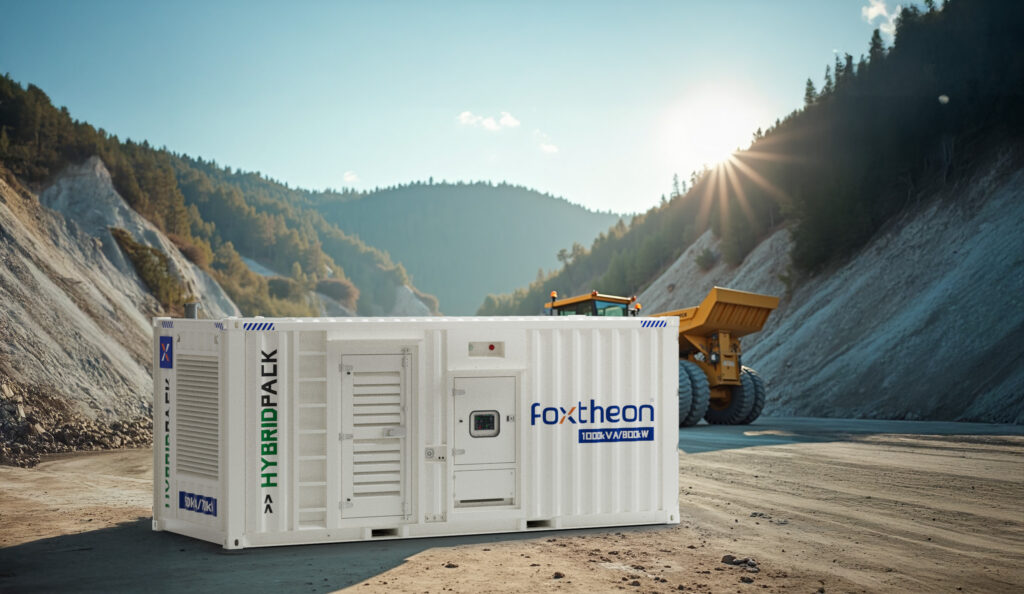
Do you really have to choose? As technology matures, the line between industrial UPS vs BESS is fading. We are seeing the emergence of “UPS-grade BESS” or hybrid systems. These units use high-speed inverters capable of UPS-like response times but utilize large LFP battery banks for long-duration storage.
This hybrid approach allows a facility to have zero-transfer backup for critical IT loads while simultaneously managing facility-wide energy peaks. It consolidates two pieces of infrastructure into one.
- Space Saving: One unified system takes up less floor space than separate UPS and BESS units.
- Unified Maintenance: Operators only need to learn and service one interface.
- Simplified Cabling: Reduces the complexity of the site’s electrical distribution.
Key Considerations for Sizing Your System
When you sit down to plan your power infrastructure, the sizing criteria for industrial UPS vs BESS will differ. Sizing a UPS is relatively straightforward. You calculate the peak load (kW) and the required runtime (minutes), then add a safety margin.
Sizing a BESS is more complex. You must analyze the facility’s load profile over a full year. You need to identify the peak demand times and calculate how much energy (kWh) is required to shave those peaks effectively. You also need to consider the solar generation curve if renewables are involved.
Over-sizing a UPS is common practice to handle inrush currents. However, over-sizing a BESS can destroy the Return on Investment (ROI). Precise data analysis is required. Foxtheon provides specialized tools to help engineers model these scenarios, ensuring the system is perfectly matched to the operational needs.
Environmental Impact and Safety
Safety regulations are strict for both systems. UPS systems with lead-acid batteries carry risks of acid leaks and hydrogen off-gassing. They require well-ventilated rooms and spill containment measures.
BESS units using Lithium-ion batteries have different risks, primarily thermal runaway. However, modern LFP chemistry is chemically stable and much safer than the batteries found in cell phones or electric cars. Furthermore, industrial BESS containers come with advanced fire suppression systems built-in.
From an environmental standpoint, the industrial UPS vs BESS debate favors BESS. Lead is a toxic heavy metal. While recycling rates are high, the mining and processing of lead are dirty. LFP batteries differ as they do not contain cobalt or lead, and their long lifespan means fewer units are manufactured and discarded over time.
Maintenance Requirements
Maintenance is an ongoing operational expense (OpEx). Industrial UPS systems are needy. Capacitors dry out and need replacement every 5 to 7 years. Fans fail. Batteries need constant impedance testing. If you neglect a UPS, it will likely fail exactly when you need it.
A BESS is solid-state and generally requires less physical intervention. The Battery Management System (BMS) actively balances the cells. Cooling systems need to be checked, and filters changed, but the overall maintenance burden is often lower. Remote monitoring allows Foxtheon technicians to diagnose issues without visiting the site, further reducing costs.
Making the Final Decision
So, who wins in the battle of industrial UPS vs BESS? It depends entirely on your pain points. If your sole concern is keeping a specific production line running for 5 minutes until a generator starts, a UPS is the standard choice. It is a mature, purpose-built technology.
However, if you want to control energy costs, integrate solar power, and provide backup for longer durations, the BESS is superior. It transforms energy from a fixed cost into a manageable asset. For many modern facilities, the ability to avoid peak demand charges pays for the system, effectively giving you “free” backup power.
The energy landscape is shifting from passive consumption to active management. The comparison of industrial UPS vs BESS highlights this transition. While the UPS remains vital for ultra-critical, sensitive loads, the BESS offers a holistic solution that addresses reliability, sustainability, and cost-efficiency.
Facility managers should look beyond the initial price tag and consider the lifecycle value. As grid instability increases and energy prices rise, the flexibility of a battery storage system becomes indispensable. By partnering with innovators like Foxtheon, businesses can deploy intelligent power systems that not only protect operations but also contribute to the bottom line.
Frequently Asked Questions (FAQ)
Q1: Can a BESS completely replace an industrial UPS?
A1: It depends on the equipment being powered. If the load can withstand a transfer time of 20 milliseconds, a BESS can replace a UPS. However, for ultra-sensitive electronics requiring zero transfer time, a specialized UPS or a hybrid BESS with UPS capabilities is necessary.
Q2: What is the main cost difference in industrial UPS vs BESS?
A2: A UPS typically has a lower upfront cost but higher maintenance and battery replacement costs. A BESS has a higher initial capital expenditure but offers lower operating costs and can generate revenue through peak shaving, often resulting in a better long-term ROI.
Q3: How long can a BESS provide backup power compared to a UPS?
A3: A standard UPS is designed for 5 to 30 minutes of runtime. A BESS is scalable and typically designed for 2 to 4 hours of runtime, making it suitable for bridging longer outages or operating during expensive peak tariff periods.
Q4: Which system is better for integrating solar power?
A4: The BESS is far superior for solar integration. In the industrial UPS vs BESS comparison, only the BESS can effectively store excess solar energy generated during the day for use at night, maximizing self-consumption and renewable efficiency.
Q5: Does Foxtheon offer both UPS and BESS solutions?
A5: Foxtheon specializes in intelligent energy storage solutions (BESS) and hybrid systems. Their technology focuses on the convergence of energy management and power reliability, providing smart alternatives to traditional standalone UPS setups.