
The logistical complexity of modern large-scale outdoor events necessitates a robust approach to energy management. Providing temporary power for music festival environments is no longer merely about deploying rows of diesel generators. It involves the sophisticated integration of high-capacity distribution networks, intelligent energy storage systems (ESS), and precise load-balancing strategies. As festivals grow in scale and technical ambition, the demand for stable, high-quality electricity becomes a primary engineering challenge that dictates the success of the entire production.
Professional event organizers and technical directors now look toward smart energy architectures to mitigate risks associated with power fluctuations. Brands like Foxtheon provide the specialized hardware and software interfaces needed to manage these complex microgrids, ensuring that the audio-visual experience remains uninterrupted while optimizing operational costs and fuel consumption.
The Architecture of Large-Scale Event Microgrids
A successful power strategy begins with a comprehensive site survey and a detailed analysis of the anticipated electrical load. Unlike industrial applications where loads are often predictable, music festivals experience extreme volatility. High-power lighting rigs, massive PA systems, and heavy-duty catering equipment create a “peaky” demand profile that can strain traditional infrastructure.
Load Profiling and Diversity Factors
Engineers must calculate the base load (the constant power required for basic operations like security lighting and site offices) versus the peak load (the maximum power required when all stage effects and sound systems are active). Understanding the diversity factor—the probability that all connected devices will draw maximum power simultaneously—is vital for right-sizing the temporary power for music festival requirements. Over-specifying leads to inefficiency and mechanical issues like “wet stacking” in generators, while under-specifying risks catastrophic system failure during a headline performance.
Power Distribution and Voltage Drop
Transmission across large festival sites often involves long cable runs, which introduces the challenge of voltage drop. Using heavy-gauge copper cabling and strategically placed distribution boards (DBs) is necessary to maintain voltage within the standard +/- 6% tolerance. Professionals utilize synchronized generator sets (parallel busbars) to create a single, resilient power pool, allowing for redundancy. If one unit requires maintenance, the others absorb the load without a flicker in the supply.
Integrating Hybrid Energy Storage Systems (ESS)
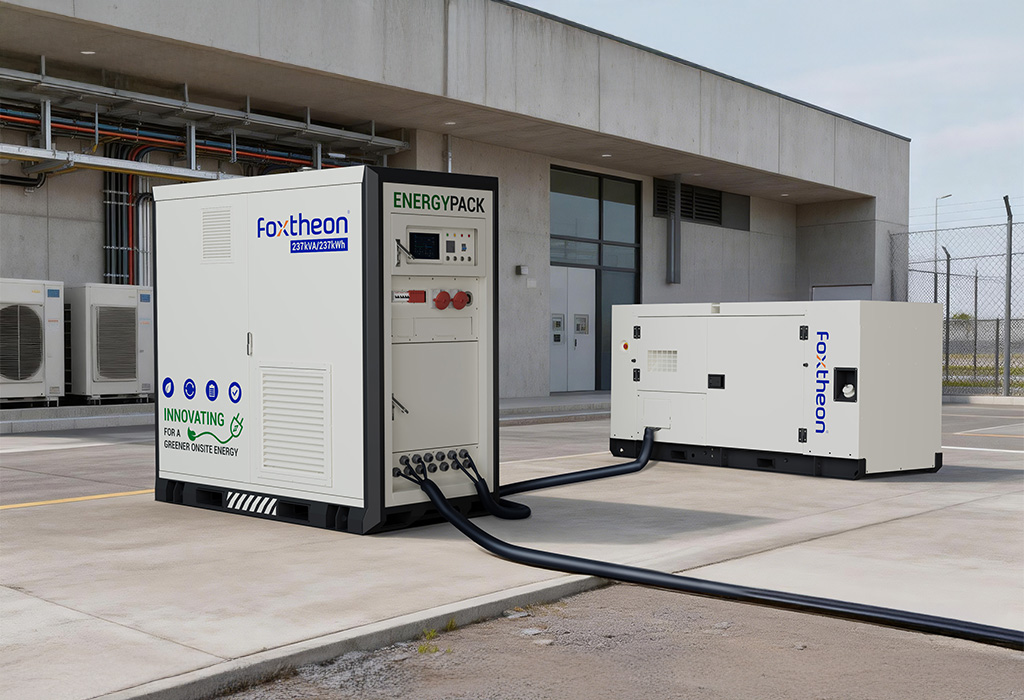
One of the most significant advancements in the sector is the move toward hybrid power configurations. By combining traditional thermal generation with advanced battery energy storage, operators can significantly improve the efficiency of temporary power for music festival sites.
The role of Foxtheon in this space involves providing high-density lithium-ion storage solutions that act as a buffer. These systems offer several technical advantages:
- Peak Shaving: The battery system discharges during moments of maximum demand, allowing the primary generators to be sized for average loads rather than peak spikes.
- Silent Operation during Low Loads: During overnight hours when power demand is minimal, generators can be shut down entirely, with the ESS handling the base load. This reduces noise pollution and mechanical wear.
- Bridge Power: In the event of a primary source failure, the ESS provides instantaneous power, giving the automated control system time to start a backup generator or reroute the load.
Managing Power Quality and Total Harmonic Distortion (THD)
Modern festival technology, including LED screens and digital mixing consoles, is highly sensitive to power quality. High Total Harmonic Distortion (THD) can cause overheating in transformers, flickering in lights, and audible “hum” in sound systems. Achieving a clean sine wave is a non-negotiable requirement for high-end productions.
When planning the temporary power for music festival stages, engineers must account for non-linear loads. Switch-mode power supplies found in many modern electronics can feed harmonics back into the system. Utilizing high-quality inverters and active filtering within the energy storage units helps maintain a THD level below 3%, protecting expensive delicate equipment from premature failure or operational glitches.
Logistical Efficiency and Environmental Responsibility
The industry is under increasing pressure to document and reduce its carbon footprint. However, this must be achieved without compromising the reliability of the supply. A data-driven approach to temporary power for music festival management allows for the precise tracking of liters-per-kilowatt-hour.
Smart Monitoring and Telemetry
Modern power systems utilize IoT-enabled sensors to provide real-time telemetry. Technical teams can monitor fuel levels, load percentages, and phase balance from a centralized dashboard. This visibility ensures that anomalies are detected before they become faults. By analyzing this data, Foxtheon solutions help site managers refine their energy strategy for future iterations of the event, moving toward a more circular and efficient energy model.
Cabling and Site Safety
Safety protocols in outdoor environments are governed by strict regulations, such as BS 7671 or equivalent local standards. All temporary power for music festival installations must incorporate Residual Current Device (RCD) protection and robust earthing (grounding) systems. Given the exposure to weather elements, all connectors and distribution points must meet IP65 or higher ingress protection ratings to prevent short circuits caused by rain or dust.
Future-Proofing Festival Energy Needs
As we look toward the next decade of live entertainment, the integration of renewable sources like solar arrays and hydrogen fuel cells into the temporary microgrid will become more prevalent. These intermittent sources require a sophisticated “brain” to manage the flow of energy. The transition toward a decentralized, smart energy hub is the key to managing temporary power for music festival locations that are often far from the existing utility grid.
The primary goal remains constant: delivering an unshakeable foundation of power that allows the creative elements of the festival to shine. By leveraging hybrid technologies and rigorous engineering standards, the industry can meet the dual demands of high-performance output and operational efficiency.
Frequently Asked Questions
Q1: How do you calculate the total power requirement for a multi-stage music festival?
A1: Calculation involves summing the peak wattage of all lighting fixtures, audio amplifiers, and video walls, then adding a significant buffer (usually 25-30%) for startup currents and expansion. We also apply a diversity factor based on the schedule of the stages to understand the maximum simultaneous draw.
Q2: Why is a hybrid energy storage system better than relying solely on generators?
A2: Hybrid systems allow generators to run at their most efficient load point (usually 70-80%). The batteries handle the “spikes,” which prevents the generators from running at inefficient low loads or struggling during sudden surges, ultimately saving fuel and reducing maintenance intervals.
Q3: What are the risks of using low-quality cables for temporary event power?
A3: Low-quality or incorrectly rated cables can lead to excessive heat buildup, voltage drops that cause equipment to malfunction, and potential fire hazards. Professional installations always use HO7RN-F grade cabling or equivalent for its durability and flexibility in outdoor conditions.
Q4: How does noise regulation impact the choice of power solutions?
A4: Many urban festival sites have strict noise ordinances. Using energy storage systems allows for “silent periods” where generators are turned off, particularly during late-night load-out or early-morning prep, helping the event stay compliant with local environmental health regulations.
Q5: Can renewable energy sources like solar really support a large festival stage?
A5: Solar alone is rarely sufficient for a main stage’s massive draw, but it is an excellent supplement for charging battery banks that power auxiliary services like site lighting, ticketing booths, or VIP areas, reducing the overall demand on the primary power system.
Q6: How do you protect sensitive digital equipment from power surges?
A6: We use a combination of Online Double-Conversion UPS (Uninterruptible Power Supplies), high-quality voltage regulators, and the inherent stabilizing properties of modern hybrid battery inverters to ensure a consistent, clean power supply free from spikes and dips.
Optimize your event’s energy infrastructure with the industry’s most reliable smart energy solutions. Contact our engineering team today to discuss your specific requirements and receive a detailed technical consultation.