
Overcoming Grid Constraints via Microgrid Storage: Powering Multi-Crane Operations in Malaysia
How the Foxtheon Hybrid BESS P350 enabled three heavy-duty tower cranes to operate simultaneously on a restricted 110 kW utility connection through intelligent peak-shaving, eliminating grid trips, reducing operating costs, and accelerating project delivery.
💡 Executive Summary
Malaysia Infrastructure Construction Project
Construction Site, Malaysia
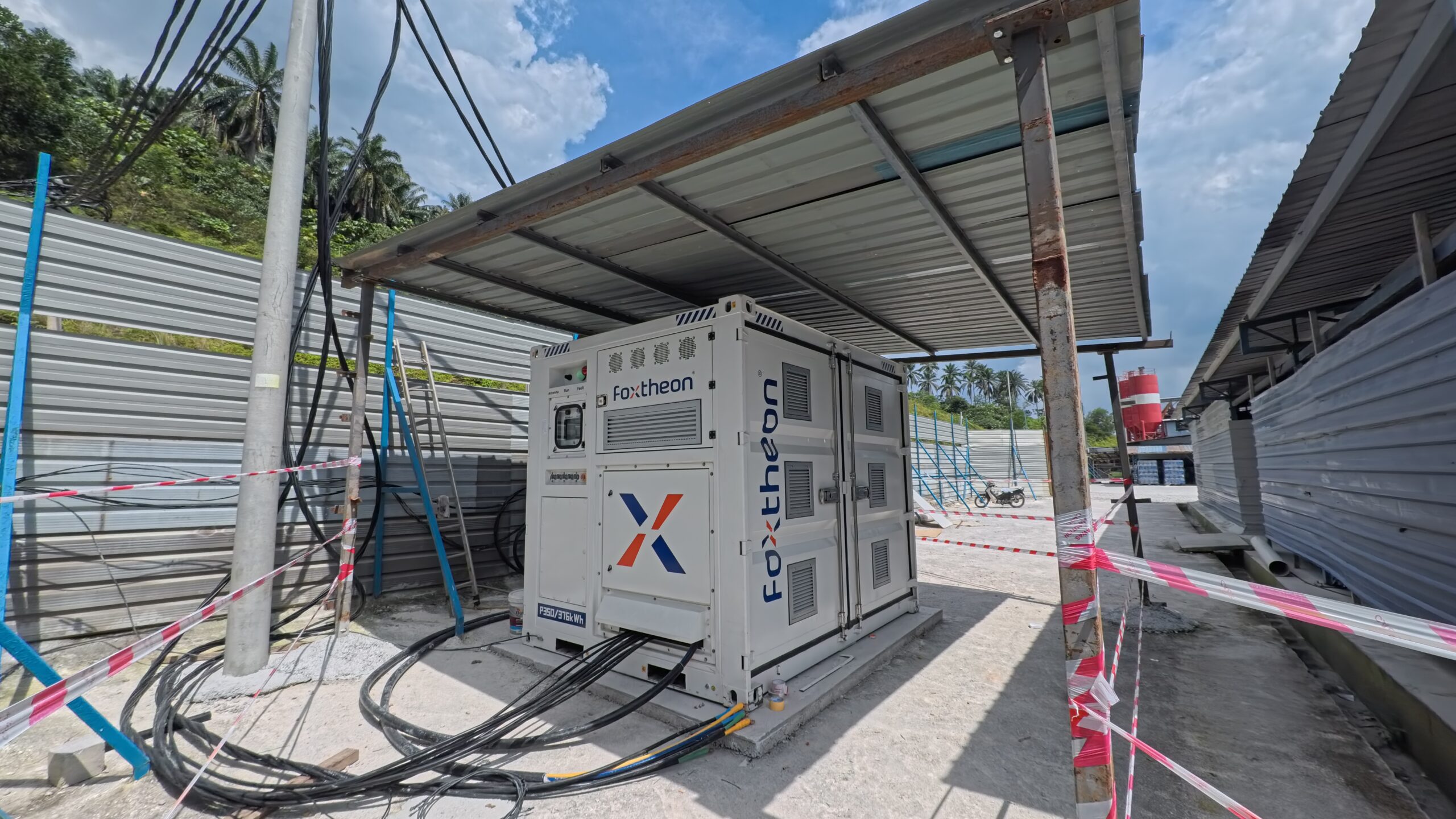
Foxtheon Hybrid BESS P350 (376kWh Battery Energy Storage System)
Implementing intelligent peak-shaving to amplify a restricted 110 kW grid supply, enabling the simultaneous operation of three heavy-duty tower cranes without utility infrastructure upgrades or high-cost diesel generation.
- Challenge: A strict utility allocation of 110 kW was insufficient to support simultaneous lifting operations from three 10-ton tower cranes, resulting in frequent overcurrent trips and severe operational disruption.
- Technology Applied: The Foxtheon Hybrid BESS P350 was deployed as an intelligent energy buffer and microgrid controller capable of delivering instantaneous battery power during peak demand events.
- Peak-Shaving Performance: The system dynamically injected an additional 40 kW to 70 kW whenever crane demand exceeded grid limitations.
- Operational Result: Grid draw remained continuously within the utility-imposed 110 kW threshold while maintaining uninterrupted crane operations.
- Economic Impact: Compared with a conventional diesel generator alternative, the solution reduced daily operating expenditure by approximately 71%.
- Environmental Impact: Achieved site-level zero-emission operation while eliminating diesel consumption, engine maintenance risk, and noise pollution.
1. The Challenge: Severe Power Bottlenecks
The project site deployed three heavy-duty 10-ton flat-top tower cranes (Model: ST60/23-10t) to maintain an aggressive construction schedule. However, the local electrical utility (TNB) could only deliver a strict maximum allocation of 110 kW of grid power to the entire job site.
Why Grid Constraints Became a Critical Project Risk
While the nominal utility connection appeared adequate on paper, the actual operating characteristics of tower cranes created a fundamentally different reality. The cranes were equipped with Variable Frequency Drives (VFDs), which improved motor control and reduced mechanical stress. However, heavy lifting operations still generated substantial short-duration power peaks that far exceeded average consumption levels.
This mismatch between available grid capacity and real-world transient demand created a persistent risk of overcurrent protection trips, operational interruptions, and project delays.
For construction projects operating under restricted grid connections, selecting an energy storage platform specifically engineered for dynamic industrial loads becomes critical. Foxtheon's EnergyPack P300 and larger P-Series systems are designed specifically for high-impact applications such as tower cranes, pumps, heavy motors, and construction equipment where rapid peak power support is required.
Technical Complications
Transient Surge Currents
According to the manufacturer’s nameplate data, each crane's main hoisting mechanism rates at 41 kW.
While equipped with Variable Frequency Drives (VFDs) for soft-starting, cranes generate massive dynamic peak power spikes—up to 1.5× rated power—during heavy lifting and acceleration phases.
Concurrent Peak Loads
Single-crane lifting transient loads reach approximately 75 kW – 80 kW.
When two or three cranes initiate heavy lifting simultaneously, aggregate demand can abruptly surge to 150 kW – 180 kW.
Operational Disruption
Because dynamic demand repeatedly exceeded the rigid utility threshold of 110 kW, the site experienced frequent overcurrent grid tripping.
This resulted in workflow interruptions, productivity losses, and increased risk to sensitive crane VFD systems.
Power Demand vs Available Grid Capacity
Direct utility infrastructure upgrades were evaluated but ultimately rejected. The required transformer expansion and grid capacity increase involved substantial capital expenditure, lengthy approval procedures, and implementation timelines incompatible with the project's construction schedule.As a result, the project team required an immediate solution capable of supporting high-power crane operations without waiting for utility network reinforcement.
2. The Solution: Foxtheon Hybrid BESS P350
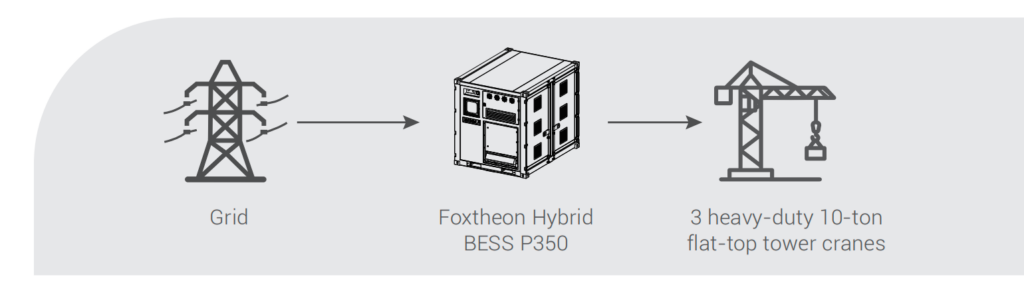
Instead of engaging in costly utility transformer expansion, the project team integrated the Foxtheon Hybrid BESS P350 into the job site's electrical topology as a smart power buffer and microgrid controller.
How the P350 Eliminated Grid Constraints
The Foxtheon Hybrid BESS P350 was deployed as an intelligent energy buffer positioned between the utility connection and the crane fleet.
Rather than allowing crane peak loads to impact the grid directly, the system continuously monitored real-time power demand and automatically responded whenever consumption exceeded the site's permitted utility threshold.
This transformed the restricted 110 kW grid connection into a stable and flexible energy source capable of supporting short-duration industrial power peaks without triggering overcurrent protection events.
The result was a resilient construction microgrid capable of maintaining uninterrupted crane operations while preserving utility compliance.
Operational Architecture & Workflow
Continuous Base-Load Charging
The restricted 110 kW grid connection routes directly into the Foxtheon P350, continuously replenishing the high-density battery bank at a safe and steady rate during low-demand periods.
This ensures stored energy is always available when heavy lifting operations begin.
Millisecond Peak-Shaving
The moment multiple cranes initiate heavy lifting and demand exceeds the utility limit, the P350 inverter instantly responds.
Stored battery energy is discharged within milliseconds to compensate for the shortfall.
Power Amplification
The BESS dynamically injects an additional 40 kW to 70 kW of power whenever required.
This bridges the gap between actual equipment demand and available grid capacity, preventing overload conditions.
Peak-Shaving in Action
Peak-shaving allows construction sites to utilize limited utility connections far more effectively by supplementing short-duration demand spikes with battery energy.
Instead of sizing the grid connection for rare peak events, energy is stored during low-load periods and released only when required.
In this project, the P350 effectively transformed a fixed 110 kW utility allocation into a flexible power supply capable of supporting crane demand peaks of up to 180 kW.
Traditional utility upgrades often require months of engineering review, infrastructure investment, regulatory approval, and construction work. By contrast, the Foxtheon Hybrid BESS P350 can be deployed rapidly and immediately unlock additional usable power capacity through intelligent peak-shaving.This allows construction projects to begin work without waiting for utility network expansion while simultaneously reducing operating costs and improving sustainability performance.
3. Economic & Environmental Impact (ROI Analysis)
To evaluate the true financial and ecological viability of the Foxtheon solution, a comprehensive comparison was conducted against the standard industry alternative: a standalone 350 kW Diesel Generator Set (Genset) running a 10-hour daily shift.
📊 Financial & Sustainability Performance Matrix
| Evaluation Metric (Per 10-Hour Shift) | Standalone 400 kVA Genset Alternative | Foxtheon 110 kW Grid + P350 Solution | 🚀 Net Benefit / ROI Impact |
|---|---|---|---|
| Primary Energy Source | Industrial Diesel Fuel | Low-Voltage TNB Utility Grid | Energy Transition Secured |
| Daily Energy Consumption | ~360 Liters of Diesel | 800 kWh of Electricity | Eliminates Low-Load Engine Waste |
| Daily Operational OPEX | Approx. 1,500 RM ($340 USD) | Approx. 430 RM ($98 USD) | 71% Reduction in Daily OPEX |
| Monthly OPEX (26 Workdays) | Approx. 39,000 RM ($8,840 USD) | Approx. 11,180 RM ($2,530 USD) | Saves 27,820 RM ($6,310 USD) / Mo. |
| On-Site CO₂ Emissions | 965 kg CO₂ / Day | 0 kg (Site Zero-Emission) | 100% Elimination of Scope 1 Carbon |
| Acoustic Noise Level | 75 – 85 dB (High Noise) | < 55 dB (Whisper Quiet) | Prevents Local Environmental Fines |
| Engine Mechanical Risk | High Risk (6 Hours of Wet Stacking/Day) | Zero Risk (Solid-State Assets) | Eliminates Downtime & Maintenance |
By replacing a conventional diesel-powered approach with the Foxtheon Hybrid BESS P350 and utility power, the project achieved substantial recurring savings while simultaneously improving operational reliability and sustainability performance.
Key Takeaways for Decision Makers
Accelerated Payback Period
With a monthly net operational savings of 27,820 RM, the capital expenditure (CAPEX) of the Foxtheon BESS is rapidly amortized through direct fuel-to-grid arbitrage.
The greater the project duration, the more significant the cumulative savings become.
Long-Term Cost Stability
Utility electricity pricing is substantially more predictable than diesel fuel markets, helping contractors better forecast project operating costs and reduce exposure to fuel price volatility.
Mitigating “Wet Stacking”
Tower cranes are highly intermittent loads. During significant portions of a workday, a conventional generator operates at only a fraction of its rated capacity.
In this application, a standard diesel generator would typically remain underloaded at approximately 20% capacity for nearly six hours per day.
This operating condition promotes wet stacking, carbon accumulation, incomplete fuel combustion, increased maintenance requirements, and accelerated engine wear.
The Foxtheon Hybrid BESS P350 completely removes this operational hazard by replacing low-load engine operation with battery-supported power delivery.
4. Key Quantifiable Benefits & Project Outcomes
The successful deployment of the Foxtheon Hybrid BESS P350 delivered measurable operational, economic, and technical advantages for the project team.
Elimination of Grid Outages
The P350 successfully clamped the grid draw within the 110 kW boundary, delivering zero overcurrent trips and enabling continuous, predictable 10-hour daily construction workflows.
Infrastructure Upgrade CAPEX
Eliminated utility substation upgrade costs and bypassed months of administrative approval processes, allowing immediate project commencement.
Premium Power Quality
The storage system filtered VFD harmonic emissions, maintaining voltage and frequency stability while reducing equipment wear-and-tear.
Operating 3 heavy tower cranes concurrently on a strict 110 kW utility limit seemed practically impossible without suffering constant project delays from grid tripping. The Foxtheon Hybrid BESS P350 completely redefined our onsite power dynamic. Not only did it 100% eliminate our overcurrent blackouts from day one, but it also saved us from months of administrative grid upgrade delays. It acts as the reliable 'brain' our jobsite desperately needed.
5. Conclusion
This Malaysian deployment serves as a definitive blueprint for modern, grid-constrained infrastructure developments.
By utilizing the Foxtheon Hybrid BESS P350 as an intelligent energy buffer, contractors can maximize localized, low-capacity utility lines to seamlessly run heavy industrial equipment, hitting the perfect equilibrium of operational reliability, economic prudence, and site decarbonization.
Rather than waiting months for utility upgrades or relying on oversized diesel generators, construction teams can unlock immediate operational flexibility through advanced energy storage and peak-shaving technologies.
As grid constraints become increasingly common across infrastructure, commercial, and industrial developments, battery energy storage systems are rapidly becoming an essential component of modern project power strategies.
FAQ
Q: Can you power multiple tower cranes with a limited 110 kW grid?
A: Yes. By integrating the Foxtheon Hybrid BESS P350, the system acts as an intelligent power buffer. It continuously charges from the 110 kW grid and automatically discharges during concurrent peak lifting loads (peak-shaving), preventing grid overcurrent tripping.
Q: What is the alternative to BESS for grid-constrained construction sites?
A: Typically, a standalone 350 kW diesel generator is required to handle the VFD surge loads of 3 cranes. However, this leads to an average fuel consumption of 360L per 10-hour day and causes engine "wet stacking" due to prolonged low-load operation.
Explore Foxtheon Energy Storage Solutions
Discover how Foxtheon Hybrid BESS solutions help construction, mining, infrastructure, rental, and industrial projects overcome grid limitations while reducing operating costs and emissions.
Need a Power Solution for a Grid-Constrained Project?
Contact Foxtheon to learn how intelligent battery energy storage and hybrid power systems can support your construction, infrastructure, mining, rental, or industrial applications.
Contact Foxtheon