
Generator + BESS Hybrid Power for Temporary and Off-Grid Sites: A Practical Guide
Learn how generator + BESS hybrid power systems improve temporary and off-grid power by managing load profiles, peak demand, generator runtime, and energy efficiency.
Temporary power is not just a generator sizing problem. In many construction, rental, and off-grid industrial applications, it is a load profile problem.
Why This Guide Starts with Load Profile
Many temporary power sites do not need high power all the time. They often have a moderate average load for most of the day, plus short peaks from cranes, pumps, compressors, conveyors, drilling equipment, welding machines, site offices, or temporary HVAC systems.
When teams size temporary power only for the highest peak, they often oversize the generator for normal operation. The site keeps running, but the system may waste fuel, increase runtime, raise maintenance pressure, and create more noise and emissions than necessary.
This is where a generator + BESS hybrid power system becomes useful.
A generator + BESS hybrid power system combines a diesel generator, a battery energy storage system, and an energy management system. The generator supplies continuous power and recharges the battery when needed. The BESS supports peak loads, sudden load changes, and low-load periods. The EMS coordinates how the generator, battery, and site load work together.
The goal is not simply to replace the generator with a battery. The practical goal is to make the generator, BESS, EMS, and real site load profile work together as one coordinated power system.
Diesel Generator
Provides continuous power supply and recharges the battery when needed.
Battery Energy Storage System
Supports peak loads, smooths load changes, and supplies low-load periods.
Energy Management System
Controls power flow, generator operation, battery state, and system response.
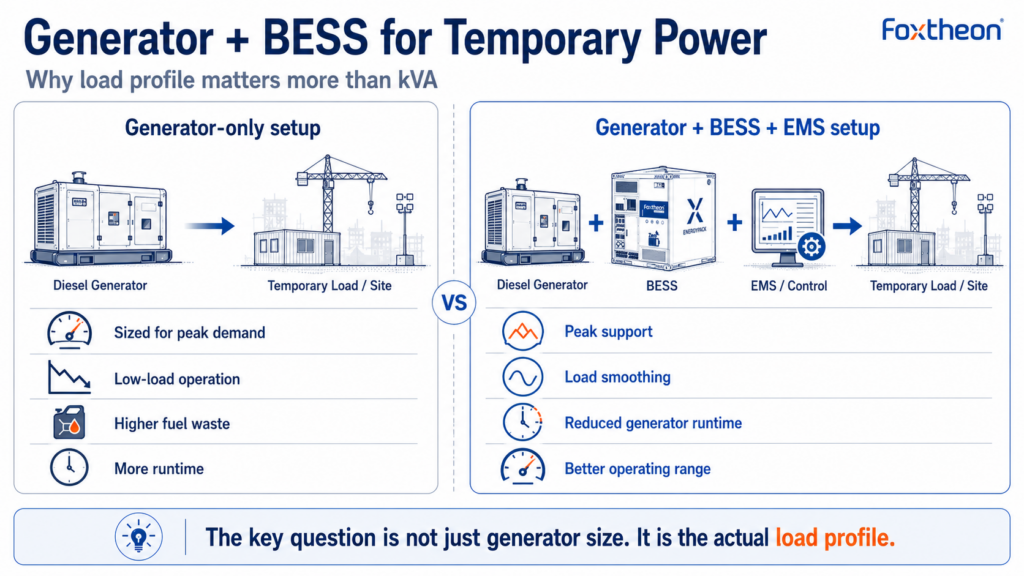
In a conventional generator-only setup, the generator must directly follow the site load. If the load rises suddenly, the generator must respond. If the site has a large temporary peak, the generator is often sized for that peak, even if the peak only occurs occasionally.
In a hybrid setup, the BESS sits between the generator and the load as a power buffer. It can discharge during short peak events, absorb sudden load changes, and supply power during low-demand periods. The EMS decides when the generator should run, when the battery should discharge, when the battery should recharge, and how the system should respond to changing site conditions.
This makes hybrid power especially useful for applications where average demand and peak demand are very different.
Why Load Profile Matters More Than kVA Alone
Generator capacity is commonly discussed in kVA or kW. These values are important, but they do not tell the whole story.
A temporary power system should not be designed only around the maximum possible load. It should be designed around how the load actually behaves over time.
A load profile shows when power is needed, how much power is needed, how long each load operates, and how often peak events occur. It helps answer questions such as:
- What is the average load during normal operation?
- What is the highest peak load?
- How often do peak loads occur?
- How long do peak events last?
- Are the loads steady, variable, or highly intermittent?
- Are there startup currents or inrush demands?
- Are there sensitive loads that require stable voltage and frequency?
- Is the generator running far below its efficient operating range for long periods?
The key question is not just generator size. It is the actual load profile.
Without this information, a generator-only system may be oversized, undersized, or controlled in the wrong way.
For example, a construction site may have a moderate daily average load, but a tower crane or pump may create short spikes that are much higher than the normal load. If the generator is sized only for those spikes, it may operate inefficiently for most of the day. If the generator is sized only for the average load, it may fail to support peak events.
A BESS can help bridge this gap by supporting the short peaks while allowing the generator to operate closer to a more efficient range.
Common Challenges in Generator-Only Temporary Power
Diesel generators remain essential in many temporary and off-grid power applications. They are robust, familiar, mobile, and widely available. However, when used alone, they can face several operational challenges.
Oversizing for Peak Demand
Temporary power systems are often sized for the worst operating moment. This may be necessary for reliability, but it can also mean the generator is much larger than the site needs during normal operation.
When the generator is oversized, it may run at low load for long periods. This reduces efficiency and can increase operating costs.
Low-Load Operation
Many generators are not designed to run continuously at very low load. Long low-load operation can lead to poor combustion conditions, wet stacking risk, carbon buildup, and additional maintenance requirements.
Fuel Consumption and Runtime
Fuel use is not only related to the rated size of the generator. It is also related to operating strategy. A generator running for long periods at inefficient load levels may consume more fuel than necessary.
Noise and Emissions
Generator noise and emissions can be important concerns for construction sites, urban projects, events, remote communities, and low-emission jobsite requirements.
Power Quality and Load Variability
Some temporary power loads are highly variable. Cranes, pumps, compressors, drilling equipment, and welding operations can create sudden load changes. These changes can affect voltage and frequency stability if the power system is not designed to respond quickly.
How BESS Works as a Power Buffer
In a generator + BESS hybrid setup, the battery energy storage system does not simply act as backup power. It becomes an active part of the power system.
Generator-Only Setup
- Generator follows site load directly
- Often sized for peak demand
- May run inefficiently at low load
- Runtime continues during low-demand periods
Generator + BESS + EMS Setup
- BESS supports short peak loads
- EMS coordinates generator and battery operation
- Generator can operate closer to an efficient range
- Runtime can be reduced during low-load periods
Peak Load Support
When a short peak occurs, the BESS can discharge quickly to support the load. This can reduce the need to size the generator only for rare peak events.
Load Smoothing
A BESS can help absorb sudden load changes and smooth the demand seen by the generator. Instead of forcing the generator to follow every rapid fluctuation, the battery can respond quickly while the generator operates more steadily.
Generator Runtime Reduction
During low-load periods, the BESS can supply the site without keeping the generator running continuously. The generator can then restart when the battery needs recharging or when the site load requires it.
More Efficient Generator Operation
A hybrid system can help the generator operate closer to a more efficient load range. Instead of running continuously at low load, the generator can operate during more favorable periods and recharge the battery as part of the system strategy.
Power Stability
Because batteries can respond quickly, a BESS can help support variable or sensitive loads. When properly integrated with an EMS, the system can improve response to changing demand and support more stable power delivery.
The Role of the Energy Management System
The EMS is the control layer of the hybrid power system. Without the right control strategy, adding a battery does not automatically create an efficient system.
A well-designed EMS coordinates the generator, BESS, and load. It can monitor demand, battery state of charge, generator status, operating schedule, and site conditions. Based on this information, it can decide when the generator should start, when it should stop, when the battery should discharge, and when the battery should recharge.
In practical terms, the EMS helps answer questions such as:
- Should the generator run now, or can the BESS support the load?
- Should the battery discharge to support a peak?
- Is the generator operating in an efficient range?
- Is the battery state of charge sufficient for the next expected load event?
- Should the system prioritize runtime reduction, peak support, power quality, or battery reserve?
- Is remote monitoring needed for fleet or site management?
For power rental companies, contractors, and industrial operators, EMS control is what turns a generator and a battery into a coordinated hybrid power system.
When Generator + BESS Hybrid Power Usually Makes Sense
A generator + BESS system is usually worth evaluating when the site has a significant mismatch between average load and peak load.
- High peak loads but lower average demand
- Frequent short-duration load spikes
- Long low-load operating periods
- Variable loads throughout the day
- Limited or delayed grid connection
- Remote sites with expensive fuel logistics
- Noise or emission restrictions
- Sensitive loads requiring more stable power
- Construction sites with cranes, pumps, compressors, or welding equipment
- Data center construction sites before permanent grid power is fully available
- Power rental fleets looking for lower-emission temporary power options
- Off-grid industrial projects that require both mobility and reliability
In these cases, the BESS can reduce the burden on the generator and help the overall system operate more efficiently.
When Generator + BESS May Not Be the Right Answer
Hybrid power is not always the best solution for every site.
A generator + BESS system may be less suitable when the load is very stable and already close to the generator’s efficient operating range. If a generator is correctly sized and operates efficiently throughout the day, the additional system complexity may not provide enough value.
It may also be less suitable for very short projects where the deployment time, transport cost, and setup complexity cannot be justified. Space limitations, poor access, charging strategy, refueling logistics, and control requirements should also be considered.
The key point is that hybrid power should not be selected only because it sounds more advanced. It should be selected when the load profile, site constraints, operating costs, and project goals support the case for integration.
Basic Sizing Checklist for Temporary and Off-Grid Power
Before sizing a generator + BESS hybrid power system, it is useful to collect detailed site information.
- Average load
- Peak load
- Startup current or inrush demand
- Load duration and duty cycle
- Daily operating schedule
- Critical and non-critical loads
- Power quality requirements
- Generator minimum load requirements
- Fuel cost and refueling constraints
- Noise restrictions
- Emission requirements
- Grid availability or grid connection limits
- Site mobility requirements
- Space and access limitations
- Monitoring and remote-control requirements
- Expected project duration
- Future load expansion plans
- Maintenance access and service strategy
The more accurate the load data, the better the system can be sized and controlled.
In some projects, a smaller generator supported by a properly sized BESS may be more effective than a larger generator running inefficiently. In other projects, a conventional generator setup may still be the most practical choice. The correct answer depends on the real operating profile.
Common Application Scenarios
Construction Site Power
Construction sites often combine variable loads, temporary offices, cranes, pumps, lighting, tools, and changing daily schedules. A generator + BESS setup can support peak events, reduce generator runtime during low-load periods, and help manage temporary power before permanent grid access is available.
Power Rental Fleets
For rental companies, hybrid power can become a flexible addition to existing generator fleets. Instead of replacing generators, BESS units can work alongside them to create new rental configurations for low-emission sites, noise-sensitive projects, and customers with variable load profiles.
Off-Grid Industrial Sites
Remote industrial sites often face high fuel logistics costs, limited service access, and demanding reliability requirements. A hybrid system can reduce unnecessary generator operation and support a more controlled power strategy.
Data Center Construction Power
Data center construction requires reliable temporary power before permanent electrical infrastructure is fully available. A generator + BESS hybrid setup can help manage temporary loads, support power quality, and reduce unnecessary generator runtime during construction phases.
Events and Temporary Facilities
Events, temporary camps, and remote facilities often require quiet and reliable power. Demand may vary significantly between setup, operation, and standby periods. A BESS can supply low-load periods and support temporary peaks, while the generator provides longer-duration energy when needed.
Generator + BESS Is an Operating Strategy, Not Just Equipment
A common misunderstanding is that hybrid power is simply a matter of adding a battery to a generator.
In reality, the value comes from system design and control strategy. The generator, BESS, EMS, and loads must be sized and coordinated together. The system must be designed around actual site behavior, not only rated power.
The most important questions include:
- What problem is the system trying to solve?
- Is the main goal peak support, runtime reduction, fuel efficiency, power quality, lower noise, or grid constraint management?
- What does the load profile look like over a full day or week?
- How often do peak events occur?
- How long must the BESS support the load?
- When should the generator run?
- How much battery reserve should be maintained?
- How will the system be monitored and maintained?
These questions determine whether the hybrid system will deliver real operational value.
How Foxtheon Approaches Hybrid Temporary Power
Foxtheon designs and builds hybrid BESS and microgrid power solutions for temporary power, construction sites, power rental fleets, and off-grid industrial applications.
Our approach starts with the load profile and site operating conditions. Rather than treating battery storage as a standalone product, we focus on how the BESS works together with generators, loads, controls, and remote monitoring.
For many projects, the objective is not to eliminate the generator completely. The objective is to reduce inefficient runtime, support peak loads, improve system flexibility, and give operators better visibility into how temporary power is being used.
This is especially important for rental companies and industrial users that need practical, deployable systems rather than theoretical energy concepts.
Conclusion
Generator + BESS hybrid power is most valuable when temporary or off-grid sites have variable loads, short-duration peaks, low-load periods, or limited grid access.
In these conditions, kVA alone is not enough to define the right power system. The load profile matters. The generator must be sized and operated in relation to real site demand. The BESS must be sized for peak support, runtime reduction, and operating strategy. The EMS must coordinate the system so that the generator, battery, and load work together.
For construction sites, power rental fleets, off-grid industrial projects, and temporary infrastructure, hybrid power is not simply about using a battery instead of a generator. It is about designing a smarter temporary power system based on how the site actually operates.
FAQ
What is generator + BESS hybrid power?
Why does load profile matter in temporary power design?
Can BESS replace a diesel generator?
How does BESS reduce generator runtime?
When does generator + BESS make the most sense?
When may generator + BESS not be suitable?
What information is needed to size a generator + BESS system?
Explore Foxtheon Hybrid Power Solutions
Foxtheon provides hybrid BESS and microgrid power solutions for construction sites, rental fleets, off-grid industrial projects, and temporary power applications.
Talk to Our Team