
Case Study · Remote Power · Australia
How Hybrid Power Helps Remote Fuel Stations Save Diesel and Protect Fuel Inventory
A Northern Territory fuel station is combining solar, battery storage and its existing diesel generator to reduce continuous genset operation—and keep more fuel available for customers.
At a remote fuel station, diesel serves two very different purposes. It is the fuel sold to customers, but it may also be the fuel consumed on-site to generate electricity.
That creates an unusual operational challenge: every litre burned by the generator is one less litre available for sale.
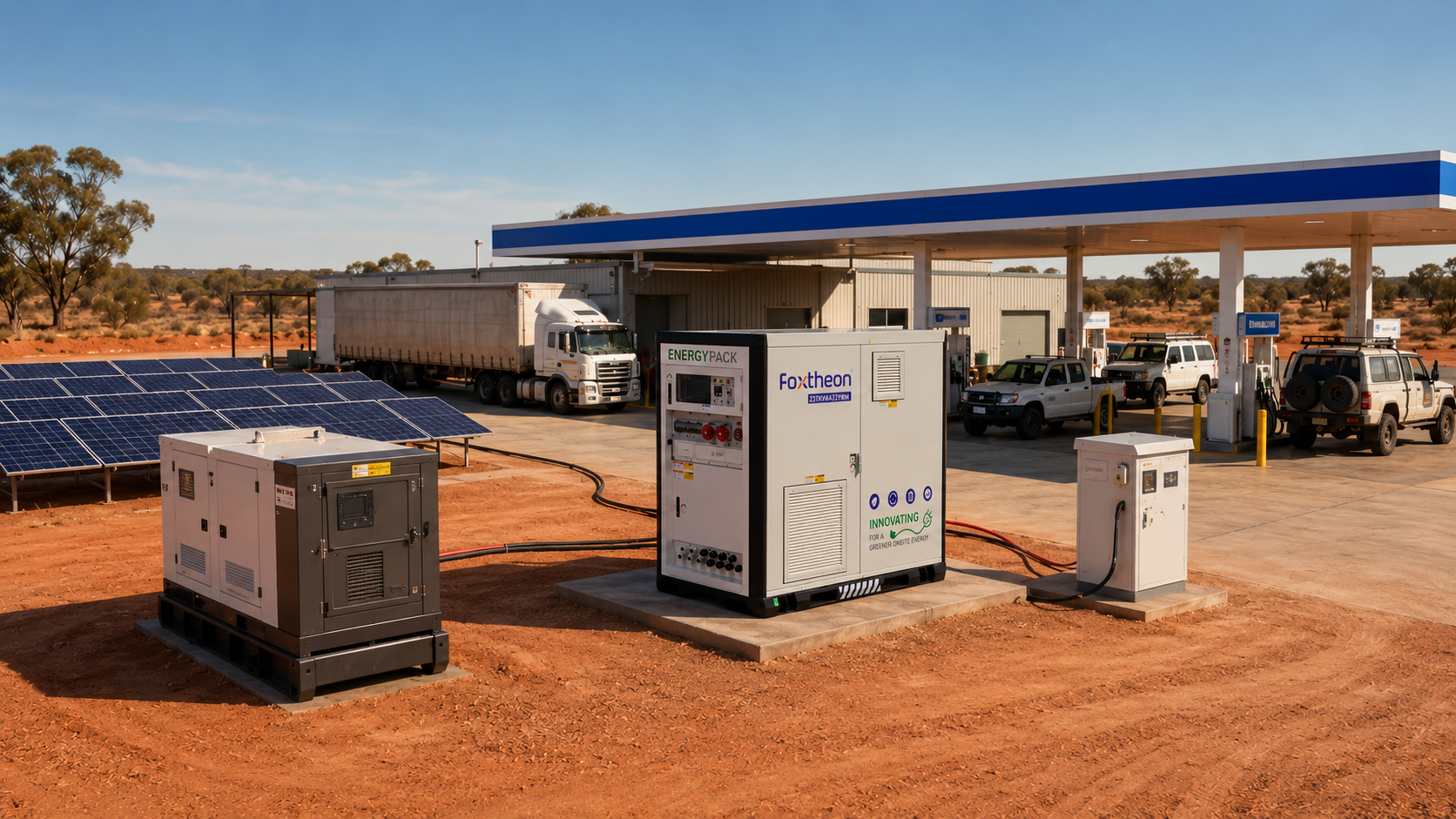
A remote fuel station in Australia’s Northern Territory recently faced this problem. The site consumes approximately 600 kWh of electricity per day and had been relying on a 100 kVA diesel generator operating around the clock.
To reduce generator dependence, Foxtheon worked with the customer to design a hybrid microgrid combining a Foxtheon M150 Pro mobile battery energy storage system, a 60 kW solar array and the site’s existing diesel generator.
The objective was not simply to reduce energy costs. It was to improve the overall operation of the fuel station.
Project at a glance
| Application | Remote fuel station |
|---|---|
| Location | Northern Territory, Australia |
| Daily electricity demand | Approximately 600 kWh |
| Previous power source | 100 kVA diesel generator operating 24/7 |
| Hybrid power solution | Foxtheon M150 Pro, 60 kW solar and existing diesel generator |
| Estimated diesel reduction | More than 150 litres per day |
| Additional benefits | Fewer generator hours, lower maintenance demand, reduced emissions and more fuel available for customers |
Why remote fuel stations depend on diesel generators
Many remote fuel stations, roadhouses and service facilities are located far from reliable grid infrastructure.
Extending the utility grid to these sites may be technically difficult, expensive or commercially impractical. Diesel generators therefore remain a common source of electricity for pumps, refrigeration, lighting, communication systems, workshops, offices and other essential loads.
Generators provide dependable power, but continuous operation creates several challenges:
- High diesel consumption
- Frequent servicing and maintenance
- Engine wear from extended operating hours
- Noise and local emissions
- Dependence on regular fuel deliveries
- Reduced fuel inventory available for customers
For a conventional industrial site, diesel used for power generation is primarily an operating expense. For a fuel station, it is also saleable stock. This makes every reduction in generator fuel consumption commercially significant.
The limitations of running a diesel generator 24/7
A generator that runs continuously must remain online even when electricity demand is relatively low.
Site loads change throughout the day. Pumps, refrigeration equipment, air conditioning, lighting and workshop equipment do not all operate at full demand at the same time. As a result, the generator may spend long periods operating below its optimal loading range.
The site must still pay for fuel, maintenance and operating hours even when only a small amount of power is required.
A hybrid power system changes this operating model. Instead of asking the generator to follow every variation in site demand, battery storage can supply the load while the generator operates only when necessary.
How the hybrid microgrid works
The Northern Territory solution combines three complementary energy sources:
- A 60 kW solar array
- A Foxtheon M150 Pro battery energy storage system
- The existing 100 kVA diesel generator
Hybrid power operating principle
Solar is used first, battery storage balances supply and demand, and the generator starts only when additional energy is required.
Supplies active daytime loads and charges the battery when generation exceeds demand.
Stores surplus energy, responds to load changes and coordinates generator start/stop logic.
Pumps, refrigeration, lighting, controls, communications, workshop and office demand.
During the day
Solar energy supplies the fuel station’s active loads. When solar generation exceeds immediate site demand, the remaining energy is used to charge the M150 Pro battery system. This allows part of the daytime solar production to be stored for use later.
During the evening and at night
When solar production decreases, the battery energy storage system supplies the site. Instead of keeping the diesel generator online throughout the night, the station can use stored energy for lighting, refrigeration, controls and other electrical loads.
When battery charge becomes low
When the battery reaches a defined state-of-charge threshold, the diesel generator starts automatically. The generator can supply the site load while simultaneously recharging the battery. Once the required battery level has been restored, the generator can stop and the battery resumes supplying the site.
This approach converts the generator from a continuous power source into a controlled part of the hybrid system.
Why battery storage is essential
Solar power alone cannot provide continuous electricity to a remote fuel station. Solar production varies with the time of day and weather conditions, while the station’s electrical systems may need to operate 24 hours a day.
Battery storage bridges the gap between renewable energy production and site consumption. It allows the microgrid to:
- Store excess daytime solar energy
- Supply loads after sunset
- Respond quickly to changes in electricity demand
- Reduce unnecessary generator runtime
- Maintain power while different energy sources are coordinated
- Start the generator only when additional energy is required
The value of the BESS is therefore not limited to its battery capacity. It comes from how effectively the system coordinates solar generation, diesel generation and real site loads.
Estimated diesel savings of more than 150 litres per day
Based on the current system design and operating profile, the hybrid microgrid is expected to reduce diesel consumption by more than 150 litres per day.
The savings come from several operating improvements:
- Solar supplies part of the station’s daytime energy
- The battery stores solar energy for use outside daylight hours
- The generator no longer needs to operate continuously
- Generator starts can be scheduled around actual energy requirements
- The generator can operate during defined charging periods instead of following every small load change
The exact savings achieved by any hybrid microgrid will depend on solar conditions, load behaviour, battery operating strategy, generator efficiency and seasonal demand. However, for this application, the impact extends beyond a lower fuel bill.
Diesel saved from power generation becomes customer inventory
This is the most distinctive commercial benefit of the project.
Every litre of diesel no longer consumed by the generator remains available as saleable inventory for the fuel station.
Lower operating cost
The station consumes less diesel to produce electricity and reduces avoidable generator operating hours.
Protected saleable inventory
More fuel remains available for customers, vehicles and local operations—the site’s core business.
The project demonstrates why energy decisions should not be evaluated only through electricity costs. At a remote fuel station, improving power generation can directly support the site’s core business.
For a remote fuel station, every litre not burned for electricity can remain available to sell.
Fewer generator hours can also reduce maintenance
Diesel generator maintenance is closely connected to operating hours. A generator running 24 hours a day accumulates service intervals quickly. Routine maintenance may include oil changes, filter replacement, inspections and other scheduled work.
Reducing generator runtime can help:
- Extend time between service intervals
- Reduce routine maintenance requirements
- Lower the consumption of engine fluids and replacement parts
- Reduce exposure to unplanned generator downtime
- Free site personnel from frequent generator-related tasks
For remote locations, this benefit can be especially important. Maintenance technicians, spare parts and replacement equipment may not be readily available. Avoiding unnecessary operating hours can therefore improve both cost efficiency and site resilience.
Lower emissions without removing the generator
Hybrid power does not necessarily mean eliminating diesel generation completely. For many remote sites, the generator remains an important source of backup power and long-duration energy support.
The objective is to use it more intelligently.
By combining solar generation with battery storage, the site can reduce:
- Diesel consumption
- Generator operating hours
- Carbon emissions
- Local exhaust emissions
- Generator noise
The generator remains available when solar and stored energy are insufficient, but it is no longer required to run continuously. This makes the transition practical for remote businesses that need reliable power but are not ready to depend entirely on renewable energy.
Why this model is relevant across remote Australia
The same operating challenge exists at many other Australian sites. Remote businesses often need reliable electricity but face limited grid access, high fuel logistics costs and demanding environmental conditions.
A solar, battery and diesel hybrid system can be considered for:
- Remote roadhouses
- Mine support facilities
- Agricultural operations
- Telecommunications sites
- Construction camps
- Workshops and depots
- Remote communities
- Off-grid commercial facilities
- Utility and infrastructure sites
The correct system design will vary by application, but the principle remains the same: use solar when available, store energy for later and operate the generator only when required.
What should be assessed before designing a remote hybrid microgrid?
A successful hybrid power system should be designed around the site’s actual operating profile rather than selected only by battery capacity.
Daily and hourly load profile
Assess daytime demand, night-time base load, short-duration peaks and seasonal variations—not only total daily energy.
Solar resource and available area
Review local conditions, roof or ground space, shading, orientation and installation constraints.
Generator size and behaviour
Confirm generator capacity, fuel consumption, loading characteristics and available control interfaces.
Battery power and usable energy
Energy capacity affects runtime, while power capacity determines the load the system can support at any moment.
Control strategy
Define when to use solar, charge or discharge the battery, and start or stop the generator.
Remote monitoring and serviceability
Provide visibility into state of charge, power flow, alarms, generator status and system performance.
Hybrid power is a business solution, not only an energy solution
The Northern Territory fuel station project shows how a hybrid microgrid can create value beyond electricity generation. By integrating solar, battery storage and the existing diesel generator, the proposed solution is expected to:
- Save more than 150 litres of diesel per day
- Reduce generator operating hours
- Lower maintenance requirements
- Reduce emissions and noise
- Improve the use of available solar energy
- Keep more fuel available for customers
For remote fuel stations, the business case is especially compelling. Diesel saved from power generation does not simply disappear from an expense line. It remains part of the station’s commercial inventory.
That is what makes hybrid power more than an energy upgrade. It becomes an operational and business decision.
Frequently asked questions
Remote hybrid power: common questions
What is a hybrid microgrid?
A hybrid microgrid is a local power system that combines two or more energy sources, such as solar panels, battery energy storage and diesel generators. A control system coordinates the available sources to supply the site reliably and efficiently.
Why use battery storage at a remote fuel station?
Battery storage allows solar energy to be used outside daylight hours. It can also supply low and variable loads without keeping a diesel generator online continuously.
Can a battery energy storage system replace the diesel generator completely?
Not in every application. Many remote sites retain the generator for backup power, extended periods of low solar production or unusually high energy demand. The BESS reduces generator dependence rather than necessarily removing the generator.
How much diesel can a hybrid microgrid save?
Savings depend on the load profile, solar capacity, battery size, generator efficiency and control strategy. For the Northern Territory project described here, the system design is expected to reduce diesel consumption by more than 150 litres per day.
Why not install solar without a battery?
Solar panels generate electricity only when sufficient sunlight is available. A battery stores excess solar energy and supplies the site when solar production falls, including during the evening and at night.
What types of remote sites can use hybrid power?
Hybrid power can support remote fuel stations, roadhouses, mines, farms, telecommunications sites, construction camps, workshops, utilities and other commercial or industrial facilities without reliable grid access.
Planning a hybrid power system for a remote site?
Foxtheon develops mobile and industrial hybrid power solutions that integrate battery storage, diesel generators, solar and grid power. A site assessment can help define battery capacity, power rating, solar configuration, generator strategy and control logic based on real operating conditions.
Performance figures are project-specific estimates based on the current system design and operating profile. Actual savings depend on solar conditions, site load, generator efficiency, control settings and seasonal demand.