
The way we generate power has changed fundamentally. We are moving away from massive, centralized coal plants toward decentralized networks powered by the sun and wind. This shift is essential for the environment, but it brings a headache for engineers: instability.
Renewable energy is vital, but it is also moody. A passing cloud can drop solar output by 80% in seconds. A lull in the wind can destabilize an entire local network. For industrial parks, remote islands, or commercial campuses relying on these networks, such fluctuations are unacceptable. They lead to equipment damage and operational downtime.
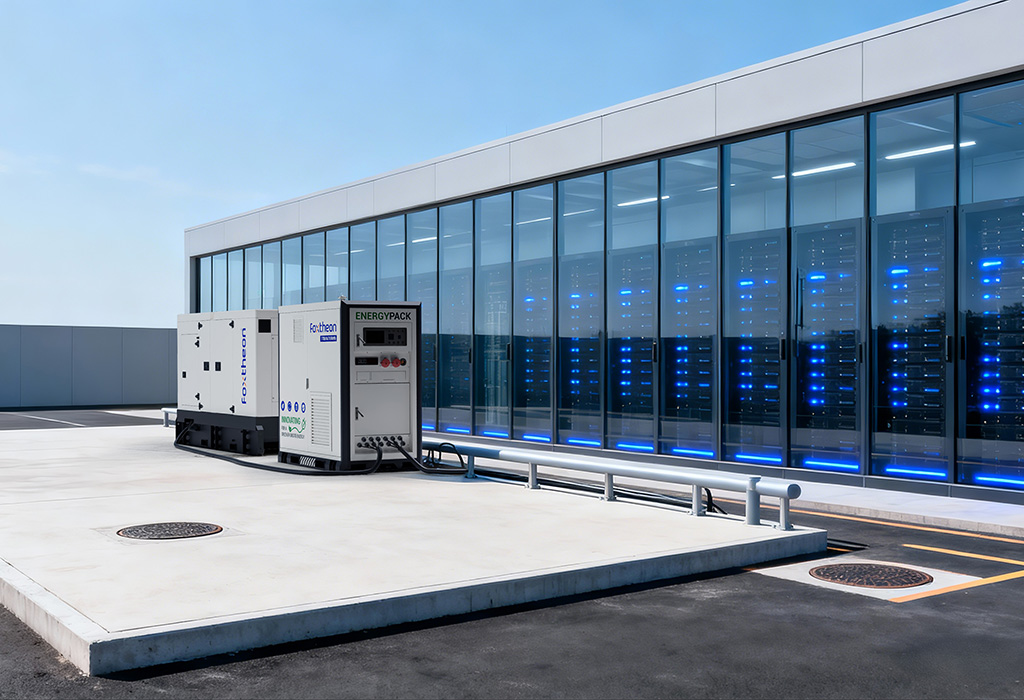
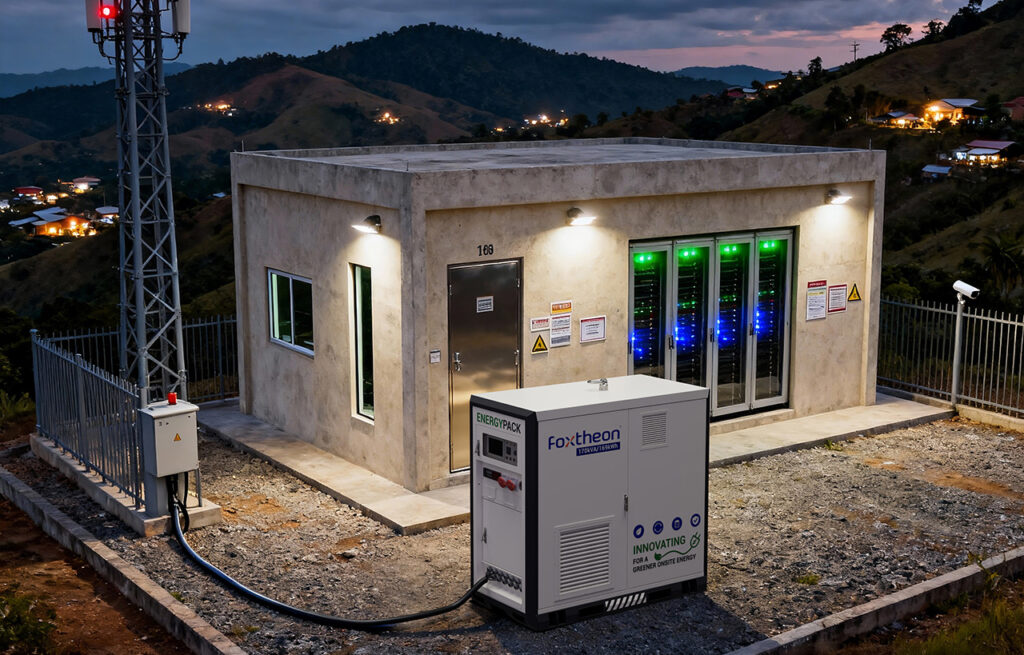
This is where energy storage steps in. It is no longer just about storing power for later; it is about keeping the grid alive in real-time. Implementing a BESS for microgrid stability has become the standard solution for smoothing out these renewable wrinkles. Companies like Foxtheon have recognized that without a smart battery acting as an anchor, a renewable microgrid is simply too volatile for critical operations.
Here is how modern Battery Energy Storage Systems (BESS) are solving the stability crisis.
1. Smoothing Renewable Intermittency
The primary enemy of a stable microgrid is the variable nature of renewable sources. In a traditional grid, huge spinning turbines provide a constant, steady output. In a renewable microgrid, the power generation graph looks like a jagged mountain range.
Managing Ramp Rates
When a solar array is covered by a cloud, power output drops almost instantly. This is called a “ramp down.” Traditional diesel generators cannot start up fast enough to catch this fall. The result is a blackout or a brownout.
A BESS solves this through “ramp rate control.” Batteries can discharge energy in milliseconds. When the solar output dives, the battery injects power instantly to fill the gap. It makes the drop gradual rather than sudden, giving backup generators enough time to start up and synchronize without crashing the system.
Eliminating Voltage Sags
Sudden load changes or generation drops cause voltage to sag. If voltage drops below a certain threshold, sensitive electronics trip offline to protect themselves. This can shut down an entire factory line. A BESS constantly monitors the bus voltage. If it detects a sag, it injects reactive power immediately to prop the voltage back up, ensuring a smooth, flat power curve.
2. Providing Virtual Inertia
This is perhaps the most technical but most critical aspect of BESS for microgrid stability.
The Problem with Inverters
Traditional grids have “inertia.” Heavy steel turbines spin at high speeds. If a load spikes, the momentum of that spinning steel keeps the grid going for a few seconds, buying time for control systems to react.
Solar panels and wind turbines connect to the grid via inverters. They have no moving parts and, consequently, zero inertia. If a large motor turns on, the grid frequency can collapse instantly because there is no physical momentum to resist the change.
The Battery Solution
Advanced BESS inverters are now equipped with “synthetic” or “virtual” inertia. Using sophisticated algorithms, the battery mimics the behavior of a spinning generator. When the grid frequency deviates, the battery aggressively pushes power against the deviation, just like a heavy flywheel would. This artificial resistance prevents rapid frequency changes, keeping the microgrid synchronized and stable.
3. The Role of BESS for Microgrid Stability in Frequency Regulation
Frequency is the heartbeat of the grid (usually 50Hz or 60Hz). In a small microgrid, this heartbeat is very easy to disrupt. A slight mismatch between power supply and power demand causes the frequency to drift.
Fast Frequency Response (FFR)
If demand exceeds supply, frequency drops. If supply exceeds demand, frequency spikes. Both are dangerous. A BESS operates as a fast-acting regulator.
Because batteries are chemical rather than mechanical, they can switch from charging to discharging almost instantly. If the frequency goes high, the BESS absorbs the excess energy. If it goes low, it pumps energy out. This continuous, sub-second balancing act keeps the frequency tight, preventing the cascading failures that lead to total blackouts.
Integrating with Fossil Fuels
Many microgrids still use diesel generators as a backup. However, diesel engines struggle to maintain exactly 50/60Hz under varying loads. By pairing a generator with a BESS, the battery handles the small, fast fluctuations, allowing the generator to run at a constant, efficient speed. This not only stabilizes the frequency but also saves fuel and reduces engine wear.
4. Seamless Islanding and Grid-Forming
Many microgrids operate in two modes: connected to the main utility grid, or “islanded” (standing alone). The transition between these two states is risky.
The Transition Moment
When the main grid fails (due to a storm, for instance), the microgrid must disconnect and support itself. This moment of separation is chaotic. Without a strong anchor, the local voltage and frequency can spiral out of control effectively crashing the local grid just as it tries to save itself.
Grid-Forming Inverters
To achieve true BESS for microgrid stability, the storage system often acts as a “grid-forming” asset. This means the BESS provides the voltage and frequency reference for the rest of the network. It tells the solar inverters what the frequency should be.
Brands like Foxtheon engineer their systems to handle this specific transition. When the main grid cuts out, the BESS instantly takes over as the master controller. The transition is often so smooth that computers and lights inside the facility do not even flicker.
5. Peak Shaving and Load Management
Stability is not just about keeping the lights on; it is about keeping the equipment within its safety margins. Overloading a transformer or a generator causes thermal stress and instability.
Shaving the Spikes
Industrial operations often have massive power spikes. Starting a large conveyor belt or a crusher might draw three times the normal current for a few seconds. If the microgrid cannot supply this, the voltage collapses.
A BESS anticipates these peaks. It releases stored energy specifically to cover these high-demand moments. By “shaving” the peak, it ensures the rest of the generation sources—like solar or smaller generators—are not overwhelmed.
Improving Power Quality
Beyond just stability, there is power quality. Harmonics and noise in the electrical line can confuse digital sensors and overheat motors. High-quality inverters used in modern BESS solutions act as active filters. They clean up the power signal, ensuring that the electricity delivered to the load is a pure sine wave. This protects expensive industrial machinery from long-term damage.
The Importance of the Energy Management System (EMS)
You cannot discuss stability without discussing the brain of the operation. The battery cells store the energy, but the Energy Management System (EMS) decides what to do with it.
A smart EMS monitors the weather forecast, the current load, and the state of charge of the batteries. It predicts instability before it happens. For example, if the EMS sees a storm front approaching on the radar, it might pre-charge the batteries to maximum capacity, preparing the system for the upcoming solar drop-off.
This predictive capability is what separates a dumb battery from a smart stability solution. It transforms the BESS from a passive backup bucket into an active grid stabilizer.
Economic Implications of Stability
While technical stability is the priority, financial stability follows close behind. An unstable grid costs money.
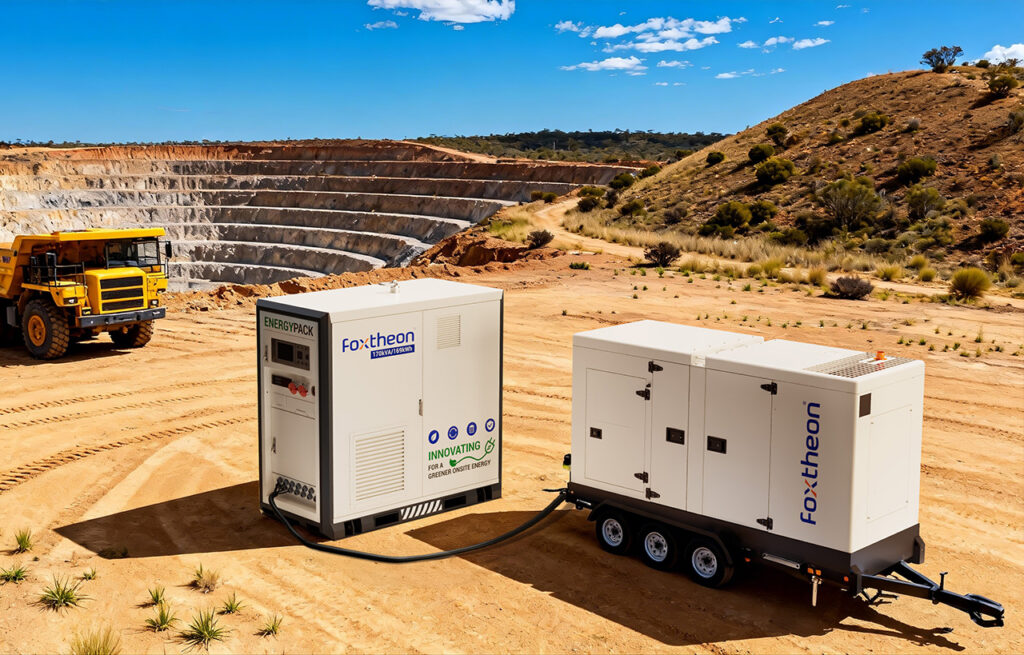
Every time a microgrid trips offline, production stops. In mining or manufacturing, an hour of downtime can cost hundreds of thousands of dollars. Furthermore, unstable voltage shortens the lifespan of capital equipment. Motors burn out faster, and LEDs fail prematurely.
By investing in BESS for microgrid stability, operators are essentially buying an insurance policy for their assets. The ROI is not just found in fuel savings from solar; it is found in the avoidance of costly interruptions and equipment replacement.
Future Trends in Microgrid Storage
The technology is moving fast. We are seeing the rise of hybrid chemistries and longer-duration storage.
Lithium Iron Phosphate (LFP)
LFP chemistry has become the dominant choice for stationary storage. It offers high safety and a long cycle life, which is crucial for stability applications that require frequent charging and discharging. The risk of thermal runaway is significantly lower compared to older lithium-ion types, making them safer for installation in populated areas.
Decentralized Control
Future microgrids may not have a single central controller. Instead, we are moving toward distributed control logic where multiple BESS units communicate with each other. If one unit fails, the others automatically adjust their parameters to pick up the slack, creating a self-healing grid.
The era of simple, fossil-fuel-based power is ending, but the need for reliability is higher than ever. As we push more renewable energy into our local networks, the physics of the grid changes. We lose inertia, and we gain volatility.
The only bridge across this gap is intelligent storage. Using BESS for microgrid stability is no longer an optional upgrade; it is a fundamental requirement for any modern energy project. It provides the virtual inertia, frequency response, and voltage support that solar and wind simply cannot offer on their own.
Whether for a remote mine, a hospital, or a data center, the integration of robust storage solutions—such as those developed by Foxtheon—ensures that clean energy is also reliable energy. By mastering the flow of electrons, we secure the operations of tomorrow.
Frequently Asked Questions (FAQ)
Q1: How fast can a BESS respond to a grid fluctuation?
A1: Modern BESS units can respond incredibly fast. Most systems can detect a frequency deviation and adjust their power output within milliseconds (often less than 20ms). This sub-cycle response time is faster than any mechanical generator, making batteries essential for catching sudden drops in renewable generation.
Q2: Can a BESS replace diesel generators entirely in a microgrid?
A2: In some cases, yes, but usually, a hybrid approach is best. While a BESS handles short-term instability and stores solar power for the night, a backup generator is often kept for long-duration emergencies (like a week of rain). The BESS, however, significantly reduces the runtime and fuel consumption of that generator.
Q3: What is the difference between “Grid-Following” and “Grid-Forming” inverters?
A3: A “Grid-Following” inverter acts as a guest; it looks for an existing voltage and frequency wave from the grid and matches it. If the grid goes down, it shuts off. A “Grid-Forming” inverter acts as the host; it creates the voltage and frequency wave itself. This allows the BESS to stabilize the microgrid even when the main utility connection is lost.
Q4: How does using BESS for microgrid stability affect battery lifespan?
A4: Frequency regulation and stability services often require “micro-cycling”—small, frequent charges and discharges. While this is different from deep cycling (full charge/discharge), modern Lithium Iron Phosphate (LFP) batteries are designed to handle thousands of these micro-cycles without significant degradation, provided the temperature is well-managed.
Q5: Is it difficult to retrofit a BESS into an existing microgrid?
A5: Generally, no. Modern BESS solutions, like those from Foxtheon, are often modular and containerized. They are designed to be “AC-coupled,” meaning they can be connected to the standard AC bus of an existing microgrid without needing to rewire the solar panels or generators. The main task is integrating the Energy Management System (EMS) to ensure all parts talk to each other.