
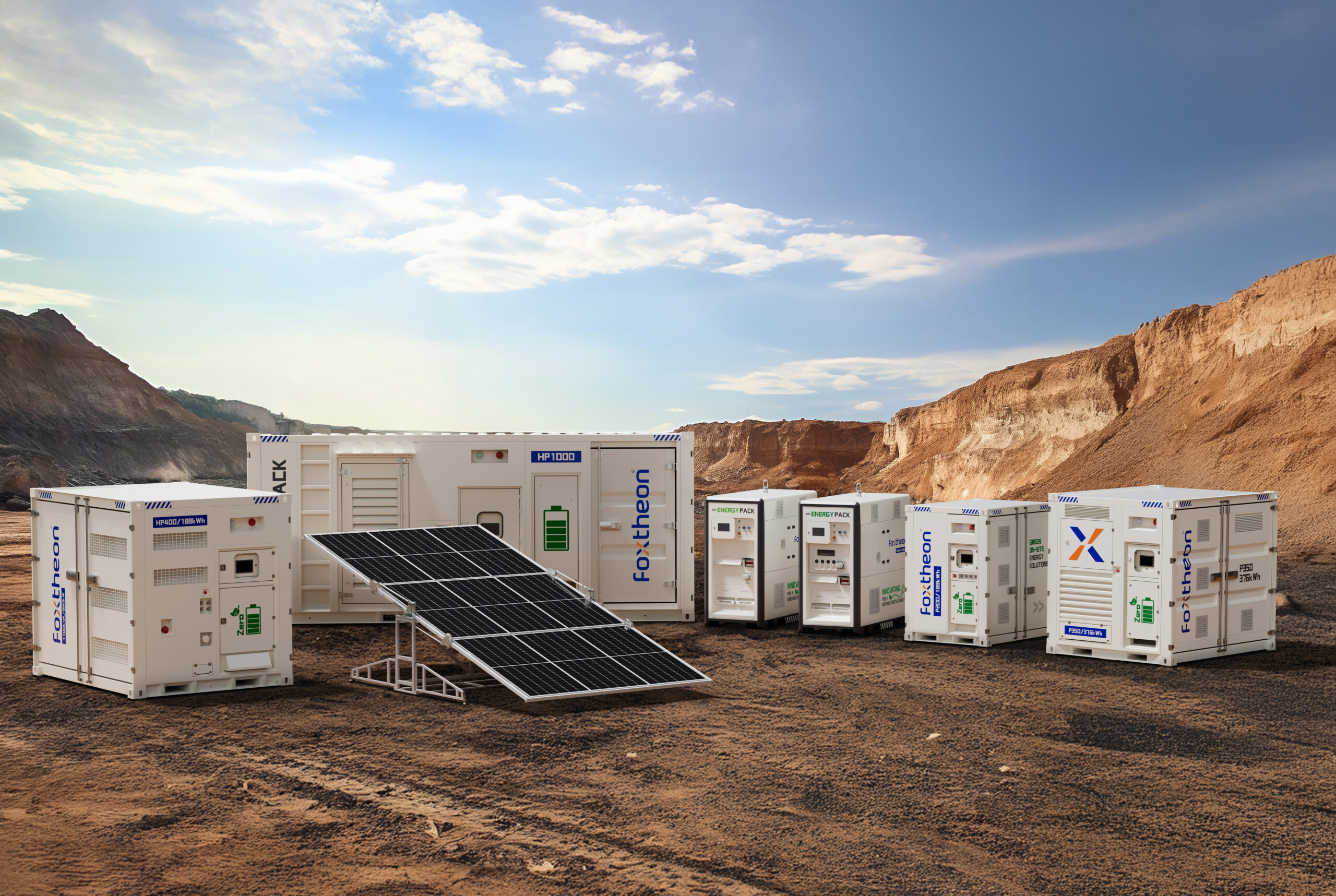
In remote industrial operations, establishing a stable, continuous electrical supply remains a major operational challenge. Historically, remote sites such as mining facilities, telecommunication towers, agricultural centers, and construction projects relied solely on diesel generator sets. While these generators offer reliable baseline power, they are subject to high fuel transport logistics, frequent maintenance intervals, and efficiency losses when operating at low load factors.
Integrating renewable energy assets alongside energy storage units with existing generation infrastructure has emerged as a practical solution. Designing reliable off grid hybrid power systems requires a meticulous balance of electrical engineering, hardware compatibility, and intelligent software orchestration to maintain system equilibrium under variable loads.
.jpg)
1. System Topology: Deciding Between AC-Coupled and DC-Coupled Architectures
The choice of coupling topology determines how energy generation sources, storage elements, and loads interact. For industrial-grade deployments, engineers must analyze the load profile and existing assets before selecting either an AC-coupled or a DC-coupled architecture.
AC-Coupled Microgrid Topologies
In an AC-coupled system, the photovoltaic (PV) inverters, wind turbine controllers, and battery energy storage inverters are connected directly to the AC bus. This configuration is highly advantageous for retrofitting existing operations where diesel generators are already installed. Because the primary generation and consumption occur on the AC side, power can directly serve the loads without undergoing multiple conversion stages.
- Scalability: High. Additional PV inverters or battery units can be connected to the AC bus at various distribution points.
- Efficiency: Optimized for daytime operations where solar generation directly powers AC industrial machinery.
- Control Complexity: Requires advanced frequency shifting controls to regulate solar inverter output when battery systems reach full state-of-charge (SoC).
DC-Coupled Microgrid Topologies
In a DC-coupled system, renewable sources charge the battery bank through charge controllers on a common DC bus. The DC power is then converted to AC via a central bi-directional inverter to supply the AC loads. This architecture is highly efficient for systems where battery storage is the primary buffer, or where DC loads (such as telecommunication equipment) represent a large portion of the total demand.
- Efficiency: Highly efficient for battery charging since PV generation bypasses AC-DC conversion losses.
- Black-Start Capability: Inherently superior, as the system can reboot itself from the DC battery bank without requiring an external AC voltage source.
- Integration: Best suited for greenfield projects where the entire power station is engineered from the ground up.
2. Mitigating the Operational Challenges of Diesel Generators in Hybrid Configurations
A common misconception is that installing solar and battery systems allows the immediate shutdown of diesel generation assets. In reality, modern off grid hybrid power systems utilize a combination of renewable assets and thermal generators to guarantee uninterrupted service during extended periods of low irradiance or peak demand.
Preventing Generator Wet Stacking
Diesel engines are designed to operate under load, typically above 30% to 40% of their rated capacity. When solar generation satisfies the majority of the daytime load, the generator may idle or run under extremely low loads. This causes incomplete combustion, leading to carbon build-up on the fuel injectors, exhaust valves, and turbochargers—a phenomenon known as wet stacking.
To prevent this, the Energy Management System (EMS) must be programmed with dynamic minimum loading controls. When solar generation threatens to push the generator below its minimum safe threshold, the EMS should either throttle the solar output or redirect the excess solar energy to charge the battery bank, keeping the generator operating within its optimal thermal range.
Optimizing Start-Stop Cycling
Frequent starting and stopping of heavy diesel engines accelerates mechanical wear and increases starter motor failures. Intelligent off grid hybrid power systems incorporate software algorithms that enforce minimum run times and cooldown periods for generators. By using the battery storage system as a dynamic buffer, the system can absorb short-term load spikes without needing to spin up a generator, reserving generator activation only for sustained high-load events or prolonged low-solar periods.
3. Advanced Battery Storage Integration and Safety Protocols
The energy storage system serves as the stabilizing core of any off-grid network. It acts as both a source of synthetic inertia to maintain system frequency and a buffer to smooth out the intermittent output of renewable generators.
Chemistry Selection: Lithium Iron Phosphate (LFP)
For industrial applications, Lithium Iron Phosphate (LFP) has become the industry standard over traditional Lead-Acid or Nickel-Manganese-Cobalt (NMC) chemistries. LFP offers several key advantages:
- Thermal Stability: High resistance to thermal runaway, making it suitable for hot, remote climates.
- Cycle Life: Typically delivers between 4,000 to 6,000 cycles at an 80% Depth of Discharge (DoD), drastically reducing replacement intervals.
- Power Density: High charge and discharge C-rates allow the battery to respond rapidly to transient startup currents from heavy industrial machinery.
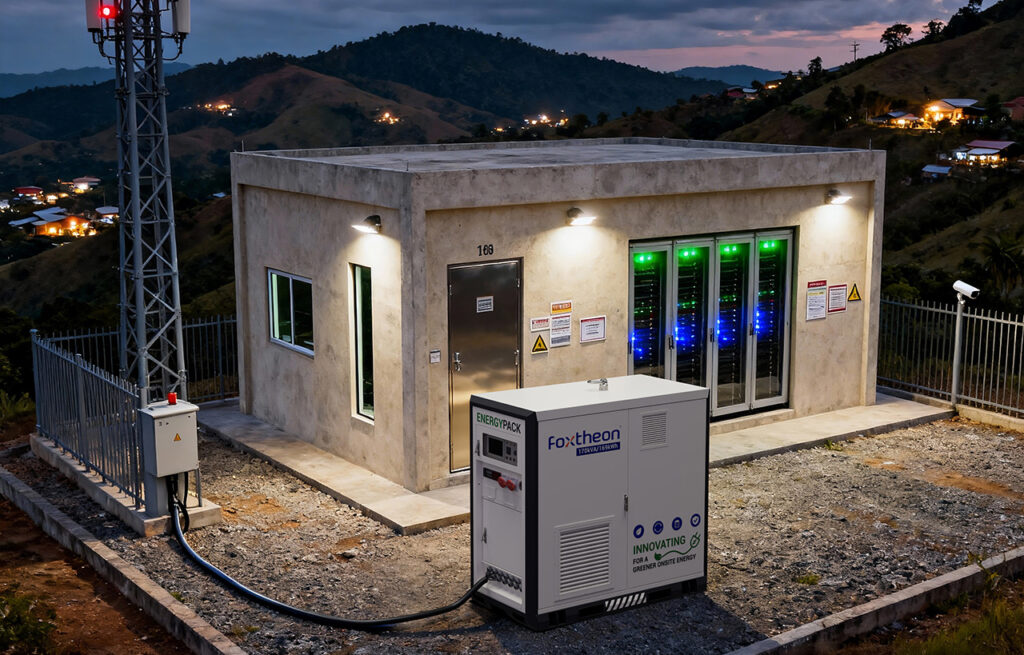
When deploying off grid hybrid power systems in remote regions, innovators like Foxtheon have introduced integrated EMS software that monitors cell-level temperature, voltage, and internal resistance to prevent premature battery degradation.
Active Thermal Management
Remote locations often experience extreme environmental temperatures. High ambient heat accelerates battery capacity fade, while extreme cold reduces round-trip efficiency and slows down charge acceptance. High-quality hybrid enclosures must feature liquid cooling or heavy-duty HVAC systems controlled by the Battery Management System (BMS) to maintain internal temperatures within the optimal 15°C to 25°C window, ensuring both safety and long-term performance.
4. Dynamic Load Balancing and Power Quality Preservation
Industrial loads are rarely linear. The startup of large inductive motors (such as pumps, conveyor belts, and air compressors) creates massive inrush currents that can cause voltage sags and frequency fluctuations in a weak off-grid network. Maintaining power quality is a fundamental requirement for protecting sensitive downstream electronics and control equipment.
The following table outlines the key power quality challenges in off-grid environments and the corresponding mitigation strategies implemented by high-end power controllers:
| Power Quality Issue | Root Cause in Off-Grid Systems | Mitigation Strategy / Technology |
|---|---|---|
| Voltage Sags & Swells | Sudden step-loads or rapid drops in solar irradiance. | High-speed reactive power injection from bi-directional storage inverters. |
| Frequency Deviation | Imbalance between active power generation and dynamic loads. | Inverter-based virtual inertia and fast-response battery dispatch. |
| Harmonic Distortion (THD) | Non-linear loads like variable speed drives (VSDs) and LED lighting. | Active harmonic filtering and high-quality sine-wave output filtering. |
| Phase Imbalance | Uneven distribution of single-phase loads across a three-phase system. | Independent phase regulation via modern multi-phase inverters. |
By integrating fast-acting control loops within the inverters, modern systems can respond to load fluctuations within milliseconds, mimicking the rotary inertia historically provided by massive spinning generators.
5. The Pivotal Role of Smart Energy Management Systems (EMS)
Hardware components alone cannot guarantee a reliable power supply; they require an intelligent coordinating layer. The EMS is the software-driven brain of off grid hybrid power systems, executing complex algorithms in real time to optimize energy dispatch.
Predictive Control and Meteorological Integration
Advanced EMS platforms utilize local weather forecasting data to anticipate solar generation patterns. If the system forecasts a prolonged period of heavy cloud cover, it can preemptively run the diesel generator at its most efficient operating point to charge the storage batteries ahead of time, preventing deep battery discharges during low-solar intervals. Conversely, if a clear, sunny day is anticipated, the EMS will leave sufficient capacity in the battery bank to absorb the coming solar peak.
Remote Monitoring and Telemetry
Remote industrial sites are often difficult to access for routine maintenance. Therefore, a comprehensive telemetry system is highly valuable. Utilizing cellular, satellite, or local fiber networks, the EMS transmits diagnostic data to a centralized operations center. This allows engineers to perform remote firmware updates, run diagnostics on individual battery strings, adjust generator start-stop parameters, and identify potential issues before they escalate into system outages.
Industrial-grade engineered equipment developed by Foxtheon addresses these dual demands, combining rugged, IP-rated hardware with cloud-connected telemetry software designed to simplify site management for non-specialist field operators.
Evaluating the Long-Term Benefits of Hybrid Power Systems
Selecting the right configuration of off grid hybrid power systems depends on the specific operational profile of your site. While some operators prioritize reducing diesel fuel supply logistics, others may focus primarily on establishing clean, silent power for remote research or eco-tourism facilities. By integrating renewable energy storage with backup thermal generation, businesses achieve:
- Enhanced System Resilience: Redundancy across solar, battery, and generator assets minimizes the risk of total site blackouts.
- Reduced Maintenance Overhead: Operating generators at higher average load profiles and fewer total hours extends maintenance intervals and delays engine overhaul schedules.
- Silent Nighttime Operation: The ability to shut down mechanical generators overnight and run entirely on battery storage reduces acoustic noise and emissions during quiet hours.
Frequently Asked Questions
Q1: Can off-grid hybrid systems operate reliably in extreme sub-zero or high-desert environments?
A1: Yes, provided they are housed in specialized enclosures with integrated active thermal management. For sub-zero operations, internal heating blankets and insulated structures prevent battery freezing, while high-desert setups utilize liquid-to-air cooling or industrial HVAC units to maintain battery cells within their rated operating thermal windows.
Q2: How does an AC-coupled hybrid system handle generator synchronization?
A2: When the generator starts, the bi-directional battery inverter measures the generator’s voltage, frequency, and phase angle. It then synchronizes its internal AC output to match the generator’s waveform before closing the coupling contactor, allowing both power sources to support the load in parallel without phase mismatch.
Q3: What is the average lifespan of the battery bank in a heavy-duty industrial hybrid setup?
A3: Utilizing modern Lithium Iron Phosphate (LFP) chemistry, the battery bank can typically last between 10 to 15 years, depending on the daily Depth of Discharge (DoD) and ambient temperature controls. Proper thermal management and charge current regulation are the most important factors for maximizing battery service life.
Q4: How do hybrid power systems respond to sudden high-surge start-up currents from heavy machinery?
A4: Bi-directional battery inverters are engineered with transient surge capacities (often 1.5 to 2 times their continuous rating for several seconds). When a high-inductive load starts, the battery inverter instantaneously discharges power to support the spike, protecting the generator from stalling or tripping due to overcurrent.
Q5: Can existing diesel generator fleets be integrated into a new hybrid system?
A5: Absolutely. Most modern microgrid controllers and EMS platforms are designed to interface with existing generator controllers via Modbus, CAN bus, or dry contacts, allowing older generators to be incorporated into a modern, automated hybrid control loop.
Consult with an Industrial Power Specialist
Implementing a highly stable off-grid power network requires precise engineering, component matching, and a thorough understanding of your site’s specific load behavior. If you are planning to modernize an existing generation setup or establish a new remote power station, integrating highly engineered off grid hybrid power systems into your next project can deliver the reliability and operational efficiency your enterprise demands.
For custom engineering consultations, system sizing requests, and detailed hardware specifications tailored to your remote project, please reach out to the technical engineering team at Foxtheon today.