
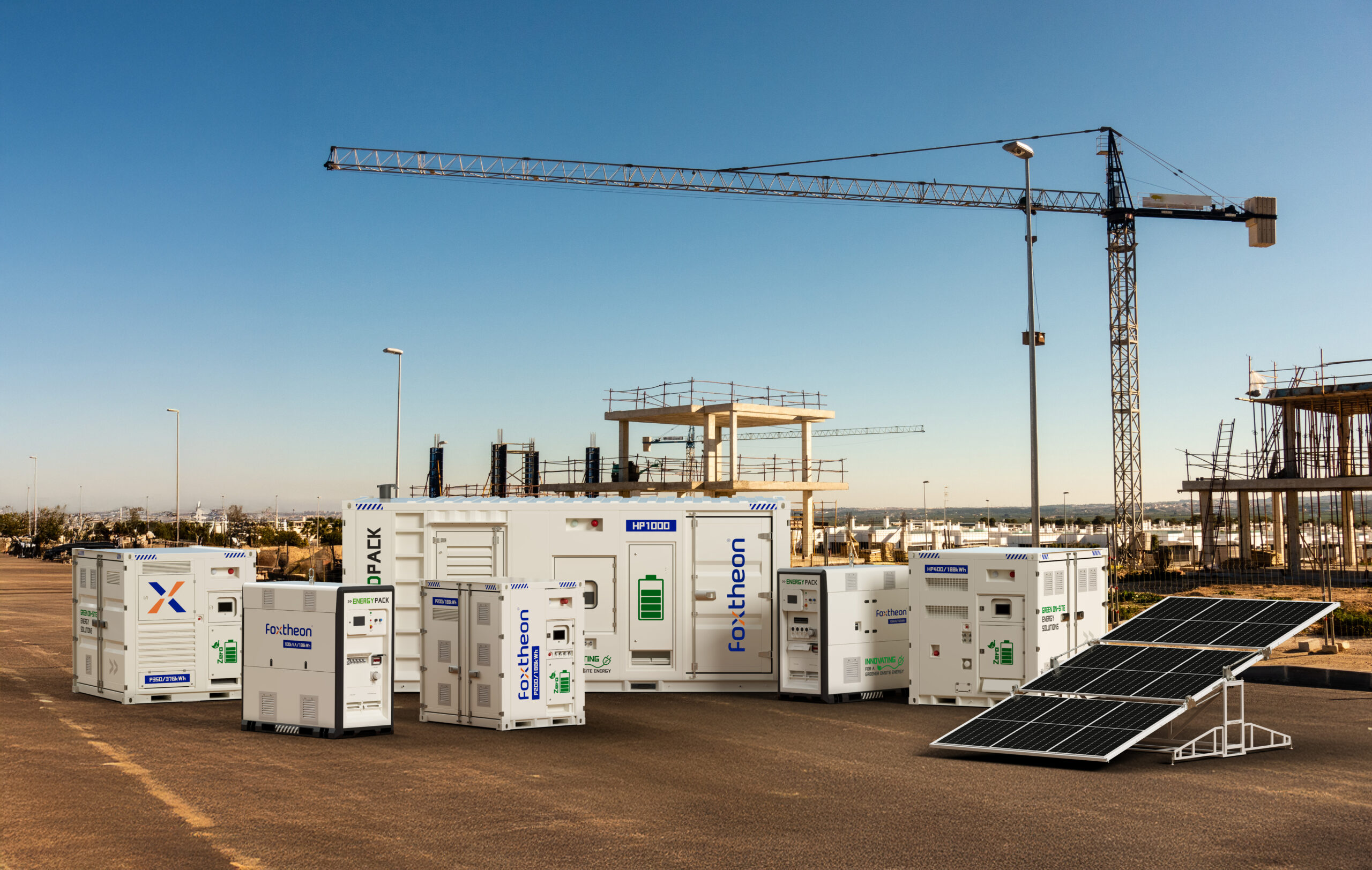
For commercial and industrial (C&I) energy managers, a BESS microgrid (battery energy storage system integrated with local generation and intelligent controls) represents a shift from passive grid dependency to active energy autonomy. Unlike standalone backup generators, a BESS microgrid provides seamless islanding, power quality improvement, and daily economic optimisation through peak shaving and arbitrage. This article examines the core technical layers—component selection, control hierarchy, protection coordination, and financial modelling—that determine success. Drawing from real-world deployments, we also explore hybrid configurations where batteries work alongside existing generators to enhance reliability without replacing proven assets.
Why a BESS Microgrid Outperforms Single-Technology Solutions
A well-designed BESS microgrid combines lithium-ion battery storage, renewable or conventional generation (solar PV, gas gensets), and a master controller. The battery provides instantaneous response to load changes and voltage dips, while generators handle long-duration events. This synergy reduces fuel consumption, lowers maintenance frequency, and maintains power quality during transitions. For facilities facing high utility demand charges or unreliable grid feeders, a BESS microgrid delivers payback periods between four and seven years, depending on local tariffs and interruption costs. Key performance metrics include islanding transition time (<20 ms), round-trip efficiency (>88%), and system availability (>99.9%). Industry leaders such as Foxtheon provide pre-engineered microgrid building blocks that reduce engineering risks and commissioning delays.
Core Components of a BESS Microgrid
Battery Energy Storage System (BESS) Subsystems
- Battery cells and racks: LFP chemistry preferred for C&I due to longer cycle life (6,000–8,000 cycles at 80% DoD) and thermal stability.
- Power conversion system (PCS): Bi-directional inverter with grid-forming capability required for black start and island operation.
- Battery management system (BMS): Cell voltage/temperature monitoring, balancing, and protection.
- Thermal management: Liquid cooling maintains cell delta-T below 3°C, extending calendar life by 20%.
Local Generation and Grid Interface
- Solar PV (optional): DC-coupled or AC-coupled, reducing reliance on stored energy during daylight.
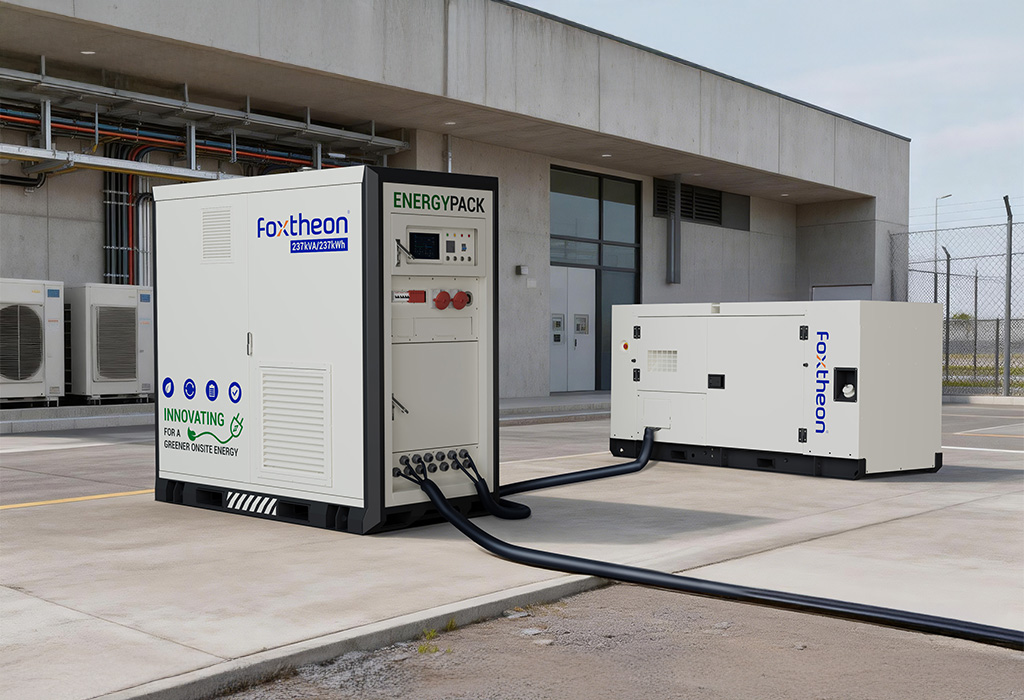
- Existing generators: Retrofitted with automatic transfer switches and remote start signals from the microgrid controller. The BESS microgrid can start generators only when battery SOC drops below a threshold, reducing runtime by 60–80%.
- Point of common coupling (PCC): High-speed static transfer switch (STS) for seamless grid-to-island transition.
Microgrid Controller (MGCC)
The MGCC runs optimisation algorithms: load forecasting, price arbitrage, demand charge management, and reserve allocation. It communicates via Modbus TCP, IEC 61850, or DNP3. A hierarchical control architecture (primary: voltage/frequency droop; secondary: state-of-charge balancing; tertiary: economic dispatch) ensures stable operation. Advanced controllers from Foxtheon include edge-AI that adapts to changing tariff structures and weather forecasts without cloud dependency.
Engineering a BESS Microgrid: Sizing Methodology
Correctly sizing a BESS microgrid requires four sequential steps:
- Load profile analysis: Collect 12 months of 15-minute interval data. Identify peak demand, critical loads (kW and kVA), and duration of typical grid outages.
- Generation assessment: If solar PV is present, simulate hourly production. For generators, note minimum stable load and start-up time (typically 10–30 seconds).
- Battery power and energy sizing: Power rating (kW) determined by the largest single load step or demand charge threshold. Energy capacity (kWh) depends on desired island duration (e.g., 2–4 hours for peak shaving, 8+ hours for resilience). Rule of thumb: C-rate of 0.5C (2-hour) to 0.25C (4-hour) for C&I applications.
- Controller hardware selection: I/O count, communication ports, and processing speed to handle all breakers and sensors.
Oversizing the battery increases upfront cost, while undersizing causes frequent generator starts or load shedding. Most projects benefit from a hybrid approach: battery handles first 15–30 minutes of an outage, then the generator starts. This reduces battery energy requirement by 40–50% compared to a battery-only islanding solution.
Control Strategies for Grid-Connected and Island Modes
Grid-Connected Mode (Normal Operation)
The BESS microgrid operates in parallel with the utility. The controller performs:
- Peak shaving: Discharges battery during preset demand intervals (e.g., 2–6 PM) to reduce monthly demand charges.
- Energy arbitrage: Charges battery during low off-peak rates (e.g., midnight–6 AM) and discharges during high peak rates.
- PV smoothing: Absorbs ramp-rate violations from solar clouds.
- Reactive power support: Adjusts inverter Q setpoint to maintain power factor above 0.95.
Island Mode (Grid Outage)
Upon loss of utility voltage, the static transfer switch opens the PCC. The battery inverter switches from grid-following to grid-forming mode, establishing voltage and frequency references. Critical loads receive uninterrupted power. If the outage extends beyond battery autonomy (e.g., SOC < 20%), the MGCC sends a start command to the on-site generator. The generator synchronises to the island via the battery inverter (virtual synchronous generator function). When grid returns, the controller synchronises and closes the PCC, then transitions back to grid-connected mode. Total transition back is seamless (<100 ms).
Economic Modelling and ROI for BESS Microgrids
Financial justification of a BESS microgrid combines hard savings and value of resilience. Key revenue and saving streams include:
- Demand charge reduction: 20–40% of monthly utility bill. Example: A 500 kW peak reduction at $15/kW saves $90,000 annually.
- Time-of-use arbitrage: $0.08–$0.15 per kWh spread, yielding $20,000–$50,000/year for a 1 MWh system cycling daily.
- Backup fuel savings: Each avoided generator hour saves $0.30–$0.60 per kWh in fuel and maintenance. For facilities with weekly generator tests, a BESS microgrid can replace monthly full-load tests, saving $5,000–$15,000/year.
- Demand response participation: Utility or ISO programs pay $50–$200 per kW-year for peak event readiness.
Total installed cost for a 500 kW / 2 MWh BESS microgrid (including controller, STS, and integration with existing generators) ranges from $500,000 to $800,000. After incentives (e.g., US ITC, state grants), net CAPEX often falls to $350,000–$550,000. With combined annual savings of $80,000–$120,000, simple payback sits at 4–6 years, and the system’s 10–12 year battery life provides strong IRR (12–18%).
Common Design Pitfalls and Mitigations
Based on field audits of 40+ C&I microgrids, three issues frequently undermine performance:
- Inadequate protection coordination: During island operation, fault currents from inverters are limited (2–3x rated current), which may not trip conventional thermal-magnetic breakers. Solution: Use electronic trip units with adjustable curves and install fast-acting current-limiting fuses on battery feeders.
- Neglecting harmonic resonance: Multiple inverters can cause harmonic interactions with transformers. Mitigation: Run impedance scans during commissioning; install passive filters if total harmonic distortion (THD) exceeds 5%.
- Generator compatibility: Older generators with mechanical governors may oscillate when paralleled with fast-responding inverters. Solution: Add a virtual inertia loop in the MGCC or replace the governor with an electronic isochronous controller.
Experienced integrators like Foxtheon include protection studies and hardware-in-the-loop (HIL) testing before shipment, reducing field rework by 70%.
Regulatory and Interconnection Considerations
Grid-connected BESS microgrids must comply with IEEE 1547-2018, UL 1741 SA (grid-support functions), and local utility rules. Key steps: (1) impact study for islanding detection and anti-islanding, (2) metering for export limitation if required, (3) telecommunications for utility remote disconnect. For facilities with existing generators, the microgrid controller must also meet NFPA 110 requirements for emergency power supply systems (EPSS) if serving life-safety loads. Many jurisdictions now offer streamlined permits for microgrids below 1 MW that use UL 9540 listed assemblies.
Frequently Asked Questions (FAQ) About BESS Microgrid
Q1: Can a BESS microgrid operate without solar PV or wind?
A1: Yes. A BESS microgrid can function with battery storage alone, using the utility for charging. During an outage, the battery provides power until either the grid returns or an on-site generator starts. Adding renewables reduces operating costs but is not mandatory. Many early microgrids were battery + generator only.
Q2: What happens if the battery is fully depleted during a long grid outage?
A2: The microgrid controller will automatically start the on-site generator before the battery reaches minimum state-of-charge (typically 15–20%). The generator then powers both the load and recharges the battery. When the generator is running, the battery acts as a spinning reserve. This hybrid strategy ensures continuous power even for multi-day outages without oversizing the battery.
Q3: How does a BESS microgrid integrate with my existing diesel or gas generators?
A3: The microgrid controller connects to the generator’s automatic start/stop contacts and voltage sensing. During an outage, the battery supplies instantaneous power while the generator starts and synchronises. Once online, the controller can either run the generator at a fixed power setpoint (with battery smoothing load steps) or use the generator only for battery recharging. The existing generator retains its original function and is never replaced or downgraded.
Q4: What is the typical lead time for designing and installing a BESS microgrid?
A4: For a 200 kW – 2 MW system, engineering and permitting take 3–5 months. Equipment fabrication (battery containers, switchgear, controller panel) requires 4–6 months. On-site installation and commissioning last 2–4 weeks. Total from signed contract to commercial operation: 8–12 months. Pre-engineered modular solutions from Foxtheon reduce lead time to 5–7 months.
Q5: Does a BESS microgrid require special operator training?
A5: The microgrid controller provides a human-machine interface (HMI) with one-line diagrams, alarm management, and automatic mode switching. Most facility technicians learn basic monitoring within one day. However, advanced parameter tuning (e.g., peak shaving thresholds, SOC reserve levels) should be performed by trained engineers or remotely supported by the integrator. Remote monitoring services are available to handle firmware updates and performance optimisation.
Building a Resilient and Cost-Effective Energy Future
A properly engineered BESS microgrid offers industrial and commercial facilities a measurable path to lower electricity costs, higher uptime, and reduced generator runtime. By combining battery storage’s fast response with existing generator assets, organisations avoid costly replacements while gaining energy independence. The key lies in accurate load analysis, protection coordination, and a controller that balances economic and reliability objectives.
Ready to assess whether a BESS microgrid suits your facility? Submit an inquiry to receive a preliminary feasibility study, including load data analysis, system sizing, and a financial model with local utility tariffs. Our B2B engineering team provides site-specific recommendations without obligation.