
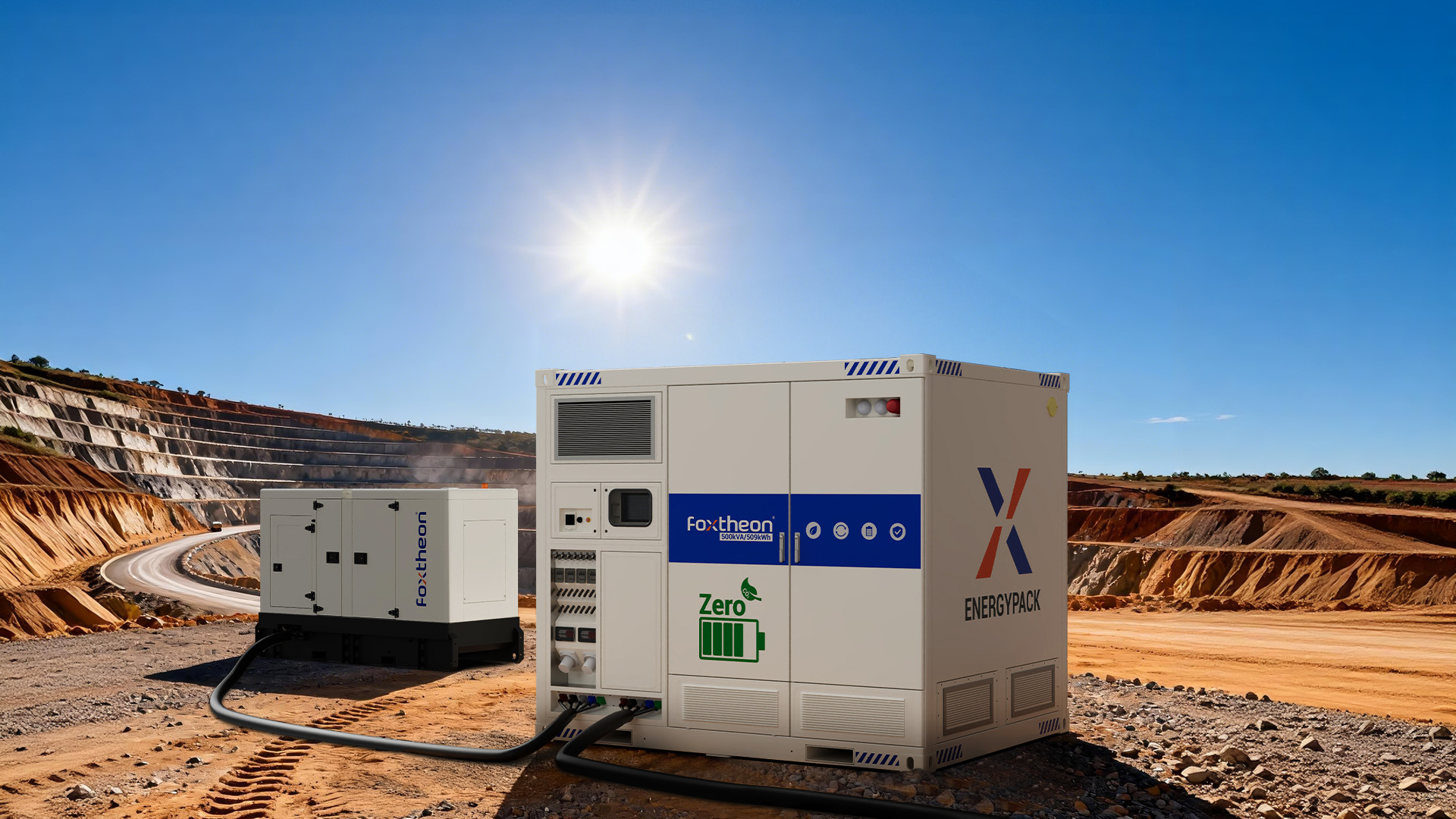
In the rapidly evolving landscape of international energy infrastructure, one of the most persistent technical hurdles for original equipment manufacturers (OEMs), engineering, procurement, and construction (EPC) contractors, and project developers is frequency compatibility. The divide between 50Hz and 60Hz power grids has traditionally forced costly, redundant investments in equipment. However, the emergence of a true global voltage BESS 50/60Hz is redefining procurement strategies and operational efficiency for multinational projects. This article dissects the engineering, applications, and economic rationale behind these universal battery energy storage systems, leveraging real-world data and addressing the specific challenges of operating across frequency domains.
1. The Frequency Divide: A $1.2 Billion Logistics Problem
The global power grid is split between two dominant standards: 50Hz (used in Europe, Asia, Africa, and Australia) and 60Hz (used in North America and parts of South America and Asia). For decades, this has presented a significant barrier to the standardization of energy assets. Shipping a 60Hz BESS to a 50Hz site without a transformer is a recipe for failure, leading to overheating, core saturation, and catastrophic insulation failure.
1.1 The Cost of Dual-Sourcing
Traditionally, international firms were forced to maintain separate inventories and supplier relationships for each frequency zone. This dual-sourcing strategy inflates capital expenditure (CAPEX) by 15-25% and complicates supply chains. A truly global voltage BESS 50/60hz eliminates this friction, allowing a single asset to be deployed in a Canadian mining camp (60Hz) and then redeployed to a European construction site (50Hz) years later, protecting the long-term value of the investment.
2. Deconstructing the Global Voltage BESS Architecture
Not all storage systems claiming global compatibility are created equal. True frequency agility requires a fundamental design philosophy centered on the power conversion system (PCS) and the energy management system (EMS).
2.1 The Role of the Bidirectional Inverter
The heart of any global voltage BESS 50/60hz is its inverter. It must feature a wide DC-link voltage range and software-configurable AC output. This allows the unit to synchronize with any grid or microgrid, regardless of frequency, without hardware modifications. This capability is essential for hybrid systems integrating with existing diesel gensets, which may operate at different frequencies based on their prime mover speed.
2.2 Battery Cell Chemistry and Thermal Management
The choice of battery cells is equally critical. Lithium Iron Phosphate (LFP) chemistry, such as the CATL cells used in systems like the Foxtheon EnergyPack M150, offers the thermal stability and cycle life required for the variable loads and harsh conditions of global project sites. Liquid cooling systems, as opposed to passive air cooling, maintain optimal cell temperatures whether the unit is operating in the 50Hz heat of the Middle East or the 60Hz cold of Northern Canada, ensuring 8000 cycles at 80% depth of discharge (DoD).
3. Application Deep Dive: Where Universal Systems Excel
The economic and operational value of a frequency-agnostic BESS becomes tangible in specific, high-stakes scenarios. Below, we analyze three primary use cases.
3.1 Global Construction & Infrastructure Projects
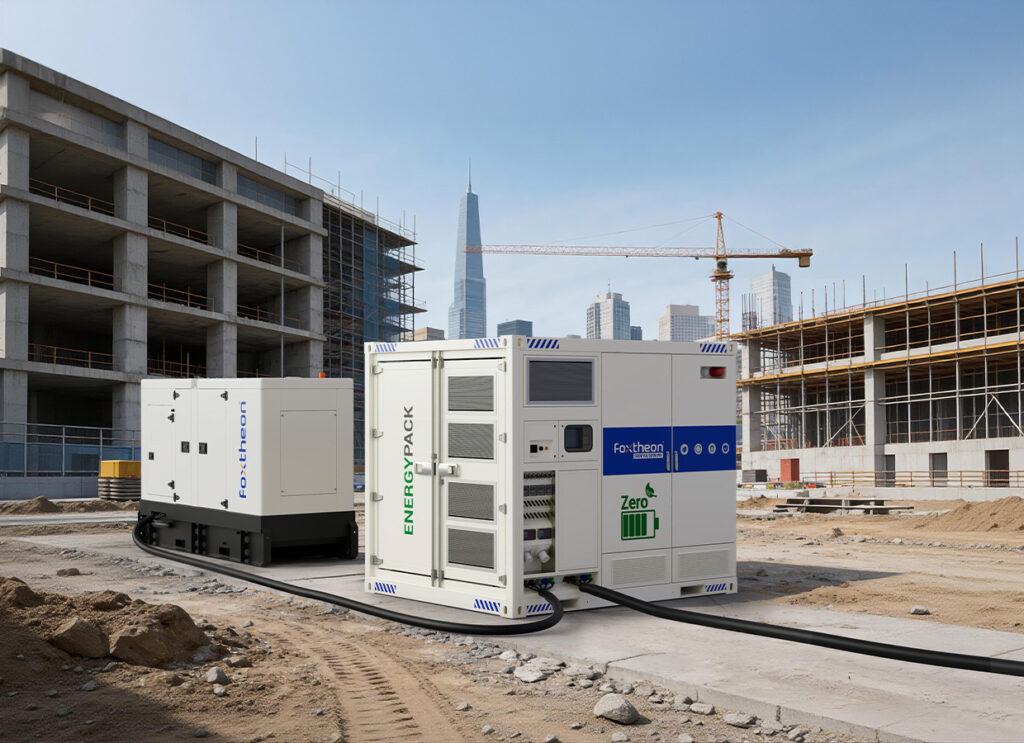
Multinational construction firms like Bechtel or Vinci frequently move heavy equipment between continents. A mobile, containerized BESS that can operate in both frequency regimes is a game-changer for project site electrification.
- Case in Point: A tunnel boring project in South America (60Hz) finishing its phase and relocating equipment to a rail project in Europe (50Hz). Instead of auctioning off the power assets, the Foxtheon unit is simply reconfigured on-site via the FoxMind™ EMS.
- Technical Benefit: These systems handle the high inrush currents of conveyor belts and crushers while providing voltage flicker mitigation, a common issue on weak, genset-only sites.
3.2 Remote Telecom and Data Acquisition
Telecom towers and SCADA systems for pipelines often rely on equipment sourced from different global suppliers, resulting in a mix of 50Hz and 60Hz loads. A global voltage BESS 50/60Hz can power this heterogeneous mix through a single inverter, simplifying the balance of plant.
- Efficiency Metric: By running the genset only at its peak efficiency point to charge the LFP batteries (reducing runtime by up to 80%), fuel consumption plummets. The EnergyPack M150 achieves up to 96.6% system round-trip efficiency, maximizing the value of every drop of diesel or watt of solar input.
3.3 Emergency Response and Temporary Infrastructure
Organizations like the Red Cross or UN agencies require power equipment that can be airlifted anywhere in the world within hours. They cannot afford to wait for a 50Hz or 60Hz specific unit. A frequency-configurable BESS provides immediate, silent power for field hospitals and water purification systems, functioning as a <20ms UPS to protect sensitive medical imaging and laboratory equipment.
4. Overcoming the Economic and Technical Pain Points
Adopting a universal system addresses two major industry pain points: stranded assets and fuel price volatility.
4.1 The Problem of Stranded Assets
In traditional project finance, energy equipment has a “use-by” location. If a project concludes, the BESS often has little resale value if it cannot be migrated to the next project’s grid frequency. A global voltage BESS 50/60hz solves this asset liquidity problem. It retains its value as a truly fungible asset, ready for deployment in the next global tender.
4.2 Mitigating Fuel Price and Logistics Risk
In remote locations, diesel can cost $2-$5 per liter due to transport costs. The ROI of a hybrid BESS is heavily dependent on reducing fuel burn. Frequency-agile systems allow for seamless integration with local solar PV (DC-coupled) and the existing genset, regardless of whether that genset is a 50Hz European model or a 60Hz American model. The FoxMind™ EMS optimizes dispatch in real-time, prioritizing solar and stored energy to shave peak loads and eliminate low-load, inefficient genset operation.
5. Technical Specifications: What to Demand from Suppliers
When procuring a global voltage system, engineers should look beyond the headline capacity (kWh) and power rating (kVA). Specific parameters dictate true global utility.
- Configurable Voltage and Frequency: The unit must support 400V, 480V, and 220V AC at both 50Hz and 60Hz without transformer swaps.
- Wide Operating Temperature: Look for a range of -20°C to +50°C to ensure operability in extreme climates, often enabled by features like PI heating films for the battery pack.
- Scalable Architecture: The system should act as a building block for larger microgrids. The Foxtheon M Series, for example, scales from 150 kVA to 900 kVA, allowing for incremental capacity additions as a project grows.
- Robust Communication Protocols: Support for Modbus TCP/RTU is essential for integration with existing site SCADA or third-party monitoring platforms.
6. The Future is Frequency-Agnostic
As the energy transition accelerates, the demand for equipment that can be deployed globally without modification will only intensify. The global voltage BESS 50/60Hz is not merely a product category; it is a strategic response to the realities of a globalized, decarbonizing economy. By standardizing on a platform like the Foxtheon EnergyPack M150, project developers can de-risk their supply chains, future-proof their investments against project migration, and significantly lower the total cost of ownership (TCO) of their off-grid and grid-edge power infrastructure. The convergence of intelligent EMS software, high-cycle LFP chemistry, and universal power electronics has finally made the truly global energy storage asset a commercial and engineering reality.
Frequently Asked Questions (FAQ)
Q1: Can a 60Hz-rated BESS be safely used on a 50Hz grid without derating?
A1: Traditional 60Hz-only transformers and motors will experience increased magnetic flux at 50Hz, leading to overheating and potentially immediate failure unless significantly derated. However, a purpose-built global voltage BESS 50/60Hz like the Foxtheon EnergyPack M150 is designed with a power conversion system rated for the full power at both frequencies. It automatically detects and configures its output to match the grid frequency, operating at its nominal kVA rating in either regime.
Q2: How does the EMS manage the transition when switching from 50Hz to 60Hz operation?
A2: Modern EMS platforms, such as Foxtheon‘s FoxMind™, manage this through software-configurable parameters. During commissioning, the technician selects the target grid code and frequency (e.g., 480V/60Hz for IEEE 1547 or 400V/50Hz for EU grid codes). The EMS then reconfigures the inverter’s switching algorithms and protection relays to comply with the local standard. This is a deliberate, offline configuration change, not an online “switch.”
Q3: What are the implications for protection coordination when using a global voltage BESS?
A3: Protection coordination remains straightforward, provided the BESS vendor provides accurate data on fault current contribution at both frequencies. The key advantage is that the short-circuit current from the inverter is electronically limited and is largely independent of the AC frequency. This predictability allows protection engineers to set relays and select breakers (e.g., 480V, 60Hz rated breakers on a 400V, 50Hz system) with confidence, knowing the BESS’s behavior is consistent.
Q4: Does operating at 50Hz vs. 60Hz affect the battery cycle life or usable energy?
A4: No, the battery DC characteristics (capacity, cycle life) are independent of the AC output frequency. The 237.5 kWh capacity of the LFP cells remains constant. The cycle life of 8000 cycles at 80% DoD is determined by the battery chemistry, thermal management, and charge/discharge rates (C-rates), not the grid frequency. The AC frequency only affects the output stage of the inverter.
Q5: Can I parallel multiple global voltage BESS units operating at different frequencies?
A5: No. All units paralleled together to form a larger microgrid must operate at the exact same frequency and phase. You cannot parallel a unit configured for 50Hz with one configured for 60Hz. However, a fleet of identical global voltage units, all configured for the same project frequency (e.g., all set to 60Hz), can be paralleled seamlessly using the master-slave controls or droop control algorithms within the EMS.
Q6: How does a global voltage BESS impact the total cost of ownership for a multinational firm?
A6: It reduces TCO through three primary mechanisms: 1) Procurement Efficiency: Bulk purchasing a single SKU for global projects yields volume discounts. 2) Asset Utilization: Units can be redeployed globally instead of being sold as used equipment or sitting idle. 3) Service & Training: Standardized components simplify global spare parts holding and technician training, reducing operational expenditure (OPEX).