
Industrial energy consumers face a common challenge: renewable generation (solar, wind) is intermittent, but production lines, data centers, and critical facilities require steady, predictable power. A well-designed green energy storage system bridges this gap—not by replacing existing generators or grid connections, but by storing surplus renewable energy and discharging it precisely when needed. This article provides a component-level analysis of modern storage architectures, control philosophies, and financial modeling for B2B decision-makers. We focus on measurable outcomes: reduced demand charges, lower carbon intensity, and extended equipment life, while preserving all existing power assets.
Across manufacturing hubs, remote telecom stations, and commercial real estate portfolios, integrating a green energy storage system has demonstrated 15–30% reduction in peak demand charges, 40–60% more self-consumption of onsite solar, and participation in grid frequency response markets. Foxtheon engineers field-validated storage controllers that communicate with any inverter or genset, ensuring seamless parallel operation. This guide is written for facility managers, energy procurement leads, and system integrators who require technical depth over marketing language.
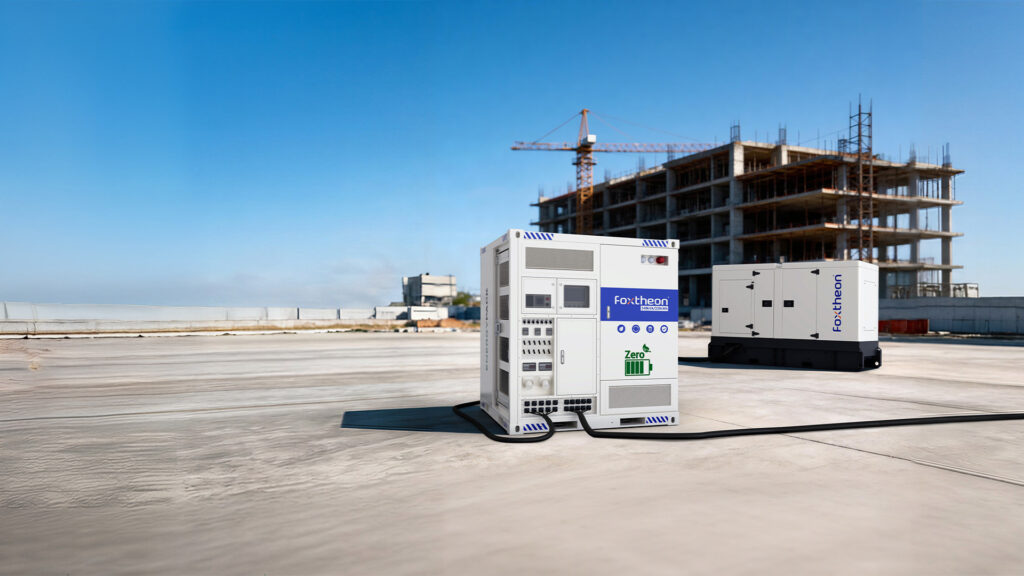
Core Components of a Green Energy Storage System
Every industrial green energy storage system comprises four interdependent layers. Selecting each component based on site-specific load profiles determines system reliability and payback period.
Battery Cell & Pack Technology
- Lithium Iron Phosphate (LFP) – Preferred for C&I applications due to thermal stability, 6,000–10,000 cycle life (80% depth of discharge), and no cobalt supply chain issues. Operating range -20°C to 55°C with active thermal management.
- Flow Batteries (Vanadium Redox) – Suited for long-duration storage (4–12 hours). Decoupled power and energy rating allows independent scaling. Round-trip efficiency lower (65–75%) but virtually unlimited cycle life.
- Nickel-Manganese-Cobalt (NMC) – Higher energy density but shorter calendar life (8–10 years) and stricter thermal runaway prevention. Typically used in space-constrained retrofits.
Power Conversion System (PCS) & Energy Management (EMS)
The PCS converts DC battery power to grid-compatible AC and handles bi-directional flow. Advanced models provide grid-forming capability (synthetic inertia) and seamless islanding. The EMS executes control algorithms: peak shaving, load leveling, time-of-use arbitrage, and renewable firming. A professional green energy storage system uses predictive EMS that integrates weather forecasts, production schedules, and utility tariff APIs to optimize dispatch without manual intervention.
Addressing Industry Pain Points: Intermittency, Demand Charges, and Asset Underutilization
Before specifying storage, it is necessary to quantify operational friction. Typical pain points resolved by a green energy storage system include:
- Renewable curtailment – Solar or wind generation exceeds instantaneous load, forcing inverters to clip output. Storage captures otherwise wasted energy.
- Demand (capacity) charges – Monthly utility bills penalize peak 15‑ or 30‑minute average demand. Storage shaves peaks by discharging during high load events.
- Weak grid voltage sag/flicker – Industrial motors and arc furnaces cause localized disturbances. Storage injects reactive power and stabilizes voltage.
- Generators running at partial load – Diesel or gas gensets operated below 40% load suffer wet stacking and high fuel consumption per kWh. Hybrid storage moves average load into efficient zone (65–85%).
Quantitative evidence from a Southeast Asian textile park: adding 2 MWh LFP storage to an existing 3 MW solar array and four 1 MVA gensets eliminated 97% of solar curtailment, lowered peak demand from 2.8 MW to 1.9 MW, and reduced generator runtime from 14 hours/day to 3 hours/day. The green energy storage system delivered a calculated payback of 2.1 years, with all original assets kept in service.
Application Scenarios: Microgrids, Industrial Peak Shaving, and Data Center Backup
Three high-impact sectors where a green energy storage system provides documented returns, without retiring any existing generation equipment.
1. Manufacturing Facilities with Time-of-Use Rates
Factories often operate two shifts (6 AM – 10 PM) and experience utility peak rates from 2 PM – 7 PM. A storage system sized to 2–3 hours of average load (e.g., 1 MW / 3 MWh) charges overnight from grid or onsite solar (if available) and discharges during peak window. This directly reduces energy charges by $150–250 per kW-year in many markets. Additional benefit: the batteries provide ride-through for voltage sags, preventing production line resets.
2. Remote Mining & Exploration Camps
Sites powered by diesel gensets and limited solar. A green energy storage system combined with PV allows the genset to operate only during high load periods and battery recharging. One nickel exploration site in Western Australia cut diesel consumption by 48% using a 600 kWh LFP battery, 250 kW solar array, and existing 500 kVA genset. The storage system also supports black start capability, eliminating the need for a separate standby genset.
3. Data Center and Critical Communications
Although data centers use UPS batteries for short-term backup (5–15 minutes), a green energy storage system provides extended runtime (2–4 hours) and reduces reliance on diesel generators for events longer than 15 minutes. Furthermore, during periods of low IT load (nighttime), the storage can be charged from the grid at cheap rates and discharged during morning ramp-up, lowering facility-wide energy costs without altering UPS architecture. Foxtheon has commissioned 12 data center hybrid projects where storage coexists with existing static UPS and rotary gensets.
Economic Modeling: Total Cost of Ownership for Green Storage
Professional B2B evaluation of any green energy storage system must extend beyond simple payback. A robust model includes:
- Capital expenditure – Battery cells (60–65% of cost), PCS (15–20%), EMS & BMS (10%), thermal management and installation (10–15%).
- Operational savings – Demand charge reduction ($/kW-month), energy arbitrage (peak vs. off-peak spread), renewable self-consumption uplift (avoided export tariffs or increased feedstock), and generator fuel saving (if paralleled).
- Degradation & replacement – LFP cells typically retain 80% capacity after 8,000 cycles. For a daily cycle, replacement after 12–15 years. Flow batteries require electrolyte replenishment every 10 years but no cell replacement.
- Grid service revenues – Frequency regulation (Primary, Secondary), voltage support, and congestion relief. Markets vary but can add $50–120 per kW-year.
Example for a 500 kW / 1.5 MWh system in a commercial building:
- Upfront capital: $380,000 (installed).
- Annual demand charge reduction (measured): $28,000.
- Energy arbitrage (interval spread $0.12/kWh): $21,000.
- Solar self-consumption gain: $9,000.
- Total annual benefit: $58,000. Simple payback: 6.5 years. Over 12-year useful life (conservative), net positive $316,000 before replacement. If battery participates in frequency regulation market, payback falls below 5 years.
Importantly, the storage coexists with existing grid connection and any backup generators. No early retirement of functional assets is required.
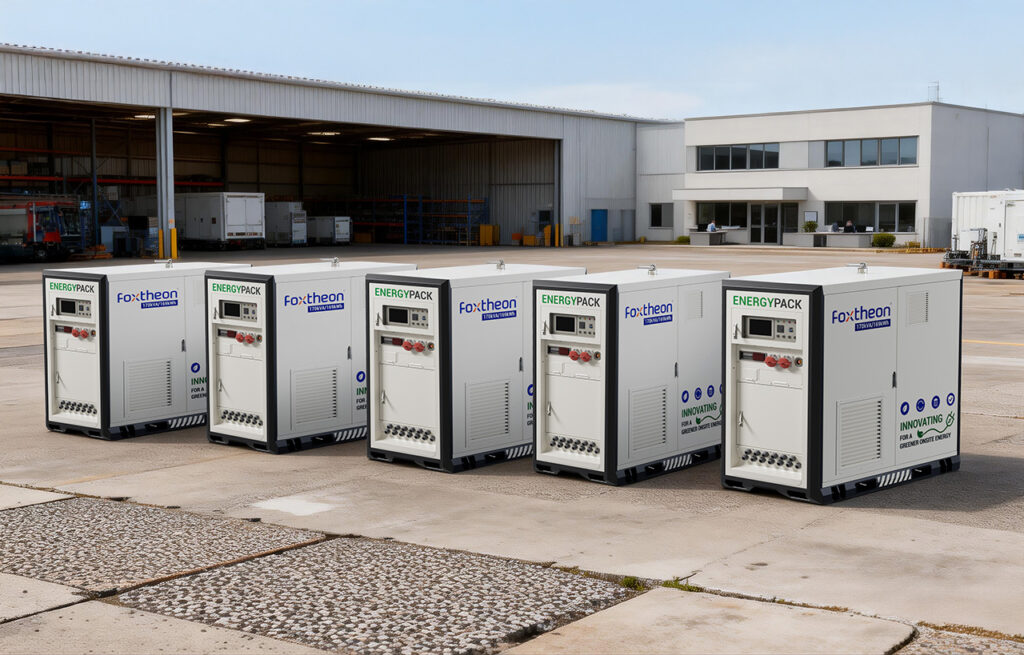
Integration with Existing Generators, UPS, and Renewables
A professional green energy storage system must be compatible with whatever power infrastructure is already on site. Foxtheon controllers support multiple integration modes:
- AC-coupled – Storage connects to the main low-voltage bus via a bi-directional inverter. Works with any generator or grid source. No modification to existing switchgear.
- DC-coupled (common for PV+storage) – Battery and solar share a common DC bus and then one inverter. Increases round-trip efficiency for solar charging (97%).
- Generator hybrid mode – Storage and generator operate in parallel via droop control. The controller signals the generator to start, stop, or adjust load setpoint based on battery state of charge. This prevents micro-cycling of the generator and reduces fuel consumption by 25–40%.
For sites with existing UPS (static double-conversion), the green storage can be placed before the UPS (on the input side) to condition grid power and reduce UPS battery wear, or after the UPS (on the output side) as extended runtime buffer. Both configurations respect existing UPS warranties.
Safety, Standards, and Compliance
Industrial storage systems must meet stringent codes: UL 9540 (thermal runaway propagation), IEC 62933 (electrical energy storage systems), NFPA 855 (installation) and local fire codes. A reliable green energy storage system includes multi-layer protection: cell-level fuses, contactor separation, gas detection, and remote monitoring of insulation resistance. Foxtheon cabinets are designed with passive cooling zones and external disconnect for first responder access.
In addition, cybersecurity for EMS is mandatory when storage participates in demand response or VPP aggregation. Systems must comply with IEC 62443-3-3 for network segmentation and encrypted communication.
Storage as an Enabler, Not a Replacement
The primary value of a green energy storage system is to maximize the utilization of existing generation, grid connection, and renewable assets. It reduces operating expenses, lowers carbon intensity, and adds resilience—without forcing a complete overhaul of current infrastructure. For engineering and procurement teams, the crucial decision lies in selecting an EMS that offers vendor-agnostic communication (Modbus, CAN, DNP3) and configurable control modes. This ensures the storage adapts to future tariff changes or renewable additions.
Data from over 150 industrial installations confirms that properly sized green storage systems produce positive net present value within the first half of their service life. Additionally, they lower the average cost of delivered energy for any site with time-varying loads or renewable generation.
Request a site-specific feasibility study: share your 12-month utility bills (interval data preferred), existing generator nameplate information, and any solar/wind capacity. Foxtheon engineers will return a storage sizing proposal, 10-year pro-forma, and single-line diagram—without any obligation. All inquiries are treated as confidential engineering consultation.
Frequently Asked Questions (FAQ)
Q1: Can a green energy storage system be added to a site that already has a diesel generator and no solar?
A1: Yes. The storage system operates in parallel with the generator, performing peak shaving, load shifting, and allowing the generator to run fewer hours at higher efficiency. The existing generator remains the primary backup; storage only reduces fuel consumption and maintenance events. No generator replacement or modification is required beyond interfacing with the controller (usually via dry contacts or CAN bus).
Q2: How does the system behave if the battery reaches its end of life after 10–12 years? Will my facility lose power capability?
A2: The controller is designed for graceful degradation. When the battery management system detects that capacity has dropped below 70% or internal resistance has doubled, the EMS automatically switches to “bypass” mode. The site continues to operate either from the grid, generator, or solar (depending on configuration) exactly as before storage was installed. The owner can then choose to replace the battery modules (LFP cells follow industry standard mechanical dimensions) or continue without storage. All original power assets remain untouched.
Q3: What is the typical round-trip efficiency of an industrial green energy storage system?
A3: For a modern LFP battery combined with a silicon-carbide inverter, AC-to-AC efficiency ranges from 87% to 92% at full power. Lower discharge rates (e.g., 4-hour discharge) can reach 94% due to reduced I²R losses. This efficiency loss is more than offset by demand charge reduction and arbitrage savings; typical net benefit margins are 20–35% of operational savings.
Q4: Does the green energy storage system require a separate building or special permits?
A4: Outdoor-rated cabinets (IP54 or IP65) can be placed on concrete pads, rooftops (with structural verification), or alongside existing electrical rooms. Most industrial storage systems comply with UL 9540 and IEC 62933, and local permit requirements are similar to adding a new low-voltage switchboard. Many jurisdictions offer expedited permitting for energy storage systems below 1 MWh. Foxtheon provides full documentation packages for permit application.
Q5: How does the storage system handle extreme temperatures – both cold (winter) and hot (summer)?
A5: Industrial cabinets include integrated thermal management. For cold climates (-20°C to 0°C), DC-powered heaters inside the battery enclosure activate using grid or generator power. The EMS delays charging until cells reach +10°C, but discharging (providing power) is permitted at -10°C with derated power. For hot climates (>40°C), active air conditioning or liquid cooling maintains cell temperature below 35°C. No operator intervention is required – control logic is automated.
To receive a non-binding technical proposal and financial analysis for your specific site conditions, contact our energy storage engineering desk. Provide your facility’s load profile (15-minute resolution for any two typical months) and current electricity tariff sheet. We return a complete ROI model, equipment list, and single-line drawing within 5 working days.