
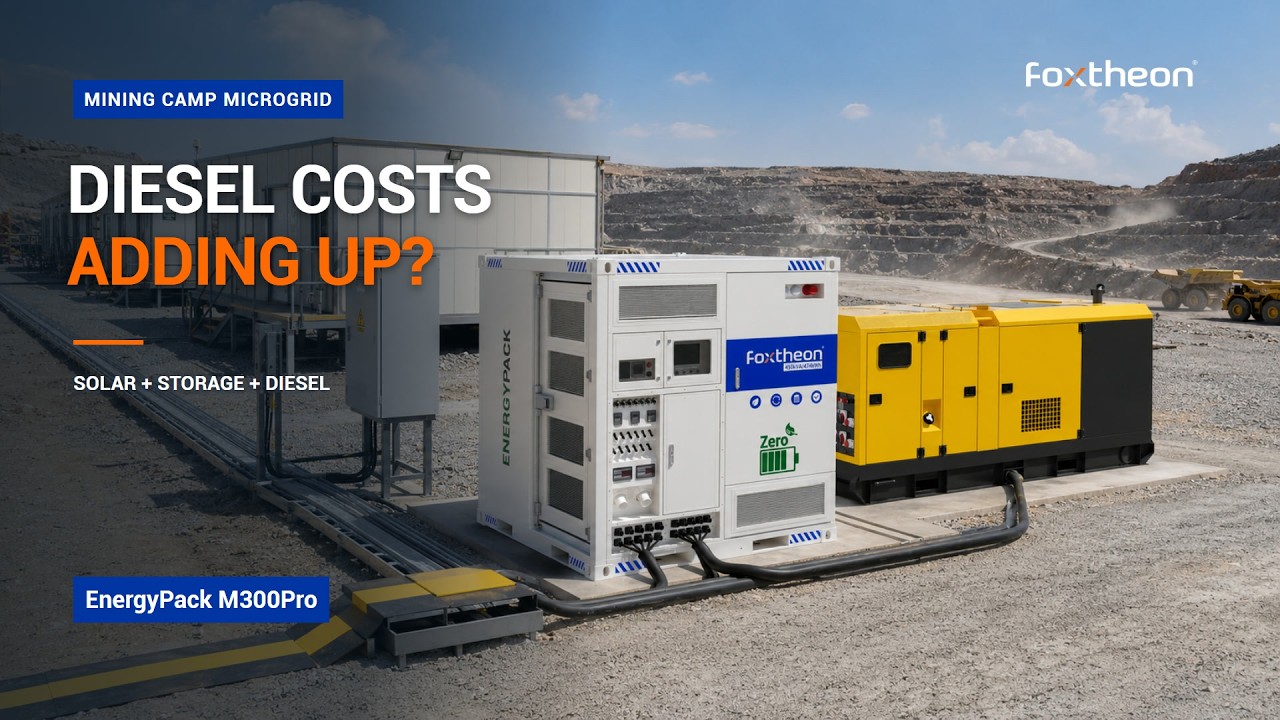
Remote mining camps need power around the clock for cooling, lighting, water supply, communications and other essential services. Their demand changes by the hour, but a diesel-only system may keep a generator running even during low-load periods.
The 3D animation explains a hybrid power solution developed by Foxtheon for a real mining camp customer. Customer and site details are withheld for confidentiality.
The operating challenge at an off-grid mining camp
A remote camp cannot pause essential services when cloud cover reduces solar output or when the battery is recharging. At the same time, keeping a generator online continuously can consume fuel and add running hours when demand is well below the generator’s rated output.
Fuel cost is only part of the issue. Each delivery may involve long transport distances, difficult site access, storage capacity, scheduling risk and the need to maintain a safe reserve. Generator runtime also affects service intervals, spare-parts planning and maintenance labour.
The design problem is therefore not simply to add solar panels or a battery. It is to coordinate variable generation, stored energy, dispatchable diesel power and a changing load while maintaining the required reserve and operating limits.
Mining camp microgrid configuration
The arrangement shown in the video combines four functions:
| System element | Role in the microgrid |
|---|---|
| Solar PV | Supplies part of the daytime load and can provide surplus energy for battery charging. |
| Foxtheon EnergyPack M300Pro | Stores energy and supplies the camp when solar output is below demand or unavailable. |
| Diesel generator | Supplies longer-duration energy when required and can recharge the battery while powering the camp. |
| FoxMind controller | Tracks demand, solar output and battery condition, then coordinates charging, discharging and generator operation. |
The site load remains the priority. The sources change their contribution as solar production, demand and battery state change.
How power flows through the day
1Solar serves daytime loads first
When solar production is available, it contributes directly to the camp’s active loads. This reduces the amount of energy that must come from stored energy or diesel generation.
If solar output is greater than immediate demand, the surplus can charge the EnergyPack M300Pro. The exact charging rate remains subject to battery, inverter and system limits.
2The battery covers the difference
When demand rises above solar output, surplus charging stops. The battery can discharge alongside solar to supply the shortfall.
This is useful because camp loads rarely stay constant. Cooling equipment, pumps and other electrical loads may cycle on and off, while solar output can change with irradiance and weather.
3Stored energy supports the camp after sunset
After solar production falls, the battery can continue supplying the camp. How long it can do so depends on usable battery energy, the evening and overnight load, reserve settings and conversion losses.
A battery’s power rating and energy capacity answer different questions. Power determines how much load it can support at a given moment. Usable energy affects how long it can support that load.
4The generator starts when additional energy is needed
When the system reaches its configured generator-start condition, FoxMind can start the diesel generator. The generator then supplies the camp and can use available capacity to recharge the battery.
The start condition is an engineering setting, not a universal percentage. It may consider battery state of charge, load, reserve requirements, forecast operating conditions, generator constraints and site priorities.
5The system returns to battery-led operation
Once the required battery condition is restored and other control conditions are satisfied, the generator can stop. The battery and available solar resume supplying the load.
This operating sequence changes the generator from a source that must run continuously into one coordinated component of the microgrid.
What FoxMind controls
The built-in FoxMind controller monitors the variables needed to manage the operating sequence shown in the animation. Its role includes deciding:
- When the battery should charge or discharge
- How the battery and solar should share the load
- When the generator should start
- When available generator capacity can recharge the battery
- When operating conditions allow the generator to stop
The practical value comes from coordinated control, not from any one component working alone. A solar array, battery and generator do not form a reliable microgrid simply because they are connected to the same site.
Protection, earthing, switching, communications and generator interfaces must be designed and commissioned for the actual configuration. The 3D animation explains operating principles; it is not an installation wiring diagram.
What this hybrid approach can improve
For a correctly sized and commissioned site, coordinated solar, battery and diesel operation can help:
- Reduce unnecessary generator running hours
- Lower diesel consumption relative to a comparable diesel-only operating strategy
- Use locally generated solar energy after the time it is produced
- Reduce the number or frequency of fuel deliveries
- Limit low-load generator operation
- Improve visibility into power flow and system condition
These are potential operating outcomes, not fixed guarantees. Actual results depend on the site’s load profile, solar resource, generator efficiency, battery settings, environmental conditions and operating discipline.
Data required before system sizing
A credible mining camp microgrid design starts with measured demand and site constraints. The following information should be reviewed before selecting equipment or estimating savings:
| Input | Why it matters |
|---|---|
| Interval load data | Shows base load, peaks, timing and variability that daily energy totals can hide. |
| Critical and non-critical loads | Defines continuity requirements and whether load prioritisation is possible. |
| Daytime and overnight energy use | Helps estimate solar contribution and required usable battery energy. |
| Peak power and motor-starting behaviour | Checks whether the inverter and combined sources can support transient demand. |
| Solar resource and installation constraints | Affects expected PV production, array size and seasonal performance. |
| Existing generator data | Confirms rating, minimum loading, fuel curve, controller interface and operating limits. |
| Fuel logistics and reserve policy | Establishes the operational value of reducing generator runtime and deliveries. |
| Temperature, altitude and dust conditions | May affect equipment ratings, cooling and maintenance requirements. |
| Communications availability | Determines remote monitoring and control options. |
| Required autonomy and contingency strategy | Defines reserve energy and the response to poor solar conditions or equipment outages. |
Nameplate ratings alone are not enough. The system should be checked against a time-based load profile and a defined operating strategy.
What the video does and does not claim
The video demonstrates the configuration and energy-flow logic of a customer solution. It does not publish the customer’s load data, solar capacity, generator rating, fuel use or measured savings.
No fixed fuel reduction or payback period should be inferred from the animation. A site-specific estimate requires a baseline, agreed assumptions and a clear measurement method. The customer and site remain confidential, and the narration was created with AI using a colleague’s voice with permission.
Watch the operating sequence by chapter
| Time | Chapter |
|---|---|
| 0:00 | Why mining camps need off-grid power |
| 0:19 | Adding solar and EnergyPack M300Pro |
| 0:35 | FoxMind control and daytime operation |
| 0:55 | Battery support and power after sunset |
| 1:16 | An integrated mining camp microgrid |
Mining camp microgrid: common questions
Why not use diesel generation alone?
Diesel generation remains useful because it is dispatchable and can provide energy when solar and stored energy are insufficient. The hybrid approach aims to operate it when needed instead of requiring continuous runtime in every load condition.
Can solar power the camp directly?
Yes. Solar can supply active loads while it is available. When production exceeds demand, surplus energy can charge the battery. When it falls below demand, the battery or generator supplies the difference.
Can the battery replace the generator?
Not automatically. The answer depends on load, battery power and usable energy, solar production, required autonomy and contingency requirements. Many remote mining applications retain a generator for extended low-solar periods, high demand and backup.
What triggers the generator to start?
The generator starts according to the configured control strategy. Inputs can include battery state of charge, current demand, reserve requirements and equipment operating limits. The correct thresholds are project-specific.
How much diesel can a mining camp microgrid save?
There is no responsible fixed answer without site data. Savings depend on the baseline generator operation, load profile, solar resource, battery sizing, control settings, generator efficiency and seasonal conditions. Measure the result against an agreed baseline after commissioning.
Plan an off-grid mining power system
Foxtheon develops hybrid power systems that coordinate battery storage, generators, solar and intelligent energy management for remote and industrial applications.
To assess a mining camp project, bring the interval load profile, generator information, solar resource, operating schedule, site conditions and fuel logistics. Foxtheon can help define the required power, usable energy, control strategy and commissioning scope.
Published by: Foxtheon Editorial Team Technical review: Foxtheon Energy Technical Team Video source: How a Mining Camp Microgrid Works | Foxtheon EnergyPack M300Pro, published 20 October 2026.
Performance is project-specific. Actual fuel consumption, generator runtime, solar contribution and battery operation depend on load, system sizing, environmental conditions, equipment settings and operating practice.