
The transition toward decentralized, resilient energy systems has highlighted the importance of commercial and industrial energy storage technology. Industrial utility-scale and commercial-grade systems rely on sophisticated engineering to balance load demands, integrate renewable sources, and provide back-up electricity during grid anomalies. Understanding the deep technical specifications of electric power storage devices is necessary for system integrators, procurement managers, and electrical engineers looking to optimize capital expenditures and operational longevity.
Modern electrical infrastructure requires storage solutions that offer high energy density, thermal stability, and seamless integration with existing power distribution panels. Rather than viewing these units as stand-alone batteries, industry professionals treat them as complex systems containing electrochemical cells, advanced power conversion systems (PCS), intelligent monitoring units, and active thermal management architectures.
Electrochemical Chemistries: Deciding the Core Storage Medium
The performance of industrial electric power storage devices depends heavily on the underlying electrochemical cell chemistry. While several chemistries exist, two primary lithium-ion variations dominate the commercial market, alongside emerging alternatives.
Lithium Iron Phosphate (LiFePO4 / LFP)
LFP has become the dominant chemistry for stationary energy storage applications. This preference is driven by its molecular stability, safety profile, and prolonged cycle life.
- Thermal Runaway Threshold: LFP cells exhibit a high thermal runaway temperature (typically around 270°C), reducing the likelihood of catastrophic fire events.
- Cycle Life: LFP cells routinely deliver between 4,000 to 6,000 cycles at 80% Depth of Discharge (DoD) before capacity degrades to 80% of its original rating.
- Chemical Composition: By avoiding cobalt and nickel, LFP reduces exposure to volatile raw material supply chains, providing a more stable pricing structure for large-scale procurement.
Lithium Nickel Manganese Cobalt Oxide (NMC)
NMC chemistry is selected when space constraints require higher volumetric and gravimetric energy density.
- Energy Density: NMC offers significantly higher energy density (typically 150–220 Wh/kg) compared to LFP (90–160 Wh/kg).
- Thermal Considerations: The thermal runaway threshold for NMC is lower (around 210°C), requiring more complex and rigorous liquid cooling architectures and monitoring systems.
- Application Suitability: Ideal for space-constrained urban microgrids or mobile energy storage units where footprint and weight are primary design constraints.
Solid-State and Flow Battery Alternatives
For ultra-long duration storage (typically 6 to 12+ hours), vanadium redox flow batteries (VRFB) present an alternative. These systems store energy in external liquid electrolyte tanks, separating power output (determined by the stack size) from energy capacity (determined by the tank volume). While flow batteries exhibit virtually zero degradation over decades, their low round-trip efficiency (around 65-75% compared to lithium-ion’s 85-92%) and large physical footprint limit their use in standard commercial applications.
System-Level Architecture: BMS, PCS, and Thermal Control
A reliable energy storage system consists of multiple subsystems working in unison to manage power flow safely and efficiently.
Power Conversion Systems (PCS)
The PCS acts as the bidirectional interface between the battery strings (DC) and the facility or utility grid (AC). Modern PCS units utilize high-efficiency silicon carbide (SiC) or insulated-gate bipolar transistor (IGBT) topologies to minimize switching losses. Key functional requirements of the PCS include:
- Four-Quadrant Operation: The capability to import or export both active power (Watts) and reactive power (VARs) to support voltage regulation and power factor correction.
- Grid-Forming vs. Grid-Following: Grid-following inverters lock onto an existing utility frequency signal. Grid-forming inverters can establish an independent local voltage and frequency reference, allowing local systems to operate in islanded mode during utility outages.
Battery Management Systems (BMS)
The BMS is the primary safety and operational controller of electric power storage devices. Industrial systems utilize a three-tiered BMS architecture:
- Local Slave Units (BMU): Monitor individual cell voltages, surface temperatures, and balancing currents.
- String Master Units (SBMS): Manage complete series-connected strings of batteries, monitoring total string current, isolating faulted strings, and coordinating balancing.
- System Master Unit (MBMS): Interfaces directly with the external Energy Management System (EMS), managing civil safety interlocks, fire suppression triggers, and high-voltage contactor controls.
Through manufacturers like Foxtheon, advanced BMS configurations integrate active balancing protocols to equalize charge distribution across cells, preventing early degradation of weaker cells and maximizing the usable energy capacity of the overall system.
Thermal Management
Temperature fluctuations accelerate cell degradation and introduce safety hazards. Thermal management is divided into two main categories:
- Forced Air Cooling: Utilizes structured ducting and variable-speed fans to pull heat away from cell surfaces. This system is cost-effective to implement but can result in temperature gradients across large battery racks.
- Liquid Cooling: Employs closed-loop chillers that circulate a water-glycol mixture through internal cold plates directly contacting the battery cells. Liquid cooling maintains a temperature deviation of less than 2°C across the pack, which extends battery life and improves thermal runaway prevention.
Commercial and Industrial Application Scenarios
Deploying electric power storage devices is guided by specific operational demands and financial objectives. Commercial facilities utilize these devices to mitigate grid risks and optimize electricity usage.
Peak Shaving and Demand Charge Mitigation
Industrial facility utility bills often consist of energy consumption charges (kWh) and demand charges (kW), based on the highest 15-minute average power draw during a billing cycle. By deploying storage systems, the facility can discharge energy during peak operation periods, effectively flattening the demand curve and lowering utility bills.
Hybridization with Existing Diesel Generator Assets
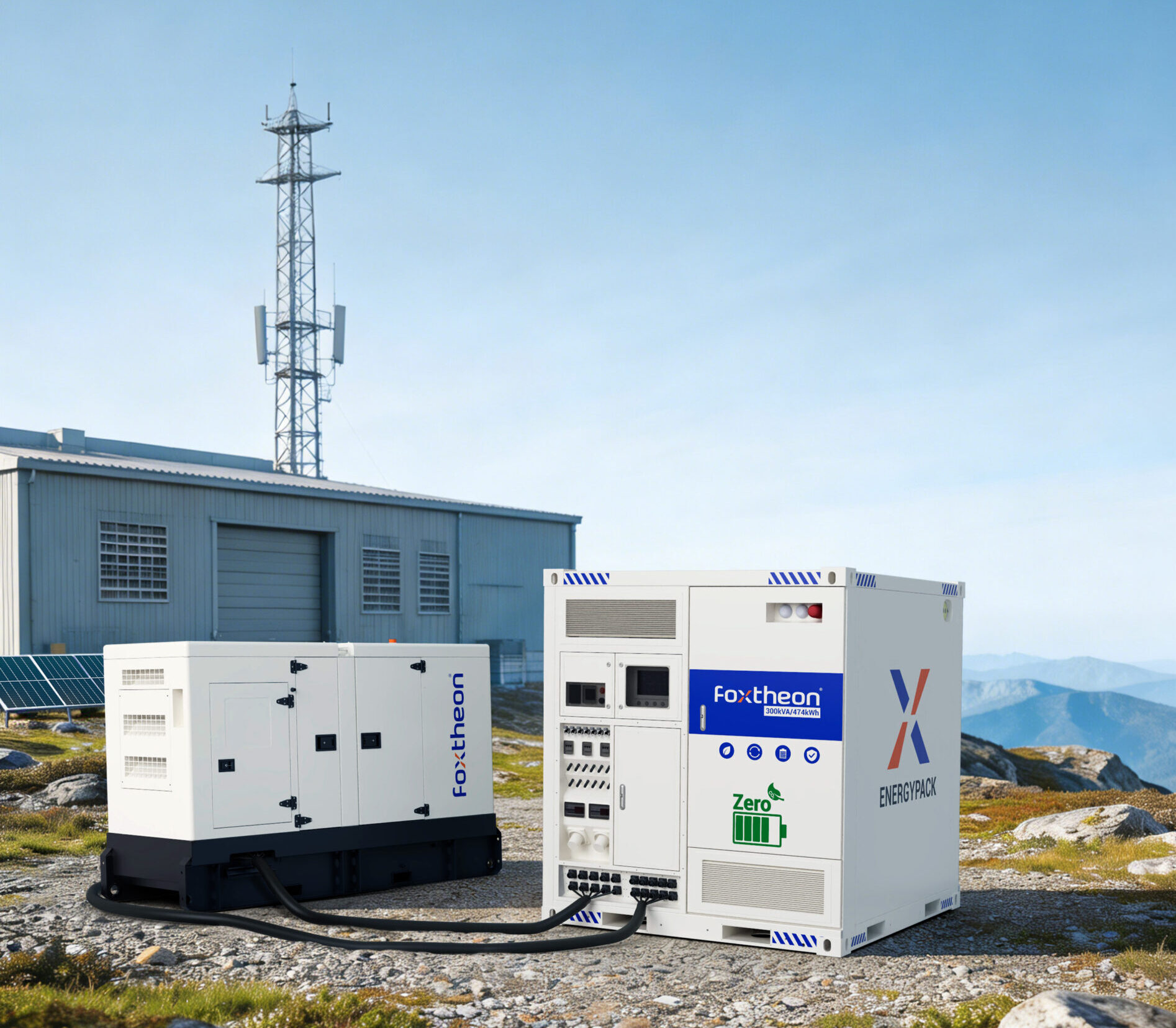
In off-grid and weak-grid environments, facilities have historically relied on diesel generators to handle variable loads. Operating a generator at low loads (less than 30-40% of its rated capacity) causes fuel wet-stacking, increased maintenance costs, and reduced efficiency. By integrating electric power storage devices, the battery system can absorb sudden load steps and store excess energy when the generator runs at its optimal efficiency curve. This hybrid configuration, optimized by systems engineered by Foxtheon, extends generator lifespan and reduces fuel consumption without compromising site reliability.
Microgrids and Renewable Energy Integration
Intermittent solar PV arrays can cause voltage fluctuations when cloud cover suddenly drops generation. Energy storage systems act as a buffer, smoothing out these rapid generation swings. In microgrid setups, these storage devices stabilize the system by absorbing excess solar power during midday and discharging it during peak evening loads.
Sourcing, Sizing, and Technical Selection Criteria
Selecting the appropriate energy storage system requires careful analysis of operational parameters, environmental conditions, and standards compliance.
| Parameter | C&I Application Focus | Technical Target Metric | Primary Sourcing Considerations |
|---|---|---|---|
| C-Rate | Peak Shaving / Frequency Response | 0.5C to 2C (High power output relative to capacity) | Ensure cell chemistries support continuous high-rate discharge without accelerated thermal degradation. |
| Round-Trip Efficiency (RTE) | Energy Arbitrage / Grid Support | >88% AC-to-AC Efficiency | Evaluate auxiliary losses from liquid chillers, HVAC, and conversion losses in the PCS. |
| IP Enclosure Rating | Outdoor Industrial Deployment | IP54 / NEMA 3R Minimum | Verify corrosion resistance certificates for coastal or high-humidity manufacturing zones. |
When selecting electric power storage devices, engineers must ensure the equipment complies with local and international safety standards. The primary certifications include:
- UL 1973: Safety standard for batteries in stationary, vehicle auxiliary power, and light electric rail applications.
- UL 9540A: Test method for evaluating thermal runaway fire propagation in battery energy storage systems, ensuring that any single-cell runaway event does not propagate to adjacent cells.
- IEC 62619: Safety requirements for secondary lithium cells and batteries used in industrial applications.
Working with reliable system integrators like Foxtheon ensures that these compliance standards are integrated into the product design from the early manufacturing stages, simplifying local permitting and insurance approval processes.
Supply Chain Dynamics and Pricing Variables
The procurement pricing of industrial battery storage is determined by several factors beyond cell raw materials. While lithium carbonate prices directly impact the bill of materials, system integration overhead, thermal management design, safety components, and logistics also play major roles.
To secure reliable pricing structures, procurement teams should evaluate suppliers on their supply chain integration. Manufacturers that design and assemble their own BMS and thermal enclosures in-house often provide more stable pricing and longer warranty support. This integration also minimizes software compatibility issues during installation, reducing commissioning timelines from weeks to days.
Frequently Asked Questions
Q1: What is the differences between active and passive cell balancing in battery storage devices?
A1: Passive balancing dissipates excess energy from high-voltage cells as heat through a resistor, bringing them down to the level of lower-performing cells. Active balancing redistributes energy from high-voltage cells to low-voltage cells using capacitive or inductive shuttle circuits. Active balancing is more efficient and minimizes heat generation within the battery pack, though it requires more complex control electronics.
Q2: How does temperature affect the lifespan of LFP electric power storage devices?
A2: LFP chemistry performs best within a temperature range of 15°C to 25°C. Operating batteries consistently above 45°C accelerates the degradation of the solid electrolyte interphase (SEI) layer, which increases internal resistance and permanently reduces capacity. Conversely, charging cells at temperatures below freezing (0°C) can cause lithium plating on the anode, creating internal short-circuit risks.
Q3: What is the significance of the UL 9540A test report during the commercial permitting process?
A3: A UL 9540A test report provides authority-having jurisdictions (AHJs) and local fire departments with detailed empirical data on how a battery system behaves during a thermal runaway event. This report details gas composition, flame propagation speed, and heat release rates. If a system passes UL 9540A without propagating fire between adjacent battery modules, local authorities are much more likely to approve indoor installations or installations with smaller structural setbacks.
Q4: How do grid-forming inverters differ from grid-following inverters in hybrid setups?
A4: Grid-following inverters require an existing external voltage and frequency signal from the utility grid to synchronize and export power. Grid-forming inverters behave as virtual synchronous machines, establishing their own voltage and frequency references. This allows the system to support a microgrid independently during utility outages and manage load fluctuations without relying on external grid references.
Q5: What is the typical round-trip efficiency of a complete AC-coupled energy storage system?
A5: The round-trip efficiency (RTE) of a complete AC-coupled system usually ranges from 85% to 90%. This metric accounts for all losses along the power path, including bi-directional conversion losses in the PCS, resistive losses in cabling, power consumed by the BMS, and auxiliary power consumption from liquid cooling chillers, fans, and control circuits.
Technical Inquiry and Engineering Consultation
Selecting the appropriate technical specifications for industrial-grade energy storage systems requires comprehensive engineering planning. If your organization is designing an industrial microgrid, integrating renewable energy assets, or optimizing facility peak demand profiles, please connect with our technical engineering team.