
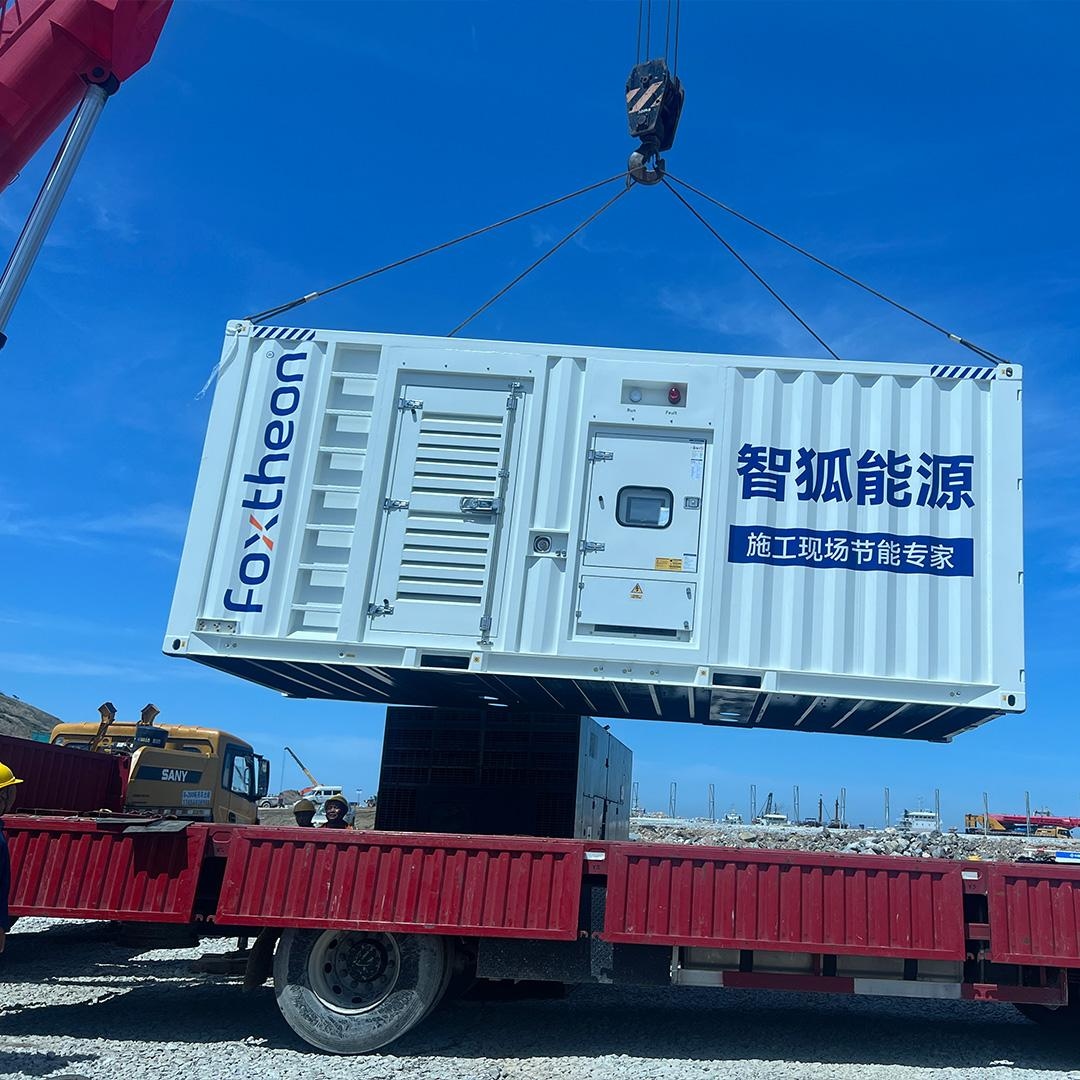
Can a hybrid generator handle sudden peak loads without being oversized for the rest of the day? This engineering explainer shows how the Foxtheon HybridPack HP1000 combines battery storage, diesel generation and local energy management to support demanding construction and remote industrial sites.
The central principle is simple: peak demand is not the same as continuous demand. A reliable system should be sized from the complete load profile—not from one maximum kW figure.
How the HP1000 responds to sudden peak loads
Heavy equipment can create short, high-impact loads during start-up or rapid operating changes. In a hybrid generator, the battery system responds quickly to support the load while the diesel generator supplies sustained power and recharges the battery when required. This power-sharing approach helps the site accommodate transient demand without forcing the generator to run continuously at an inefficient size.
For engineers and project planners, the practical inputs are:
- maximum or peak load in kW or kVA;
- normal continuous load;
- daily energy demand in kWh;
- motor start-up, inrush or impact-load characteristics; and
- site temperature, altitude and other environmental conditions.
Why variable demand affects generator fuel efficiency
Remote sites rarely operate at a constant load. A generator selected only for the highest possible peak may spend long periods at low load. The HP1000 hybrid architecture allows battery storage and the generator to share demand under the control of a local energy management system (EMS). During lower-demand periods, stored energy can supply the load and reduce unnecessary generator operation. When demand rises or the battery needs charging, the generator can operate in a more useful range.
Actual fuel use and generator runtime depend on the measured load profile, controls, operating strategy and approved project configuration. A site assessment is therefore more reliable than a generic fuel-saving percentage.
Local EMS control and site deployment
The local EMS coordinates battery and diesel power so the system can respond to changing demand without requiring operators to manage every power source separately. Deployment planning should also cover transport, lifting, electrical connections, commissioning and the interfaces between the HP1000, the load and any additional power sources.
Environmental derating matters as well. High altitude, high ambient temperature, dust, moisture and other harsh-site factors can affect available power and thermal performance. Final selection should always use project-specific conditions and current Foxtheon technical documentation.
Battery safety and protection
A hybrid power system needs protection at multiple levels. The video explains the role of battery monitoring, thermal management, electrical protection and system control in maintaining safe operation. Correct installation, commissioning and maintenance remain essential for every site.
Where this hybrid generator approach is used
The HP1000 is intended for high-demand off-grid and temporary-power applications with changing or impact-heavy loads, including construction, piling, marine works, mining and remote infrastructure. The same load-profile method also applies to cranes, pumps, compressors and other motor-driven equipment.
Explore Foxtheon’s HybridPack HP1000, see hybrid power systems for construction sites, or review hybrid power for mining and remote industrial sites.
Video chapters
- 00:00 — Why remote sites are difficult to size
- 00:25 — Six practical hybrid-power questions
- 00:35 — Sudden loads and one-step load response
- 01:20 — Variable demand and generator efficiency
- 02:15 — Generator, battery and EMS operation
- 03:10 — Deployment and site integration
- 03:55 — Harsh environments and derating
- 04:45 — Battery safety and protection layers
- 05:35 — Real-world load cases
- 06:15 — Start with load data, not generator size
Frequently asked questions
Can a hybrid generator handle sudden peak loads?
Yes, when the battery inverter, generator and controls are correctly sized for the site’s transient and sustained demand. The battery can respond quickly to short peaks while the generator supports longer-duration power.
What data is needed to size a hybrid generator?
Use peak load, continuous load, daily energy demand, start-up characteristics and site conditions. A time-based load profile is more useful than a single maximum-power number.
Does a battery always reduce diesel consumption?
Not automatically. Results depend on load variation, generator size, operating hours, control settings and site conditions. The strongest opportunities usually occur where a generator would otherwise run oversized or at low load for long periods.