
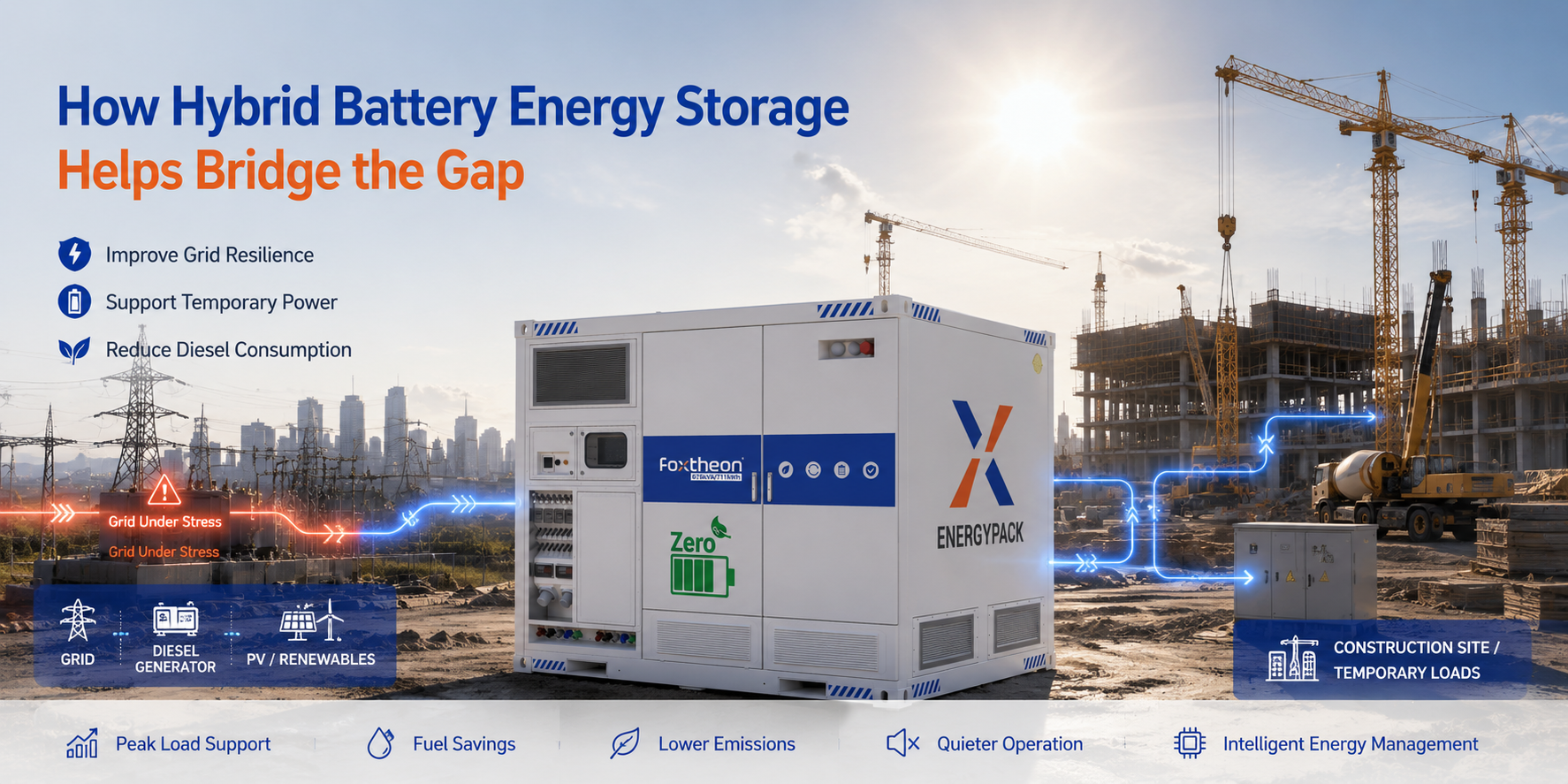
As extreme heat drives electricity demand to record highs, utilities and businesses face growing pressure on already constrained power grids. While expanding grid infrastructure can take years, energy demand is increasing today. Hybrid Battery Energy Storage Systems (Hybrid BESS) are emerging as a practical solution for improving grid resilience, supporting temporary power, and reducing reliance on diesel generation during periods of peak demand.
Rising Temperatures Are Creating a New Power Challenge
Across Europe, North America, the Middle East, and parts of Asia-Pacific, heatwaves are becoming longer, more frequent, and more intense.
As temperatures rise, electricity demand increases rapidly. Air conditioning systems, cooling equipment, data centres, manufacturing facilities, hospitals, EV charging infrastructure, and commercial buildings all consume significantly more electricity during prolonged periods of extreme heat.
For many regions, the challenge is no longer generating enough electricity—it is delivering enough capacity exactly where and when it is needed.
During peak demand periods, local distribution networks can become heavily loaded, temporary grid constraints may occur, and infrastructure projects requiring additional electrical capacity often experience delays while waiting for permanent grid upgrades.
As climate conditions continue to evolve, power resilience is becoming just as important as power availability.
Why Grid Expansion Cannot Keep Pace
Expanding electrical infrastructure is a long-term process.
Increasing transformer capacity, building new substations, reinforcing transmission lines, and obtaining regulatory approvals often require several years before additional capacity becomes available.
Electricity demand, however, does not wait.
Construction projects begin before grid upgrades are complete. Industrial facilities expand production faster than utilities can reinforce local networks. Temporary events, emergency response operations, and seasonal cooling demand create sudden increases in electricity consumption that existing infrastructure was never designed to support.
This growing gap between infrastructure development and real-world demand is driving greater interest in flexible temporary power solutions.
The Limitations of Conventional Temporary Power
Diesel generators remain one of the most widely used solutions when grid capacity is unavailable or insufficient.
While dependable, generator-only systems are not always the most efficient approach for today's operating environments.
Power demand rarely remains constant. Equipment starts and stops throughout the day, cooling systems cycle continuously, and electrical loads fluctuate depending on weather conditions and operational requirements.
Because generators are typically sized for maximum demand, they often spend long periods operating at relatively low load. This reduces fuel efficiency, increases engine wear, and results in higher operating costs.
In addition, continuous generator operation contributes to higher emissions, increased noise, and more complex fuel logistics—particularly on construction sites, urban infrastructure projects, and critical public facilities.
The Limitations of Conventional Temporary Power
Diesel generators remain one of the most widely used solutions when grid capacity is unavailable or insufficient.
While dependable, generator-only systems are not always the most efficient approach for today's operating environments.
Power demand rarely remains constant. Equipment starts and stops throughout the day, cooling systems cycle continuously, and electrical loads fluctuate depending on weather conditions and operational requirements.
Because generators are typically sized for maximum demand, they often spend long periods operating at relatively low load. This reduces fuel efficiency, increases engine wear, and results in higher operating costs.
In addition, continuous generator operation contributes to higher emissions, increased noise, and more complex fuel logistics—particularly on construction sites, urban infrastructure projects, and critical public facilities.
| Aspect | Generator-Only Solution | Hybrid Battery Energy Storage (Hybrid BESS) |
|---|---|---|
| Fuel Efficiency | Lower efficiency under fluctuating loads | Optimizes generator runtime and reduces fuel consumption |
| Peak Load Handling | Requires oversized generators | Battery supplies short-duration peak loads |
| Operating Costs | Higher fuel and maintenance costs | Lower fuel use and reduced maintenance |
| Noise | Continuous generator operation produces higher noise | Battery operation significantly reduces noise during low-load periods |
| Emissions | Higher CO₂ and exhaust emissions | Lower emissions through optimized energy management |
| Flexibility | Limited adaptability to changing demand | Automatically adjusts to real-time load variations |
How Hybrid Battery Energy Storage Supports Grid Capacity
Rather than replacing existing power sources, Hybrid Battery Energy Storage Systems (Hybrid BESS) work alongside generators, renewable energy, and the electrical grid to improve overall system performance.
Battery storage responds instantly to sudden increases in electricity demand, supplying short-duration peak loads while allowing generators or grid connections to operate more efficiently.
When demand decreases, stored energy can continue supplying the load independently, reducing unnecessary generator runtime and lowering fuel consumption.
This intelligent operating strategy helps organizations:
- Support temporary power where grid capacity is limited
- Reduce diesel fuel consumption and operating costs
- Improve voltage and frequency stability
- Handle short-term peak loads without oversizing generators
- Increase operational resilience during periods of grid stress
- Reduce emissions and site noise
For projects facing uncertain or changing power requirements, Hybrid BESS offers both flexibility and reliability.
Why the Foxtheon EnergyPack M600 Is Built for High-Demand Applications
Large temporary power projects require more than simply storing electricity. They require intelligent energy management capable of adapting to rapidly changing operating conditions.
The Foxtheon EnergyPack M600 has been developed to meet these challenges.
With 675 kVA rated output and up to 948 kWh battery capacity, the M600 provides high-capacity energy storage suitable for demanding temporary power applications where grid capacity is limited or unavailable.
At the heart of the system is the FoxMind™ Energy Management System (EMS), which automatically coordinates battery storage, diesel generators, renewable energy sources, and grid power.
By continuously monitoring electrical demand, the system optimizes energy dispatch in real time, helping operators reduce fuel consumption while maintaining stable and reliable power.
Its compact containerized design also enables rapid transportation, installation, and deployment, making it suitable for temporary infrastructure projects, emergency operations, and large industrial sites.
EnergyPack M600 Highlights
• 675 kVA rated output
• Up to 948 kWh battery capacity
• Intelligent FoxMind™ Energy Management System (EMS)
• Containerized design for rapid deployment across temporary power applications
Designed for Reliable Performance in Extreme Conditions
Heatwaves place additional stress on every component of a power system.
To ensure reliable operation in demanding environments, the EnergyPack M600 incorporates an industrial liquid-cooling thermal management system capable of supporting operation across ambient temperatures ranging from -20°C to +50°C.
Combined with intelligent monitoring and integrated system protection, the M600 helps maintain stable performance throughout extended deployments, even when operating conditions become increasingly challenging.
Building More Resilient Power Systems for the Future
Heatwaves are no longer isolated events. They are becoming a recurring challenge for utilities, infrastructure operators, and businesses around the world.
While expanding the electrical grid remains essential, new infrastructure cannot always be delivered as quickly as demand grows.
Hybrid Battery Energy Storage Systems provide a practical way to bridge this gap—improving energy efficiency, supporting temporary capacity, and strengthening power resilience during periods of peak demand.
For rental companies, EPC contractors, utilities, and industrial operators, adopting hybrid energy storage is not simply about reducing fuel consumption. It is about building more flexible and resilient power systems that are better prepared for the challenges ahead.
With high-capacity energy storage, intelligent energy management, and rapid deployment capabilities, the Foxtheon EnergyPack M600 helps organizations deliver reliable temporary power whenever and wherever additional capacity is needed.
Explore the Foxtheon EnergyPack M600 to discover how hybrid battery energy storage can strengthen grid resilience and support your next temporary power project.