
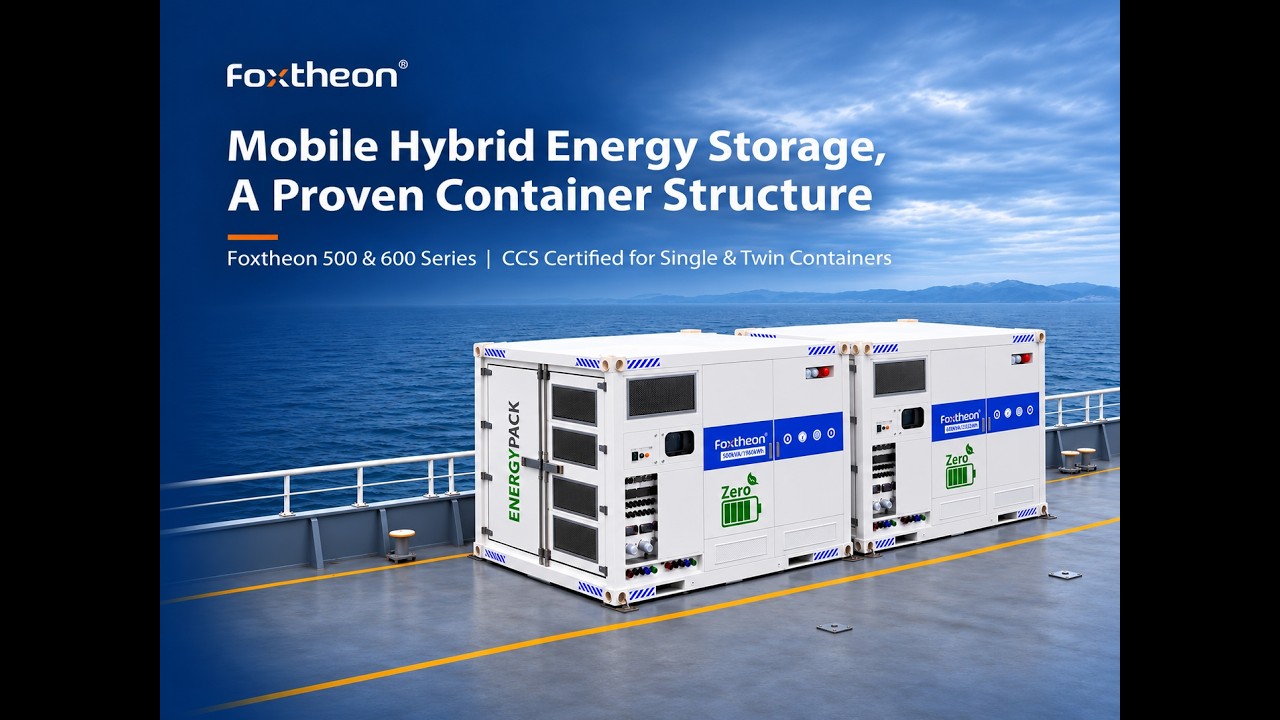
Mobile power projects do not always require the same battery capacity. This 53-second video shows how Foxtheon EnergyPack 500 and 600 Series units can be deployed individually in a 10-ft format or paired in a standard 20-ft transport configuration. The modular approach helps project teams scale battery storage while keeping transport and site logistics straightforward.
The video focuses on a practical question for construction, equipment rental, temporary power and off-grid projects: how can battery capacity be adjusted without turning every deployment into a different transport problem?
What the Video Shows
Foxtheon EnergyPack uses a modular container format. A single 10-ft unit can be deployed where the project needs a smaller footprint or lower installed capacity. When a project requires more capacity, two compatible units can be paired into one standard 20-ft transport configuration.
This gives operators a clearer path between project requirements and logistics planning. The system can be scaled by changing the number of units while preserving a transport format that is familiar to freight and site teams.
Why Modular Transport Matters for Mobile BESS
Temporary and mobile power demand can vary significantly from one project to another. A rental fleet may serve a compact urban site one week and a remote industrial project the next. A modular mobile BESS approach can help teams:
- deploy one unit for smaller loads or space-constrained sites;
- pair two units when additional battery capacity is required;
- plan transport around standard container dimensions;
- move the same product family between projects with different requirements; and
- expand a fleet incrementally instead of treating every capacity level as a separate platform.
Actual system selection still depends on the site’s peak power, daily energy use, charging source, operating schedule and environmental conditions. Modular packaging simplifies deployment choices, but it does not replace project-specific sizing.
CCS Recognition for the Container Structure
The container structures of the Foxtheon EnergyPack 500 and 600 Series are recognized by the China Classification Society (CCS) in both single-unit and paired-unit configurations. This recognition relates to the container structures and the two transport arrangements shown in the video.
For procurement or compliance review, project teams should confirm the exact model, configuration and documentation required for their route and application.
Where This Mobile BESS Approach Fits
The modular configuration is relevant to applications where equipment must be transported, redeployed or resized regularly, including:
- construction and infrastructure projects;
- equipment and power rental fleets;
- temporary site power;
- remote and off-grid operations; and
- projects with changing capacity requirements.
For more practical demonstrations, visit the Foxtheon Video Guides. To discuss load profiles, transport constraints or system selection, contact the Foxtheon team.
Frequently Asked Questions
What is a modular mobile BESS?
A modular mobile battery energy storage system uses repeatable units that can be deployed alone or combined to meet different project requirements. The goal is to make capacity planning and redeployment more flexible.
How can two 10-ft units simplify transport?
In the configuration shown, two compatible 10-ft EnergyPack units can be paired into a standard 20-ft transport arrangement. This helps teams scale the system while retaining a familiar container format for logistics planning.
Which projects can use this type of system?
Typical applications include construction sites, temporary power, equipment rental, remote operations and off-grid projects. The correct configuration depends on the measured or estimated site load and operating requirements.
Watch on YouTube: Modular Mobile BESS: Scale Power Without Complicating Transport