
Fuel Prices Are Rising Again — Is Your Off-Grid Power Strategy Ready?
As global fuel prices continue to fluctuate, off-grid industries are once again facing a familiar challenge: rising operating costs, tighter project margins, and increasing pressure to improve energy efficiency.
As global fuel prices continue to fluctuate, off-grid industries are once again facing a familiar challenge: rising operating costs, tighter project margins, and increasing pressure to improve energy efficiency.
For sectors like construction, mining, infrastructure, oil & gas, telecommunications, and remote industrial operations, diesel generators have long been the default off-grid power solution. They are reliable, flexible, and easy to deploy. But as diesel prices rise worldwide, the hidden inefficiencies of traditional diesel-only power systems are becoming increasingly difficult to ignore.
The question is no longer simply how to secure temporary power.
It is how to build a more efficient, intelligent, and sustainable off-grid energy system.
At Foxtheon , we believe the future of off-grid power generation lies in hybrid energy solutions that combine diesel generators, battery energy storage systems (BESS) , solar integration, and intelligent energy management into one optimized ecosystem.
Global Fuel Markets Are Entering Another Period of Volatility
Recent reports from major international media outlets suggest that rising diesel and fuel prices are no longer viewed as short-term fluctuations, but as part of a broader global energy challenge.
According to Reuters, ongoing geopolitical tensions and supply chain disruptions have pushed global oil prices above USD 100–110 per barrel in recent months, increasing inflationary pressure across transportation, logistics, and industrial sectors. Reuters also reported that diesel markets are facing growing supply pressure due to disruptions in global shipping routes and tightening refinery capacity.
Industry analysts are also revising fuel forecasts upward. A recent market analysis cited by Rigzone noted that global diesel price forecasts for 2026 have been raised significantly as supply risks continue to impact energy markets.
For industries that rely heavily on continuous diesel-powered operations, the financial impact is becoming increasingly difficult to ignore.
| Market Indicator | Recent Situation | Industry Impact |
|---|---|---|
| Global Oil Prices | Brent crude surpassed USD 100–110/barrel | Higher operating and logistics costs |
| Diesel Prices | Global diesel forecasts revised upward | Increased off-grid power expenses |
| Supply Chain Risks | Shipping disruptions and refinery pressure | Fuel supply uncertainty |
| Industrial Operations | Higher fuel volatility worldwide | Greater demand for fuel-efficient energy systems |
Against this backdrop, improving fuel efficiency is no longer just about sustainability. It is becoming a critical strategy for protecting profitability and operational resilience in off-grid industries.
The Hidden Cost of Traditional Diesel Generator Systems
Many off-grid construction sites and remote industrial projects operate under highly variable load conditions.
A tower crane may require sudden peak power for only a few minutes.
A welding machine may cycle on and off throughout the day.
Site offices, pumps, lighting systems, and auxiliary equipment often continue operating under very low load conditions.
To avoid power shortages, many operators oversize their diesel generators as a safety margin.
The result is a common but costly problem across remote power applications:
- Diesel generators running continuously at low load
- Excessive fuel consumption
- Increased engine wear and maintenance
- Carbon buildup caused by inefficient operation
- Higher operating expenses
- More noise and carbon emissions
In many cases, the generator spends more time idling inefficiently than supplying productive power.
As fuel prices increase, these inefficiencies directly reduce project profitability and operational competitiveness.
Explore Smarter Off-Grid Energy Solutions
Learn how modern hybrid power systems and battery energy storage solutions can help reduce diesel runtime, improve efficiency, and lower operating costs across temporary and remote power applications.
Why Hybrid Power Systems Are Becoming the New Standard
Across the global off-grid energy industry, hybrid power systems are rapidly replacing traditional diesel-only power solutions. Industries such as construction, mining, infrastructure, and telecom are under increasing pressure to reduce fuel costs while maintaining reliable temporary power in remote locations.
A modern hybrid energy system combines diesel generators, battery energy storage systems (BESS), solar integration, and intelligent energy management into one coordinated solution. Instead of forcing generators to handle every sudden load fluctuation, battery storage can support peak shaving and low-load operation, allowing generators to run closer to their optimal efficiency range.
The result is lower fuel consumption, reduced maintenance, improved power stability, and greater operational flexibility. As diesel prices continue to rise, hybrid generator systems are becoming a long-term strategy for improving efficiency and resilience in off-grid power applications.
Hybrid Generator Systems
Combine battery storage and diesel generation to reduce fuel consumption and improve generator efficiency.
Learn More →Battery Energy Storage Systems
Store energy intelligently, support peak shaving, and improve site energy flexibility.
Explore Solutions →Off-Grid Microgrid Solutions
Integrate diesel, battery storage, and solar power into a coordinated energy ecosystem.
Discover More →Intelligent Energy Management Is the Real Difference
In the off-grid energy sector, the real breakthrough is not simply battery storage or generator technology alone — it is intelligent energy management. Many companies assume hybrid power only means adding batteries to a generator, but the real value comes from how intelligently every energy source is coordinated.
Modern off-grid operations often experience rapidly changing power demands from cranes, welding systems, pumps, lighting, and temporary facilities. Without intelligent control, diesel generators frequently operate inefficiently under low-load conditions, leading to unnecessary fuel consumption and higher maintenance costs.
Advanced energy management systems (EMS) continuously monitor load demand and dynamically control how power is distributed between generators, battery storage systems, and renewable energy sources such as solar. This intelligent coordination improves fuel efficiency, stabilizes power quality, reduces generator runtime, and enhances overall energy reliability for remote operations.
Intelligence Is What Unlocks Hybrid Energy Performance
Modern hybrid energy systems achieve their greatest value when paired with advanced energy management systems (EMS) capable of automatically optimizing energy flows between generators, battery storage, and renewable power sources.
Real-time load monitoring, predictive dispatching, peak shaving, and automated generator control help operators maximize fuel savings while maintaining stable and reliable power delivery.
Load Demand
Continuous site power monitoring
EMS Control
Real-time energy optimization
Battery Storage
Peak shaving & load balancing
Generator
Operate in optimal efficiency range
See Mobile Battery Storage in Action
For projects seeking greater flexibility and fuel savings, mobile battery energy storage systems can play a critical role in supporting hybrid power strategies and reducing generator runtime.
Watch a mobile BESS solution operating in real-world applications →
Rising Fuel Prices Are Accelerating the Energy Transition
Fuel price volatility is no longer a temporary challenge.
Global supply chain disruptions, geopolitical uncertainty, environmental regulations, and increasing global energy demand continue to impact diesel fuel costs worldwide.
For companies operating remote construction projects, mining operations, temporary infrastructure sites, and industrial microgrids, waiting for diesel prices to stabilize is no longer a sustainable strategy.
The companies gaining long-term competitive advantages today are investing in:
- Hybrid power generation
- Battery energy storage systems
- Smart off-grid energy infrastructure
- Fuel-saving technologies
- Renewable energy integration
- Intelligent remote energy management
Reducing fuel dependency is no longer only about sustainability goals.
It is becoming a core operational and financial strategy.
Build a More Fuel-Efficient Off-Grid Power Strategy
Discover how hybrid generators, battery energy storage systems, and intelligent EMS technologies can help reduce fuel consumption, improve resilience, and lower total operating costs.
The Future of Off-Grid Energy Is Hybrid
Across construction, mining, infrastructure development, oil & gas, telecom, and remote industrial sectors, the transition toward hybrid energy systems is already underway.
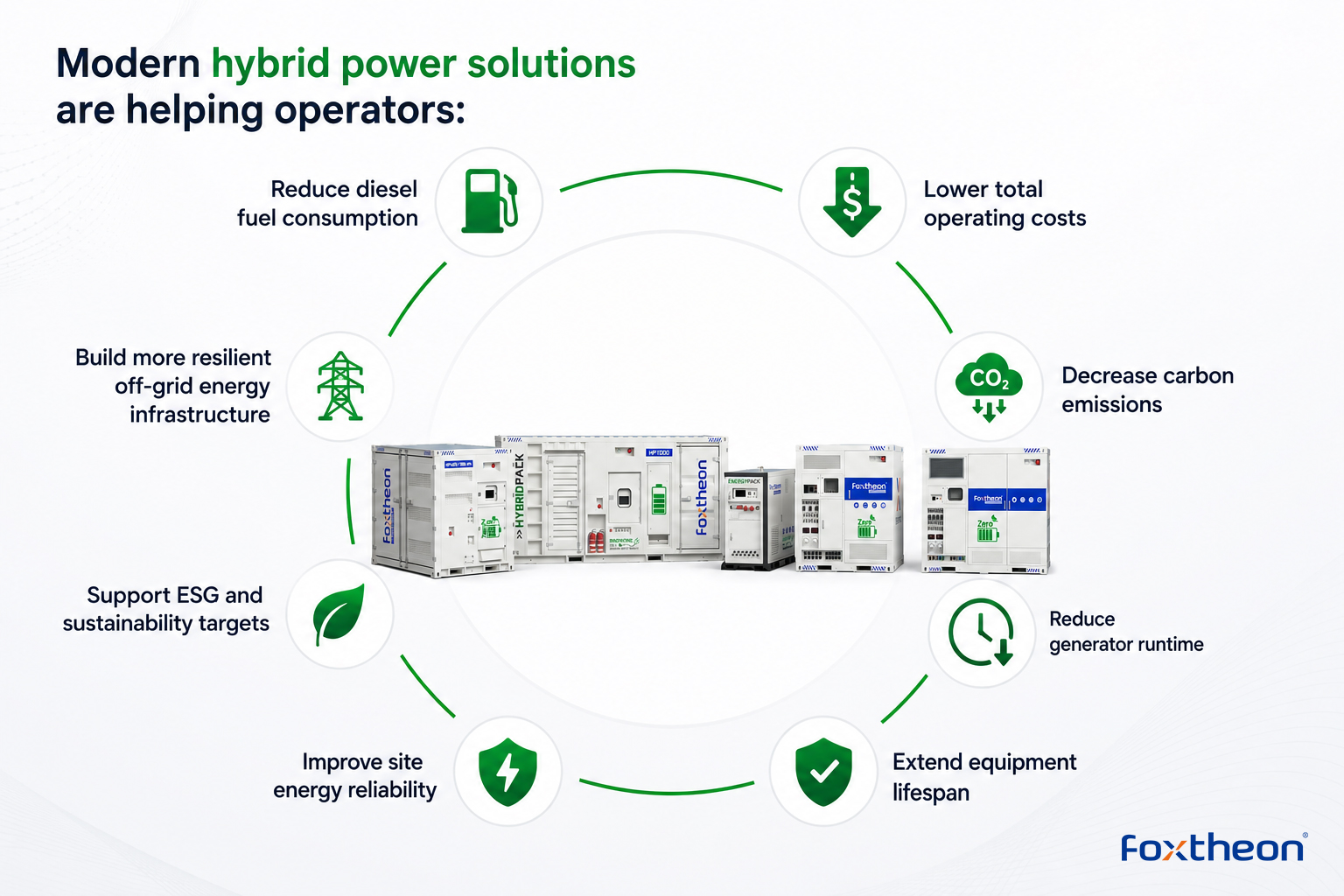
Modern hybrid power solutions are helping operators reduce diesel fuel consumption, lower operating costs, decrease carbon emissions, reduce generator runtime, improve energy reliability, extend equipment lifespan, support ESG objectives, and build more resilient off-grid energy infrastructure. As energy costs, sustainability requirements, and operational demands continue to rise, hybrid systems are becoming a practical pathway toward smarter and more efficient site power management.
At Foxtheon , we are committed to helping global industries build smarter off-grid power ecosystems through intelligent hybrid generator systems, battery energy storage solutions, and advanced energy management technologies.
Because in today’s energy landscape, resilience is no longer just about having power.
It is about using energy intelligently, efficiently, and sustainably.
Explore Related Solutions
Hybrid Generator Systems
Reduce diesel consumption while maintaining reliable off-grid power generation.
Learn More →Battery Energy Storage Systems
Deploy flexible energy storage to support peak shaving, backup power, and microgrid operation.
Learn More →FoxMind™ Energy Management
Optimize energy usage through intelligent control and real-time dispatching.
Learn More →Frequently Asked Questions
Why are hybrid power systems becoming more popular?
Hybrid power systems help reduce fuel consumption, lower operating costs, improve energy efficiency, and increase power reliability in off-grid applications.
How can battery energy storage systems reduce diesel fuel usage?
Battery energy storage systems support peak shaving and low-load operation, allowing generators to run less frequently and closer to their optimal efficiency range.
What industries benefit most from hybrid energy solutions?
Construction, mining, telecom, infrastructure, oil & gas, utilities, and remote industrial operations are among the sectors seeing the greatest benefits.
What role does an EMS play in hybrid power systems?
An Energy Management System continuously optimizes how energy is distributed between generators, batteries, and renewable energy sources to maximize efficiency and reliability.
Key Topics Covered
Off-grid power generation, hybrid energy systems, battery energy storage systems (BESS), mobile battery storage, diesel generator optimization, energy management systems (EMS), hybrid generators, temporary power solutions, construction site power, mining power systems, telecom energy infrastructure, industrial microgrids, renewable energy integration, fuel-saving technologies, smart energy management, energy resilience, remote power generation, sustainable power solutions, hybrid microgrids, intelligent power systems, and distributed energy resources.
Ready to Reduce Fuel Costs and Improve Off-Grid Energy Efficiency?
Discover how Foxtheon’s hybrid power technologies can help optimize your energy infrastructure and improve operational resilience.