
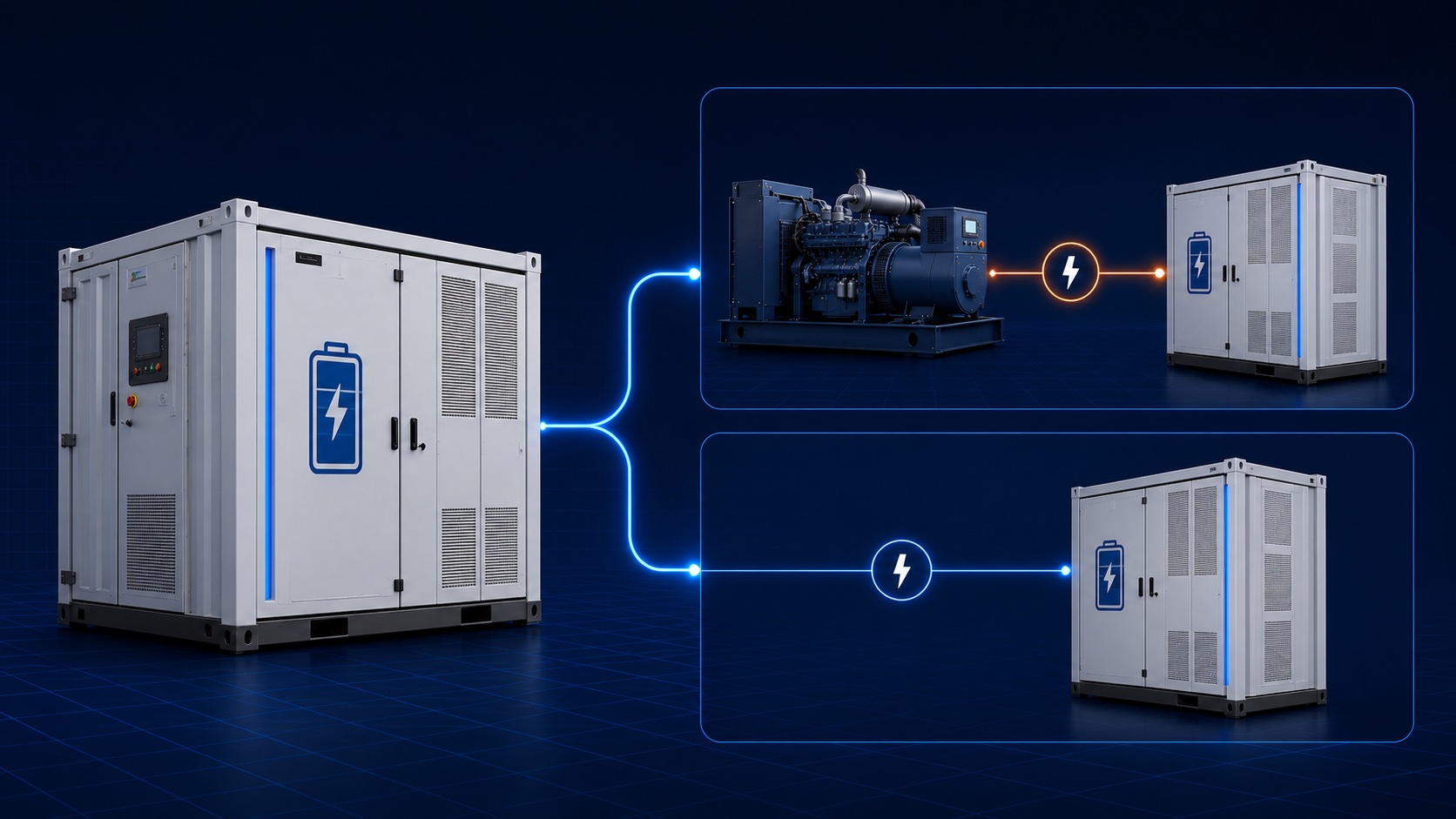
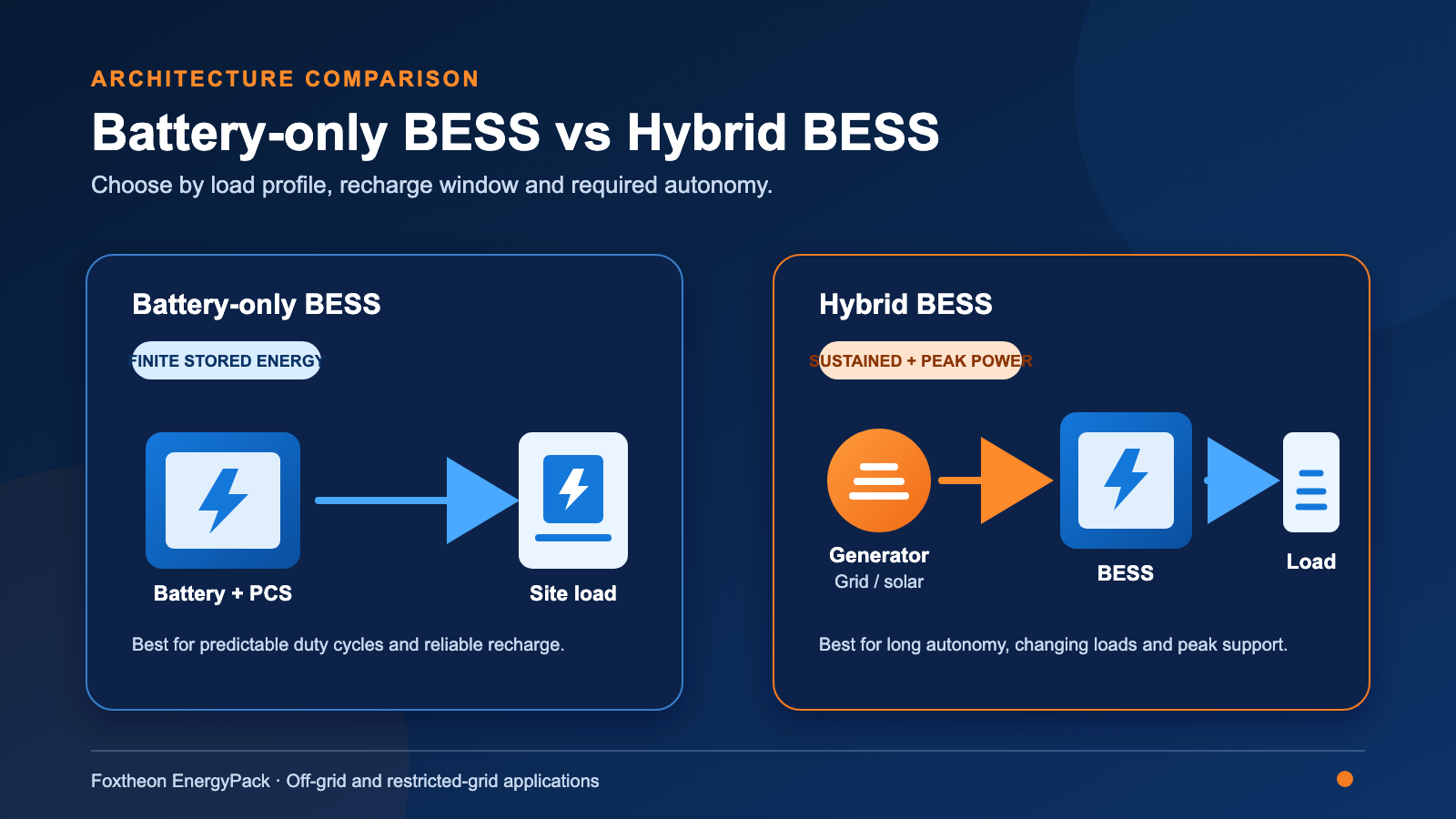
A battery-only BESS can supply an off-grid load without running an engine, but only until its usable stored energy is depleted. A hybrid BESS adds a controllable charging source, usually a diesel generator, or operates with a restricted grid connection or solar input. That makes it better suited to long operating periods, uncertain loads and sites where the battery cannot rely on a fixed charging window.
The choice should start with the load profile. Peak kW and kVA determine how much instantaneous power the system must deliver. The accumulated energy demand between charging opportunities determines usable kWh. A project also needs a credible plan for several low-solar days, an extended shift or a heavier load than forecast.
In this article, hybrid BESS means a battery energy storage system operating with the grid, a generator or renewable generation under coordinated control. It does not mean a storage device that combines two battery chemistries.
The short answer
Choose battery-only operation when the daily energy requirement is predictable, the battery can be recharged before the next duty cycle and the site can accept a defined operating duration.
Choose a hybrid BESS when the site needs longer autonomy, has uncertain or changing loads, or uses a generator or restricted grid connection as the sustained energy source. The battery handles peaks and selected low-load periods. The generator, grid or solar source replenishes energy.
| Site condition | Battery-only BESS | Hybrid BESS |
|---|---|---|
| Predictable short operating window | Strong fit | May add unnecessary complexity |
| Long or changing shifts | Requires more battery capacity | Generator or grid can recharge during operation |
| No dependable recharge source | Limited by stored energy | Generator provides controllable recharge |
| Short load peaks above average demand | PCS can cover peaks if correctly sized | Battery can cover peaks while the source covers sustained demand |
| Noise-sensitive hours | Silent apart from cooling equipment | Battery mode can create quiet periods, but the generator still runs when required |
| Several days of poor solar production | Requires enough storage for the full design event | Generator can cover the energy shortfall |
| Restricted grid connection | Can charge between duty cycles | Can charge below the limit and discharge above it |
Start with power and energy as separate calculations
A common mistake is to compare systems by battery capacity alone. A 500 kWh battery may still be unsuitable if its power conversion system cannot supply a short 400 kVA event. A high-power BESS may also run out of energy if the site repeats those events faster than it can recharge.
For a restricted source, calculate the active-power deficit at each time step:
P_bess(t) = max[P_load(t) - P_source_limit, 0]The maximum result is the minimum active-power requirement before reserve and derating. The design must also check apparent power:
S = sqrt(P^2 + Q^2)Here, P is active power in kW, Q is reactive power in kvar and S is apparent power in kVA.
Energy is the accumulated deficit:
E_deficit = sum[max(P_load - P_source, 0) x delta_t] / eta_dischargeThe usable battery capacity must cover the largest energy deficit before the system can recharge. The final value also needs a permitted state-of-charge window, temperature allowance, conversion losses, ageing allowance and operating reserve.
Rated power and energy capacity describe different limits. Storage duration is the relationship between the two, so a site-specific time series is more useful than a single average-load value.
When battery-only power is the better choice
Battery-only operation is practical when the duty cycle has a clear end and the next recharge opportunity is reliable. Examples include a short event, night work followed by daytime grid charging, or a temporary task with measured energy use and a fixed schedule.
The minimum stored energy required for a simple constant-load period starts with:
E_required = P_load x operating_hours / eta_systemHere, eta_system is the end-to-end discharge efficiency from stored battery energy to the served AC load. This is only a starting point. The study must add auxiliary loads, cooling, the permitted state-of-charge window, reserve and any increase in demand that the site must tolerate.
Battery-only power becomes harder to justify when the system has to carry enough energy for several uncertain days. Adding more kWh can extend autonomy, but it also increases transport weight, space, charging time and capital cost. If the project still needs a backup generator for exceptional conditions, the actual design is already a hybrid architecture even if the generator rarely runs.
When a generator and BESS are the better combination
A generator and BESS are useful when the site has a large gap between average demand and short peaks. A generator sized for the highest possible instant may spend much of the day at light load. In a hybrid system, the battery can supply the lower load with the engine off, then the generator can start to serve the load and recharge the battery.
A common control sequence for mobile energy storage follows this pattern: the battery carries a light site load, the generator starts when the battery reaches its threshold, and generator power serves the load and charges the battery. After charging, the generator stops and the battery resumes supply.
The generator cannot be selected only from average kW. It must carry the intended site load plus charging power, accept the remaining load steps and operate within the manufacturer's limits after temperature and altitude derating.
The battery also needs enough reserve for the next peak. A control system that depletes the battery before a crane or crusher starts has failed even if it reduced engine runtime during the previous hour.
When a restricted grid and BESS are the better combination
A small or temporary grid connection can be treated as the sustained source. The BESS charges when site demand is below the connection limit and supplies the difference when demand rises above it.
On construction sites, a BESS can act as a power buffer for intermittent equipment with high current requirements, including tower cranes, hoists and welders. The battery does not create energy. It moves energy from a low-demand charging period to a high-demand event.
At a Foxtheon project in Malaysia, three tower cranes operated behind a 110 kW utility limit. Site demand reached 180 kW, so the maximum reported active-power gap was:
180 kW site demand - 110 kW grid limit = 70 kW BESS contributionThe deployed P350 supplied 40 to 70 kW during lifting peaks while grid draw stayed within the utility limit. The 70 kW result defines the reported maximum active-power contribution, not the complete battery size. Peak duration, repeated crane cycles and recharge time still determine the required energy capacity.
Read the full Malaysia hybrid BESS case study or the detailed guide to reducing tower-crane generator size with hybrid BESS.
What solar changes, and what it does not
Solar can reduce the energy that must come from the grid or generator, but it is not a guaranteed dispatchable source. The model needs solar production and site load on the same time axis. Monthly energy totals are not enough.
A battery-only solar system needs enough generation and storage for the design weather period. A hybrid solar, battery and generator system can use the generator when solar production and battery state of charge are both low.
A robust resilience study should compare diesel-only, solar plus storage, and solar plus storage plus diesel against the same critical-load profile and autonomy target. Adding a generator can reduce the amount of battery and solar capacity required for a long outage, but the result depends on fuel availability and the generator operating strategy.
A practical selection process
1. Measure the load
Record kW, kVA, current, voltage, power factor and frequency. The sample interval must be fast enough to capture the event the battery will support. One-minute averages can hide a ten-second motor or lifting peak.
2. Define the operating period
State how many hours or days the system must operate before recharge. Include shift extensions, weekend operation and the credible worst case rather than the nominal schedule alone.
3. Define every charging source
Record the maximum grid import, generator rating, permitted battery charge power and expected solar production. Check whether those sources can serve the live load and recharge the battery at the same time.
4. Size PCS power and usable energy separately
Check continuous and short-duration kW and kVA against the load profile. Then simulate state of charge across the full duty cycle.
5. Test failure conditions
Model a delayed recharge, a heavier load, a failed solar day and a source outage. Decide which loads must continue and which can be shed.
6. Compare operating cost and logistics
Include fuel, delivered fuel cost, maintenance, transport, grid energy, battery degradation and labor. A lower fuel total does not automatically mean a lower project cost if the system is oversized or difficult to move.
Questions to answer before choosing battery-only or hybrid
- What are the maximum kW and kVA, and how long do the peaks last?
- How much energy does the site use between dependable charging windows?
- What state-of-charge reserve is required for the next critical event?
- Can the grid or generator serve the load and charge the battery together?
- What happens during an extended shift or poor solar production?
- Does the generator have a defined minimum loading or operating range?
- What temperature and altitude derating applies?
- Which loads can be shed if a source fails?
- Is transport weight or container size a project constraint?
- Is the project long enough for the expected operating savings to recover the added system cost?
Where EnergyPack fits
Foxtheon EnergyPack hybrid BESS is designed for mobile and industrial sites that need battery peak support, generator integration, restricted-grid operation or renewable input. P and M Series systems cover different power, energy and deployment requirements.
Final selection should be based on a load profile and the site's electrical design. Send Foxtheon the time-series load data, source limits, operating schedule and environmental conditions for a preliminary configuration review.
Frequently asked questions
Is battery-only power always cleaner than a hybrid BESS?
Battery operation has no on-site combustion emissions, but the full comparison depends on how the battery is charged, equipment manufacturing, transport, battery losses and the generator fuel that the system avoids. Define the study boundary before making a lifecycle claim.
Can a hybrid BESS operate with the generator off?
Yes. The battery can supply the load while the generator is off, subject to PCS power, usable energy and reserve limits. The generator starts when the control strategy calls for more energy or support.
Does adding a generator mean the battery can be smaller?
Often, yes, because the generator can supply sustained energy and recharge the battery. The battery must still cover the required peaks, quiet periods and reserve. The most economical combination depends on the load profile and fuel logistics.
Can a BESS replace a grid upgrade?
It can defer or avoid an upgrade when the existing connection can supply the site's energy but not its short peaks. If the connection lacks enough energy across the operating period, storage alone will not solve the constraint.
What data are needed for a first sizing review?
Provide time-series kW and kVA, peak duration, source limits, generator information, recharge windows, operating hours, temperature, altitude and the required reserve. Equipment nameplates are useful, but measured feeder data provide a stronger basis for final selection.