
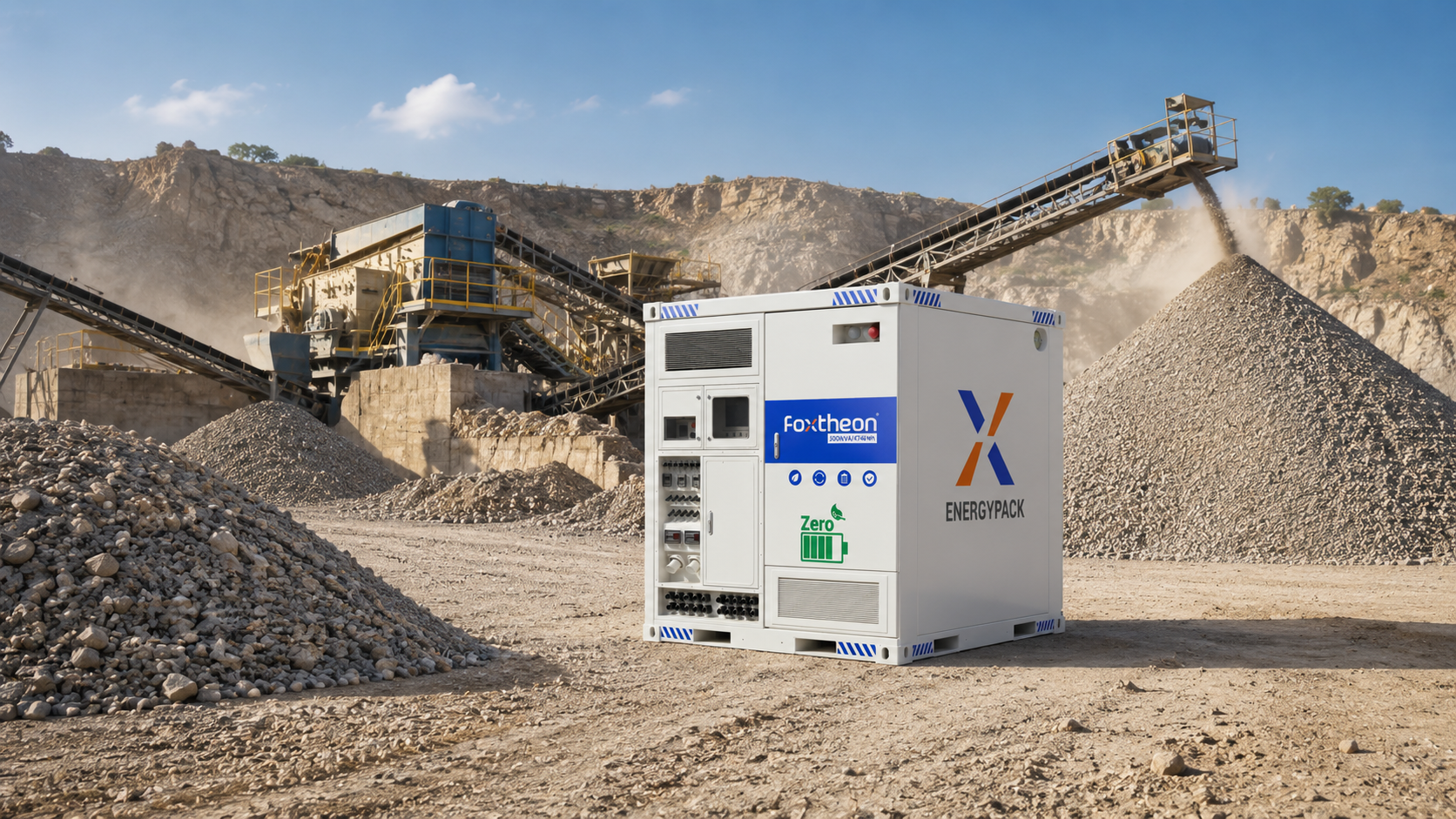
Large-scale civil, industrial, and commercial construction projects operate under demanding electrical conditions. Long before a municipal grid interconnection is permitted, energized, and handed over, civil engineering teams require heavy electrical infrastructure to operate heavy plant machinery, automated batching systems, material hoists, and personnel support facilities. Installing engineered temporary power for construction sites ensures that progress proceeds smoothly through structural, mechanical, and fit-out phases without unplanned downtime.
Modern electrical infrastructure must account for variable demands, remote geographical placements, and stringent environmental regulations governing site acoustics and local exhaust emissions. Meeting these operational demands requires deep knowledge of load characterization, protective discrimination, switchboard enclosure metallurgy, and synchronization mechanisms between rotary generation assets and modern energy storage systems.
Load Profiling and Dynamic Demand Analysis
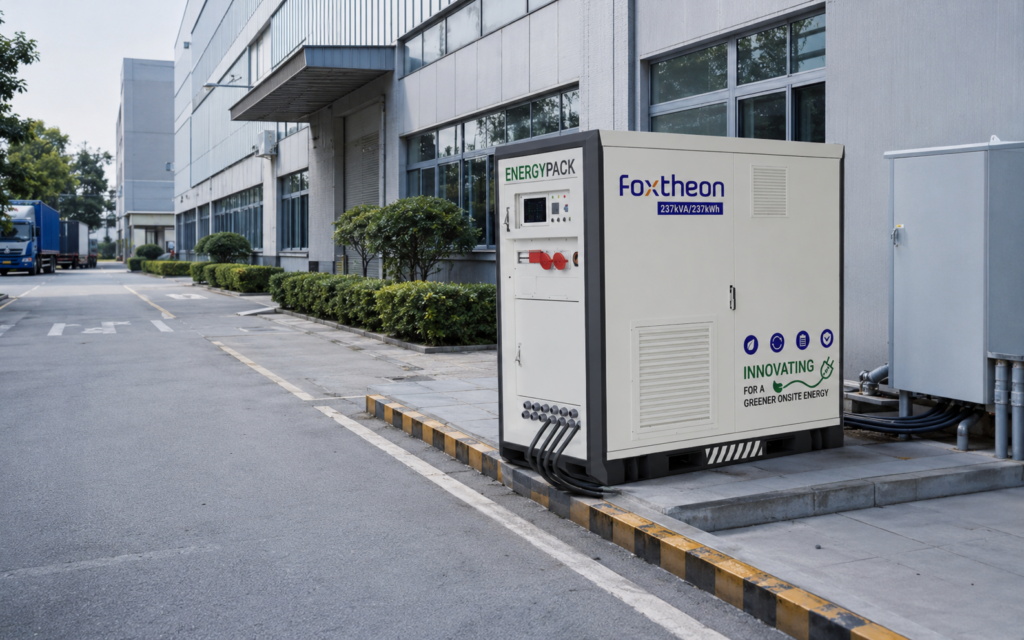
The electrical network of an active building project is defined by extreme demand fluctuations. Unlike steady-state commercial buildings, site load curves exhibit severe load step-changes, low base loads during off-shift hours, and heavy inductive inrush currents during operational peaks. Accurate profiling directly informs generating set sizing, cable schedules, and protective switchgear selection.
Inductive Inrush and Transient Load Management
Construction plant operations rely heavily on inductive motors. Tower cranes, concrete pump lines, aggregate batching plants, and subterranean dewatering pumps utilize squirrel-cage induction motors that introduce operational challenges:
- Direct-On-Line (DOL) Starting: Motors starting across the line draw starting currents ranging from six to eight times their full-load current (FLC). This surge induces momentary voltage dips across the local microgrid, which can trip sensitive low-voltage electronics, site survey base stations, and telecommunications equipment.
- Variable Frequency Drive (VFD) Non-Linear Loads: While modern cranes utilize VFDs to attenuate inrush currents, their bridge rectifiers inject significant Total Harmonic Distortion (THD) back into the distribution network. High harmonic currents increase thermal stresses on alternator windings and neutral conductors.
- Regenerative Braking Energy: Lowering multi-ton structural loads with tower cranes converts potential energy into electrical energy. If the local microgrid cannot absorb this reverse energy flux, bus voltages can spike, leading to premature overvoltage faults on drive converters.
Continuous Baseline vs. Peak Cyclic Loads
A typical project presents two distinct operating conditions. The diurnal production window features high cyclic demand, where tower cranes, hoists, batch plants, and fabrication machinery run concurrently. This creates an intermittent aggregate load factor between 40% and 75% of connected nameplate capacity. In contrast, the nocturnal or idle window requires minimal continuous supply, maintaining only site security perimeter lighting, telemetry hardware, curing heating blankets, and environmental dewatering pumps. Operating oversized mechanical prime movers during these light-load periods causes cylinder glazing and wet stacking, reducing combustion thermal efficiency and increasing maintenance intervals.
Site Electrical Distribution Architecture and Switchgear Materials
The operational resilience of temporary power for construction sites depends on the mechanical integrity and thermal endurance of the primary distribution boards (PDBs), sub-distribution assemblies (SDAs), and intermediate connection enclosures situated across the job site.
Panel Enclosure Metallurgies and Ingress Protection
Construction microgrids face mechanical abrasion, suspended particulate matter, concrete slurry, and open-air weather conditions. Equipment enclosures must meet rigorous environmental ratings:
- Electro-Galvanized Mild Steel: Heavy-gauge cold-rolled mild steel (minimum 1.6mm to 2.0mm thickness) treated with a hot-dip zinc coating and electrostatically applied polyester powder coating provides strong mechanical impact resistance against site machinery. It is standard for primary intake distribution kiosks.
- Glass-Reinforced Polyester (GRP) and SMC: Sheet-Molding Compound (SMC) and GRP enclosures offer superior resistance to marine atmospheres, chemical leaching, and galvanic corrosion. Furthermore, non-conductive GRP enclosures provide Class II double-insulation properties, reducing indirect touch voltage hazards in wet utility tunnels.
- Ingress Protection (IP) Classifications: Outdoor distribution hardware requires a minimum rating of IP56 to resist high-pressure water jets and continuous fine cement dust. Enclosures hosting power conversion electronics require compartmentalized airflow with IP65-rated sealed busbar chambers to maintain clean operation around electrical switchboards.
Busbar Sizing and Fault Clearance Coordination
Main distribution assemblies must feature hard-drawn, high-conductivity electrolytic copper busbars (Cu-ETP compliant with IEC 60439 / IEC 61439). Busbar bracing must withstand the electromechanical forces generated during prospective short-circuit faults ($I_{sc}$).
Protective discrimination (selectivity) requires coordinated time-current trip curves between the upstream Air Circuit Breakers (ACBs), intermediate Molded Case Circuit Breakers (MCCBs), and downstream Miniature Circuit Breakers (MCBs) backed by Residual Current Devices (RCDs). Tiered earth-leakage thresholds (e.g., adjustable 300mA time-delayed upstream protection transitioning to 30mA instantaneous personal protection at branch sockets) ensure that transient earth faults at an individual hand tool trip only the local sub-distribution breaker, preserving operational continuity across the wider microgrid.
Integrated Rotary and Solid-State Energy Architecture
Modern job sites increasingly combine conventional rotary generation with solid-state Battery Energy Storage Systems (BESS) into unified, synchronized microgrids. Rather than isolating systems, advanced project sites deploy intelligent controls to manage energy across every available asset.
Engineering teams specify hybrid microgrids to solve the structural mismatch between peak inductive loads and low idle baselines. Foxtheon supplies advanced energy storage architectures and intelligent control interfaces tailored for heavy industrial applications, enabling existing generator fleets to operate within peak fuel-efficiency bands.
When engineering modern temporary power for construction sites, combining rotary alternators with energy storage systems delivers measurable operational advantages:
- Peak Shaving and Inrush Support: The storage inverter provides instantaneous sub-cycle response, injecting reactive and active power to absorb motor-start transients from tower cranes and hoists. Consequently, the primary alternator does not need to be sized purely for peak inrush currents, running closer to its continuous operating rating.
- Automatic Engine Start/Stop Coordination: When load profiles drop below a programmable threshold (such as 25% of generator capacity during night shifts), the master controller commands the diesel engine to safely power down. The inverter takes over the entire baseline load, eliminating wet-stacking and cutting fuel use and mechanical wear during non-productive site hours.
- Dynamic Frequency and Voltage Regulation: Fast-acting four-quadrant bidirectional power conversion systems (PCS) stabilize bus voltage and system frequency when regenerative crane loads feed power back into the microgrid, safely sinking excess reverse power into battery modules.
Cable Management, Voltage Drop Mitigation, and Earthing Schemes
Distributing low-voltage power across extensive civil footprints requires careful cable sizing and earthing design. Long cable runs from the primary intake hub to the work face introduce line impedance, which can lead to excessive terminal voltage drop.
Voltage Drop and Sizing Calculations
To adhere to international installation codes (such as IEC 60364-7-704 for construction and demolition sites), terminal voltage drops under full operational load should not exceed 5% at sub-distribution boards and final motor circuits. Voltage drop calculation for balanced three-phase systems follows the standard formula:
$$\Delta V = \sqrt{3} \times I \times L \times (R \cos\phi + X \sin\phi)$$
Where:
- $I$ = Design operating current (Amperes)
- $L$ = Route run length (kilometers)
- $R$ = AC conductor resistance at operating temperature ($\Omega/\text{km}$)
- $X$ = Conductor inductive reactance ($\Omega/\text{km}$)
- $\cos\phi$ = Circuit operating power factor
When running long feeder lines to upper-deck hoists or remote dewatering pits, copper cross-sectional areas must often be upsized beyond basic continuous thermal ampacity ratings to compensate for run lengths exceeding 150 meters, avoiding thermal dissipation issues and low-voltage dropouts.
Earthing Configurations and Fault Path Integrity
Construction sites present dynamic grounding environments where shifting earth surfaces, trenching operations, and damp conditions alter earth path resistance. Common earthing arrangements include:
- TN-S Configuration: The star point of the supply source connects directly to earth, with separate protective earth (PE) and neutral (N) conductors routed continuously throughout the installation. This configuration simplifies residual current fault detection and limits common-mode noise across sensitive test equipment.
- TT Configuration: Often utilized on widespread infrastructure projects where running an integrated protective conductor over long distances is impractical. Site distribution boards connect to local earth electrode matrices (driven copper-bonded steel rods). This approach requires strict time-delay coordination across upstream RCDs to clear earth faults reliably.
- Equipotential Bonding: Structural steel frameworks, crane rails, scaffolding runs, and external piping arrays must be tied directly to the main earthing terminal (MET) using minimum $16\text{mm}^2$ copper conductors to eliminate stray touch potentials.
Evaluation Framework for Equipment Providers
Specifying equipment for temporary power for construction sites requires thorough technical vetting of prospective original equipment manufacturers (OEMs) and supply partners. Procurement teams evaluate hardware against several industrial parameters:
1. Structural Robustness and Mechanical Construction
Distribution boards, mobile step-down transformer kiosks, and energy storage enclosures must feature structural lifting eyes, certified crane slings, and reinforced heavy-gauge forklift pockets. Skid bases must be fabricated from heavy structural channel steel to endure rough site handling. All external fittings, hinges, and quarter-turn cam locks should feature grade 316 stainless steel to prevent seizing over multi-year deployment cycles.
2. Telemetry and Remote Microgrid Interoperability
Modern site operations demand remote visibility into fleet health, active load allocations, power factor metrics, and fuel consumption. Top-tier equipment integrates industrial controllers communicating over Modbus TCP/RTU, CANbus, or cellular 4G/5G backhauls. Platforms engineered by Foxtheon provide cloud-based performance monitoring, delivering high-resolution operational insights that help site engineers optimize asset balancing across fluctuating demand periods.
3. Regulatory Compliance and Type-Testing
Suppliers must deliver certified third-party type-test documentation verifying system performance under current international electrical and machinery directives:
- IEC 61439-4: Particular requirements for assemblies for construction sites (ACS).
- IEC 60364-7-704: Electrical installations of buildings – Requirements for special installations or locations – Construction and demolition site installations.
- Harmonic Compliance: IEEE 519 compliance for total harmonic voltage distortion limits under non-linear thyristor loading profiles.
Advanced Microgrid Operation Across Project Phases
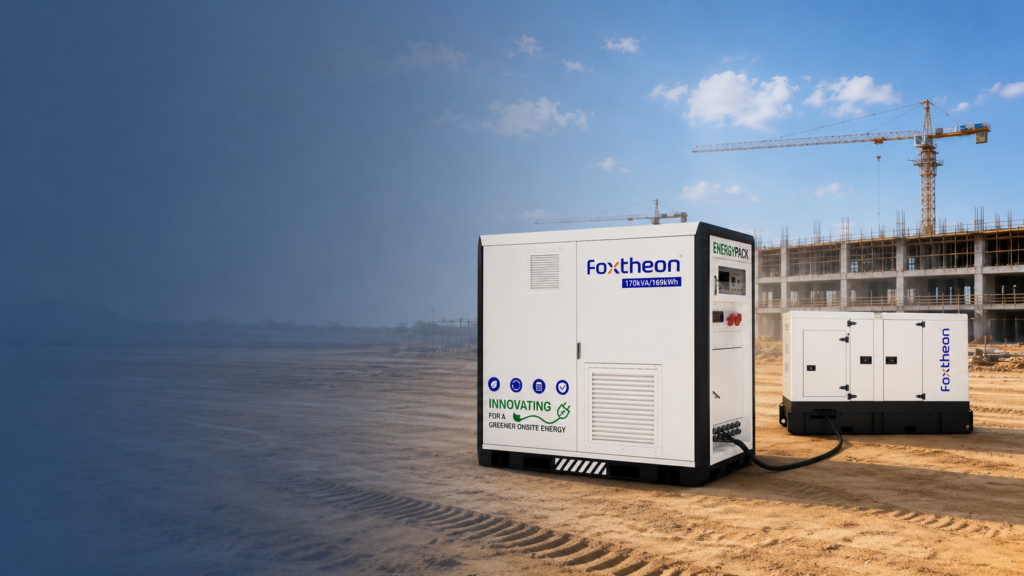
Power requirements evolve dramatically throughout the life of a construction project, and a well-engineered electrical infrastructure adapts smoothly to each phase:
Early Civil and Substructure Phase
During preliminary excavation and foundation installation, loads focus on continuous perimeter dewatering pumps, piling rigs, earth-moving workshops, and site welfare facilities. Operating requirements favor self-contained, high-ingress-protection generating skids coupled with compact energy storage units to reliably power pump lines overnight without continuous engine noise.
Superstructure and Core Construction Phase
Once structural cores rise, electrical demand shifts toward high-inertia vertical transport systems—tower cranes, personnel hoists, concrete placement booms, and heavy welding plants. System design during this phase focuses on managing dynamic transient steps, maintaining robust voltage stability across long vertical risers, and utilizing solid-state storage to smooth heavy peak currents.
Fit-Out, Commissioning, and Handover Phase
During mechanical, electrical, and plumbing (MEP) fit-out, overall power demand drops from heavy structural equipment to widespread low-voltage tooling, task lighting, and temporary HVAC units for climatic moisture control. Finally, as permanent building switchgear undergoes cold and hot commissioning, the temporary microgrid powers integrated building management systems (BMS) before final utility energization.
Implementing an integrated approach to temporary power for construction sites provides engineering contractors with stable, reliable electrical infrastructure from initial ground-breaking through to practical completion.
Frequently Asked Questions
Q1: How do project engineers calculate the required capacity for temporary site power?
A1: Sizing requires aggregating connected loads ($kW/kVA$) across plant equipment, cranes, lighting, and temporary offices, then applying an empirical diversity factor (typically 0.6 to 0.8 depending on operational patterns). Sizing calculations must separately account for the highest single inductive motor inrush demand (DOL or VFD starting) to verify that the power supply’s transient voltage drop remains within the 10% to 15% recovery envelope.
Q2: Why is harmonic distortion a technical concern on modern construction sites?
A2: Tower cranes, personnel hoists, and heavy welding plants commonly utilize Variable Frequency Drives and switched-mode power supplies. These non-linear loads draw current in sharp pulses rather than smooth sinusoidal curves, producing harmonic currents. These harmonics can cause localized overheating in alternator windings, trip protective RCDs unpredictably, and distort control signals across site telematics.
Q3: How do energy storage systems integrate with existing diesel generators on site?
A3: Battery energy storage systems integrate directly onto the main low-voltage AC bus using grid-forming or grid-following bidirectional inverters. During peak inductive loading, the battery inverter provides instantaneous support to the generator via peak shaving. During low-demand periods, the system automatically shuts down the generator engine and sustains baseline loads using stored energy.
Q4: What are the main advantages of GRP enclosures over steel enclosures for site distribution?
A4: Glass-Reinforced Polyester (GRP) enclosures provide superior corrosion resistance in wet, coastal, or chemically aggressive environments. They do not rust when surface coatings are scratched, resist physical denting, and offer Class II electrical insulation that eliminates touch-voltage hazards on the enclosure body itself.
Q5: What protective switchgear standards must temporary site panels comply with?
A5: Temporary power assemblies must comply with the IEC 61439-4 standard (Requirements for Assemblies for Construction Sites). Branch circuits feeding mobile hand tools and general-purpose sockets require Residual Current Devices (RCDs) with a tripping sensitivity not exceeding 30mA, operating within a 40ms trip window upon fault detection.
Engineering & Technical Inquiries
Engineering teams and project contractors requiring customized technical specifications, distribution schematics, or hybrid energy system designs can submit an inquiry directly to the electrical engineering department:
Direct Engineering Consultation: Foxtheon Technical Infrastructure Division
Specifications & System Sizing: Submit Technical Microgrid Request (RFI/RFP)