
Decentralized industrial microgrids increasingly depend on multi-source generation matrices to maintain baseline power quality, support dynamic load steps, and maximize asset longevity. Integrating synchronous internal combustion engines with electrochemical battery energy storage systems (BESS) and variable solar photovoltaic (PV) generators presents clear electrical and mechanical challenges. A properly engineered Hybrid Power Solution bridges the gap between variable renewable outputs and rigid prime-power requirements, ensuring continuous system frequency and voltage equilibrium across mining, manufacturing, remote infrastructure, and commercial sites.
Historically, off-grid or weak-grid facilities relied entirely on reciprocating diesel or heavy fuel oil (HFO) generators sized for worst-case peak surges. This operational profile frequently forced engines to run well below their optimal 70% to 80% continuous running power rating, inducing wet-stacking, incomplete combustion, and premature component degradation. By introducing smart energy storage and high-penetration PV arrays, engineering firms such as Foxtheon configure power architectures where the mechanical assets operate strictly within their thermal sweet spots while the energy storage hardware manages transient deviations and low-load operational periods.
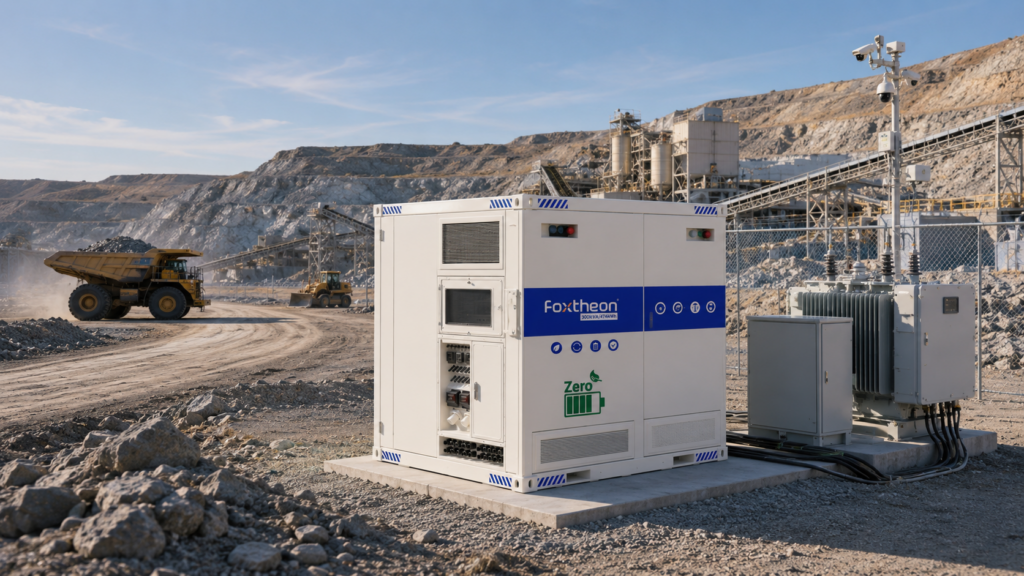
Defining the Multi-Vector Topology of a Modern Hybrid Power Solution
Specifying an industrial Hybrid Power Solution demands a clear topological decision at the early design phase: Direct Current (DC) bus coupling versus Alternating Current (AC) bus coupling. Each topology delivers distinctive impedance behaviors, short-circuit contribution profiles, and conversion efficiency curves.
- AC-Coupled Microgrids: In an AC-coupled topology, the solar inverters, battery bidirectional power conversion systems (PCS), and synchronous alternators connect to a centralized medium-voltage (MV) or low-voltage (LV) switchgear bus. This configuration proves advantageous in brownfield retrofits where legacy alternator plants must remain active without altering existing distribution panels. System capacity expansions occur modularly, allowing maintenance personnel to isolate the energy storage bay without de-energizing the main generation line.
- DC-Coupled Microgrids: In high-irradiance installations where the distance between the photovoltaic field and the battery storage medium remains minimal, DC coupling routing solar generation straight to the battery DC link via maximum power point tracking (MPPT) charge controllers reduces conversion stages. Eliminating intermediate DC-AC-DC transformation steps increases round-trip conversion efficiency. However, fault isolation requires specialized direct-current circuit breakers (DCCBs) capable of quenching high DC arcs.
The electrical baseline established by the IEEE 2030.7 Standard for Microgrid Controllers governs how these decoupled sub-systems communicate during islanded, utility-parallel, and black-start conditions. Adherence to open protocols like Modbus TCP and SunSpec ensures that supervisory control platforms regulate active power (P) and reactive power (Q) without proprietary protocol lock-in.
Synchronizing Mechanical Alternators with Electrochemical Storage
A primary function of a high-tier Hybrid Power Solution is stabilizing the rotational inertia deficit caused by high-penetration inverter-based resources (IBR). Mechanical reciprocating alternators utilize heavy rotating flywheels, naturally dampening sudden rate of change of frequency (RoCoF). In contrast, solid-state inverters offer no intrinsic mechanical inertia unless explicitly programmed with specialized firmware.
Modern hybrid engineering implements two distinct inverter control methodologies:
- Grid-Following (GFL) Controls: The inverter tracks the voltage waveform synthesized by the prime-power generator via an internal Phase-Locked Loop (PLL). Under GFL mode, the battery storage functions as a dispatchable current source, injecting or absorbing active power during baseline peak shaving or load balancing.
- Grid-Forming (GFM) Controls: The inverter utilizes droop control algorithms or Virtual Synchronous Machine (VSM) emulation to act as an independent, low-impedance voltage source behind a synthetic reactance. GFM inverters dictate bus frequency and voltage vectors, enabling the microgrid to maintain dynamic equilibrium even when mechanical alternators decouple during sustained periods of zero generation demand.
By delegating sub-second transient loads—such as large induction motor starts or heavy hydraulic pump cycling—to the high-speed response of lithium iron phosphate (LFP) cells, the internal combustion gensets experience uniform thermal cycles. This prevents mechanical stress on crankpins, connecting rods, and turbochargers, thereby extending major overhaul intervals (TBO) across the entire generation fleet.
Advanced Photovoltaic Arrays and Module-Level Performance
Solar arrays deployed in heavy industrial environments encounter severe atmospheric challenges, ranging from extreme ambient thermal cycling to airborne abrasive particulates. Selecting the correct PV technology directly influences the steady-state performance of the wider multi-source generation package.
Commercial microgrids increasingly pivot away from legacy p-type Passivated Emitter and Rear Cell (PERC) modules toward n-type Tunnel Oxide Passivated Contact (TOPCon) and Heterojunction (HJT) chemistries. These advanced silicon wafers exhibit several mechanical and electrical advantages:
- Lower Temperature Coefficient: Standard n-type TOPCon modules display a temperature coefficient of maximum power (Pmax) around -0.30%/°C, significantly outperforming legacy modules operating above -0.38%/°C. In high-ambient environments like arid extraction sites, this reduction retains active power capability during mid-day peak demand.
- Bifaciality Ratios Exceeding 80%: Utilizing the albedo effect of surrounding ground surfaces (crushed gravel, concrete pads, or desert sand) generates auxiliary reverse-side yield, offsetting irradiance losses during early morning and late afternoon azimuth angles.
- Reduced Degradation Profiles: N-type substrates demonstrate high immunity to Light-Induced Degradation (LID) and Light- and Elevated Temperature-Induced Degradation (LeTID), keeping the first-year power retention above 98% and annual linear degradation below 0.4% over a 30-year operational lifecycle.
The solar array must interface with multi-tracker central or string inverters validated against IEC 62257 standards for off-grid rural and industrial power systems. Fast MPPT tracking algorithms prevent destructive reverse-power flow into the mechanical engine busbars when sudden cloud cover dissipates, preserving alternator exciter components.
Dispatch Control Philosophies and Firmware Architecture
The intelligence of an integrated Hybrid Power Solution resides within its Supervisory Control and Data Acquisition (SCADA) and microgrid controller firmware layer. System-level balance requires determinism, executing commands across millisecond, second, and minute time horizons.
Deterministic state machines process parameters across multiple generation vectors through layered priority tiers:
- Spinning Reserve Reduction: Conventional standalone generator sets run continuously to provide “spinning reserve”—spare capacity held idling specifically to catch unanticipated load spikes. The microgrid controller utilizes the sub-cycle power response of the BESS to act as virtual spinning reserve, allowing non-essential engines to safely shut down while remaining within safe operating margins.
- Minimum Genset Loading Constraints: Engine manufacturers typically mandate minimum continuous loads of 30% to 40% to maintain adequate cylinder pressures and prevent lubricating oil from escaping through the exhaust manifold (wet-stacking). When aggregate facility demand drops below these thresholds, the controller diverts excess engine capacity directly into charging the battery bank.
- Dynamic Frequency Droop Control: In the event of sudden multi-megawatt motor starts, the BESS automatically injects active power proportional to the frequency deviation (Δf). This capability provides immediate primary frequency response, isolating the mechanical governor from high-stress mechanical hunting.
Through empirical hardware-in-the-loop (HIL) simulations validated by testing laboratories like the National Renewable Energy Laboratory (NREL), multi-source control architectures reliably achieve deterministic transition states between parallel operation, islanding, and peak load shaving.
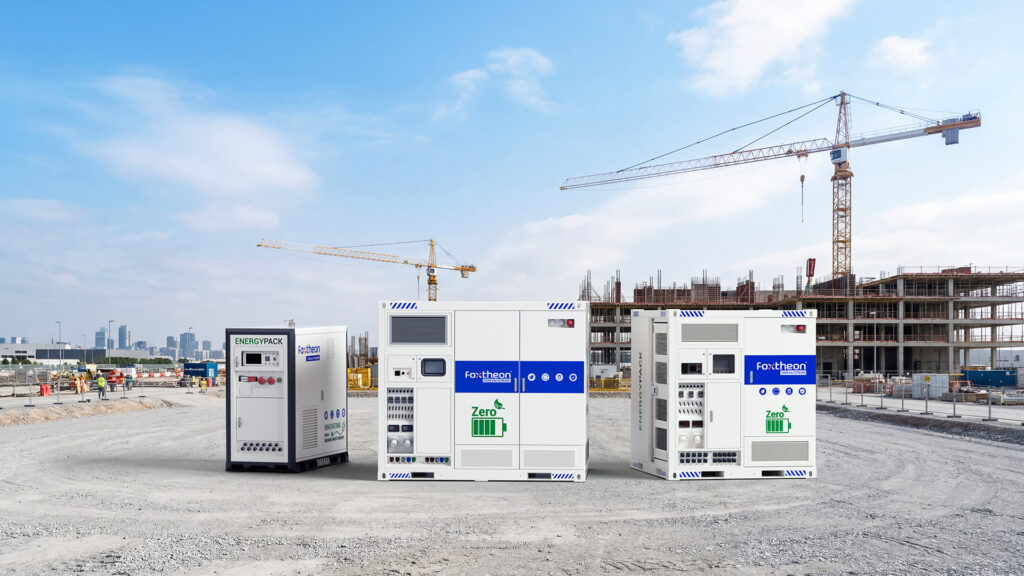
Engineering Evaluation Criteria for Systems Procurement
Specifying equipment within this technical tier requires a systematic review of electrochemical, mechanical, and protection specifications. Engineering procurement teams must assess integrators based on hardware compatibility, balance of plant (BOP) robust design, and testing protocols.
Industrial clients partner with organizations like Foxtheon because custom-engineered microgrid enclosures demand holistic packaging that accounts for harsh environments. Key evaluation parameters include:
- Thermal Management Topologies: Battery compartments utilize dedicated liquid-cooling distribution manifolds containing closed-loop dielectric or water-glycol mixtures rather than simple forced-air HVAC units. Liquid cooling maintains inter-cell thermal deltas below 2°C, preventing localized thermal variance that causes accelerated, uneven cell aging across high-capacity lithium iron phosphate packs.
- C-Rate and Cycling Durability: The battery cells and BMS must comfortably sustain continuous 0.5C to 1C discharge profiles without entering aggressive thermal throttling modes. Battery modules must be rated for at least 6,000 to 8,000 cycles at 80% to 90% Depth of Discharge (DoD) under nominal operational temperatures.
- Switchgear Breaking Capacity and Arc-Flash Protection: High fault currents originating from both synchronous engines and grid-forming converters necessitate medium-voltage switchgear rated for elevated short-circuit interrupting capabilities (typically 25kA to 40kA for 3 seconds). Integrated fiber-optic arc detection relays ensure clearing times below 50 milliseconds to isolate damaged sections.
- Factory Acceptance Testing (FAT) Rigor: Prior to on-site mobilization, the entire integrated package—including the energy storage enclosures, power conversion skids, engine synchronizing panels, and automated transfer switches—must undergo dynamic full-load and unbalanced-load FAT testing against simulated site conditions.
Selecting an industrial Hybrid Power Solution ensures electrical continuity across fluctuating industrial profiles. The seamless convergence of solid-state power conversion, mechanical rotation, and advanced software layers establishes an optimized framework for modern, decentralized operational infrastructure.
Frequently Asked Questions
Q1: What is the primary difference between grid-following and grid-forming inverters within a hybrid system?
A1: A grid-following (GFL) inverter requires an existing voltage and frequency reference supplied by an external source, such as a synchronous generator or utility grid, using a phase-locked loop to inject synchronized current. A grid-forming (GFM) inverter functions as a pure voltage source, establishing its own voltage magnitude and frequency through internal reference clocks and droop algorithms, enabling full microgrid operation without mechanical generators online.
Q2: How does integrating energy storage prevent engine wet-stacking in industrial installations?
A2: Wet-stacking occurs when an engine operates under sustained loads below 30% to 40% of its rated capacity, leading to low cylinder temperatures and unburned fuel collecting in the exhaust system. The microgrid controller continuously monitors facility demand; if load levels fall below the engine minimum threshold, the controller dispatches the spare capacity to charge the battery bank, keeping the engine loaded within its ideal thermal efficiency zone.
Q3: Why is Lithium Iron Phosphate (LFP) preferred over Nickel Manganese Cobalt (NMC) in industrial hybrid platforms?
A3: LFP chemistry provides superior chemical and thermal stability, presenting a substantially higher thermal runaway threshold (around 270°C) compared to NMC (around 210°C). Furthermore, LFP delivers higher cycle durability (often exceeding 6,000 cycles at 80% DoD) and operates without volatile cobalt, making it well-suited for stationary industrial systems where energy density by weight is secondary to reliability, structural safety, and equipment longevity.
Q4: Can a hybrid microgrid operate continuously if the renewable PV source drops off due to heavy cloud cover?
A4: Yes. The microgrid controller manages immediate generation imbalances through automated multi-layer dispatch. When solar generation drops sharply, the high-speed battery power conversion system injects the necessary active power into the AC bus within milliseconds, preventing frequency dips. The controller simultaneously ramps the running generators or starts idle standby units in a smooth, synchronized sequence to absorb sustained base load.
Q5: What international electrical standards dictate the performance of decentralized hybrid power systems?
A5: System design, interconnected equipment performance, and microgrid control are primarily governed by the IEEE 2030 series (notably IEEE 2030.7 for microgrid control specifications and IEEE 1547 for interconnection standards), alongside the IEC 62257 series for off-grid and hybrid rural electrification architectures. High-voltage battery systems must also conform to UL 9540, UL 1973, and IEC 62619 for electrical, thermal, and functional safety verification.
Direct Project Engineering Inquiries
To request technical design documentation, single-line diagrams, or system specifications for your specific load profile, submit your project parameters directly through the Foxtheon application portal: https://www.foxtheon.com/contact/