
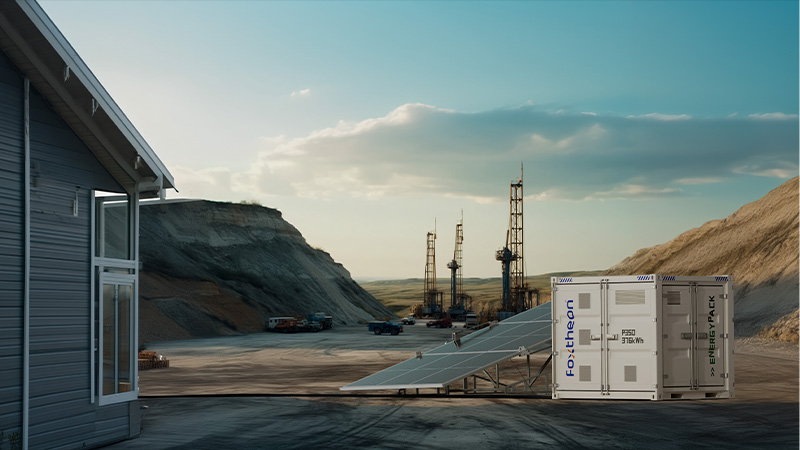
Autonomous microgrids deployed in mining operations, remote telecommunication stations, isolated agro-industrial complexes, and islanded utilities require dependable power quality under variable operating conditions. The engineering behind off grid electricity storage forms the core stabilizing mechanism for these isolated networks. Rather than relying entirely on continuous fuel logistics or unpredictable renewable generation, utility-scale and commercial energy systems depend on advanced electrochemical storage to maintain frequency, provide synthetic inertia, and balance dynamic loads.
Integrated energy solution providers like Foxtheon develop power conversion and battery storage platforms that interface with solar arrays, wind turbines, and thermal generation assets, establishing balanced standalone electrical architectures.

Architectural Topologies: AC-Coupled vs. DC-Coupled Microgrids
Selecting between AC-coupled and DC-coupled architectures determines conversion efficiency, system expandability, control responsiveness, and protection design in off-grid deployments.
DC-Coupled Architecture
In DC-coupled systems, intermittent renewable sources (such as photovoltaic arrays) and the electrochemical storage bank connect to a common DC bus through dedicated Maximum Power Point Tracking (MPPT) charge controllers. A bidirectional power conversion system (PCS) interfaces the DC bus with the facility AC distribution network.
- Conversion Efficiency: Solar energy charging the battery directly through DC-DC converters eliminates redundant DC-AC-DC conversion stages, maintaining round-trip charging efficiencies above 92%.
- Fault Current Management: High DC short-circuit capacities necessitate fast-acting DC isolation breakers and coordinated fusing to manage prospective fault currents.
- Use Case Suitability: Ideal for systems where solar generation precisely matches daytime base loads and direct battery charging constitutes the primary operating regime.
AC-Coupled Architecture
AC-coupled designs connect all generation assets (PV grid-tie inverters, thermal generators) and the battery energy storage system directly to a common AC bus. The energy storage PCS acts as a grid-forming voltage source establishing system frequency (50/60 Hz) and voltage amplitude.
- Scalability: Additional energy sources or loads can be added to the AC bus without redesigning the DC architecture or recalculating battery charge controller capacities.
- Redundancy: Distributed inverters operate independently. If a single generation unit trips, the storage PCS continues supporting the remaining network assets.
- Use Case Suitability: Recommended for medium-to-high voltage industrial microgrids, retrofits on established sites with existing generation equipment, and installations requiring high instantaneous power output across geographically dispersed buildings.
| Parameter | DC-Coupled Systems | AC-Coupled Systems |
|---|---|---|
| Solar-to-Battery Efficiency | Higher (Direct DC-DC conversion) | Lower (DC-AC-DC conversion losses) |
| Integration Flexibility | Moderate (Tied to common DC bus voltage) | High (Universal standard AC bus coupling) |
| Grid-Forming Capability | Handled via centralized master inverter | Handled via bidirectional grid-forming PCS |
| System Expansion Complexity | Requires DC bus reconfiguration | Modular plug-and-play along the AC feeder |
Electrochemical Cell Chemistries in Standalone Storage
The operational profile of an off grid electricity storage system requires cell chemistries capable of handling deep discharge cycles, dynamic charge rates, and wide operating temperature ranges.
Lithium Iron Phosphate (LiFePO4 / LFP)
LFP has emerged as the dominant chemistry for commercial and industrial energy storage because of its robust crystal structure and thermal stability.
- Thermal Stability: The olivine crystal structure features strong P-O covalent bonds, preventing oxygen release during high-temperature events. The thermal runaway threshold for LFP sits around 270°C, providing structural safety compared to alternative layered-oxide chemistries.
- Cycle Longevity: LFP cells routinely deliver 6,000 to 8,000 cycles at 80% Depth of Discharge (DoD) under standard 0.5C operating parameters.
- Voltage Plateau: A stable nominal voltage (3.2V per cell) ensures predictable discharge curves and uniform inverter DC input conditions throughout the discharge window.
Sodium-Ion (Na-Ion)
Sodium-ion is emerging as a viable alternative for stationary installations where energy density by weight is a secondary consideration.
- Low-Temperature Performance: Na-ion chemistries exhibit superior capacity retention in sub-zero conditions, retaining upwards of 85% capacity at -20°C without active pre-heating.
- Discharge Characteristics: Na-ion cells can be fully discharged to 0V for logistics and storage without inducing anode dissolution, easing international maritime and terrestrial transport logistics.
Hybrid Energy Management: Synchronizing Storage with Thermal Assets
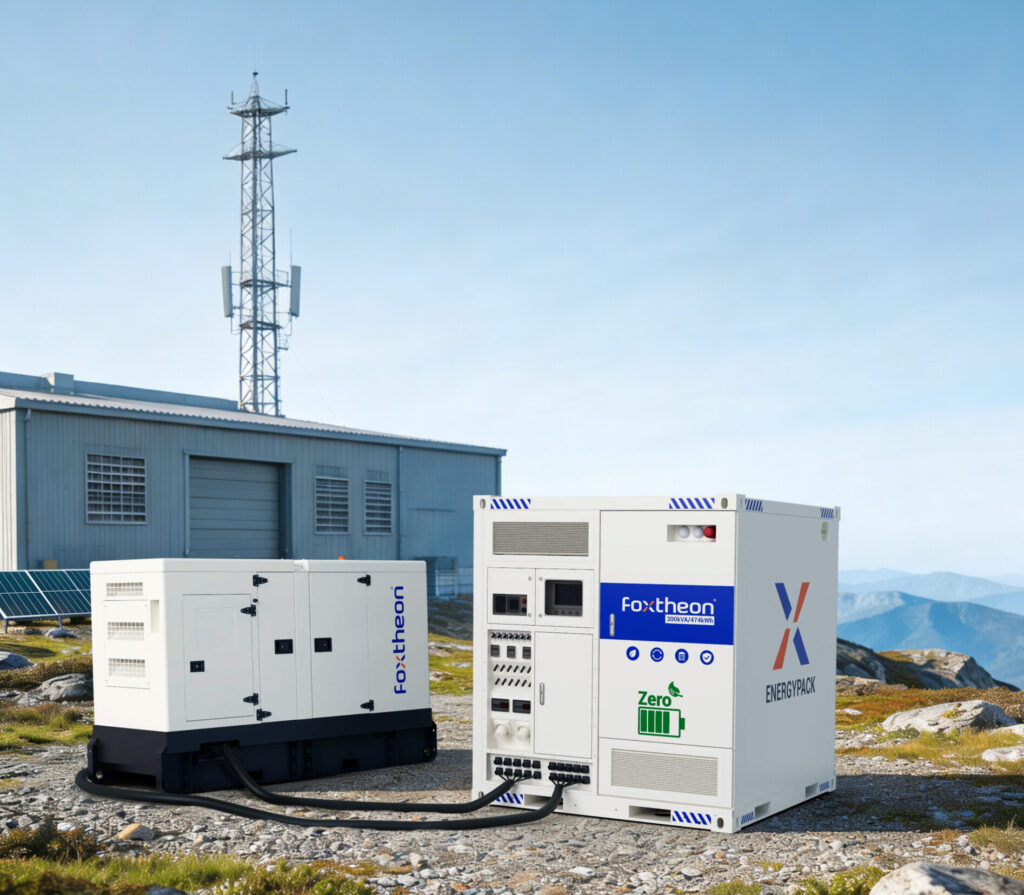
In autonomous microgrids, diesel, gas, or heavy fuel oil (HFO) generators historically carry continuous baseline loads. Introducing off grid electricity storage shifts thermal assets from variable load followers to optimized, stable run-mode machines.
Microgrid controllers developed by Foxtheon implement advanced droop control algorithms (P-f and Q-V droop) and virtual synchronous generator (VSG) algorithms. These control modes yield direct technical improvements across the power station:
- Dynamic Load Leveling: Large inductive loads (e.g., slurry pumps, crushers, ventilation shafts) generate severe inrush currents. The battery system injects instantaneous active and reactive power within milliseconds, mitigating voltage sags and preventing generator under-frequency trips.
- Optimizing Generator Loading: Running thermal generators below 30-40% load causes low-load wet stacking, unburned fuel accumulation, and low mechanical efficiency. The storage system absorbs excess generator output to run the engine at its optimal fuel-efficiency band (typically 75-85%), storing the surplus for low-demand periods.
- Spinning Reserve Replacement: Rather than keeping multiple generators idling in reserve to handle sudden renewable drops or load spikes, the battery system functions as the primary spinning reserve. This decreases running engine hours and prolongs service intervals for mechanical components.
Subsystem Engineering in Industrial Storage Units
A reliable off grid electricity storage deployment requires careful balance-of-plant engineering to maintain long asset service life and system availability.
Multilevel Battery Management Systems (BMS)
BMS architecture spans three discrete supervisory layers:
- Cell-Level Monitoring (Slave BMS): Measures individual cell voltages (millivolt accuracy) and surface temperatures across positive/negative terminals via dedicated NTC thermistors.
- String-Level Control (Master BMS): Aggregates pack telemetry, calculates State of Charge (SoC) and State of Health (SoH) via extended Kalman filtering, and directs active or passive cell balancing.
- System-Level Energy Control (System BMS): Coordinates multi-rack configurations, interfaces via industrial Modbus TCP/IP or CAN protocols with the central Microgrid Controller, and commands high-voltage direct current contactors.
Thermal Management: Liquid Cooling vs. Forced Air
Modern utility-grade and industrial storage systems favor closed-loop liquid cooling platforms over standard HVAC forced-air designs.
- Temperature Uniformity: Cold-plate liquid distribution keeps intra-rack cell temperature differentials under 3°C. Preventing localized hot spots ensures uniform cell aging and stops premature string degradation.
- Parasitic Load Reductions: Liquid systems use variable-speed pumps and external heat exchangers, cutting parasitic auxiliary power consumption by 20% to 35% compared to continuous forced-air cooling.
- Ingress Protection: Sealed, liquid-cooled enclosures prevent external dust, sand, and humidity from entering cell compartments, satisfying IP55 or IP65 industrial requirements in harsh environments.
Application-Specific Sizing and Load Profiling
Sizing an off grid electricity storage system requires precise analysis of dynamic load steps, daily operational hours, environmental derating factors, and renewable power variations.
Remote Mining and Processing Operations
Mining microgrids run large motor loads that trigger cyclic surges alongside continuous baseline requirements.
- High C-Rate Sizing: Inverters must support 1.5C to 2C short-duration discharge rates to absorb start-up transients from industrial ball mills and hoist mechanisms without sagging the bus voltage.
- Harmonic Filtration: Variable Frequency Drives (VFDs) introduce substantial harmonic distortion (THD). The storage system’s PCS must incorporate active power filtering capabilities to maintain grid compliance under IEEE 519 standards.
Remote Telecom and Radar Infrastructure
Communications networks require uninterrupted DC or AC power supply across unstaffed, extreme-environment outposts.
- Extended Autonomy: Sizing focus centers on C/10 to C/20 discharge profiles designed to sustain 48-hour to 72-hour zero-generation spans during adverse meteorological conditions.
- Autonomous Restart: The system must include automated black-start capabilities that self-energize the DC bus and initiate renewable charging without on-site technical intervention.
Supplier Selection and Manufacturing Compliance Criteria
Procuring industrial-grade energy storage requires thorough evaluation of structural compliance, manufacturing tolerances, and standardized safety certifications.
- Safety and Testing Standards: Equipment should hold verified testing certifications to UL 9540 (Energy Storage Systems and Equipment), UL 9540A (Thermal Runaway Fire Propagation Testing), and IEC 62619 (Secondary Lithium Cells and Batteries for Industrial Applications).
- Factory Acceptance Testing (FAT): Comprehensive testing protocols must evaluate multi-rack balancing, emergency shutdown (ESD) response times under full electrical load, dynamic step-load tracking, and thermal run-mode stability prior to transport.
- Integrated System Support: Suppliers must supply detailed protection coordinate curves, short-circuit calculations, and hardware integration schemes compatible with on-site infrastructure.
Engineering teams partnering with specialized manufacturers such as Foxtheon ensure their off grid electricity storage projects leverage purpose-built enclosures, proven BMS platforms, and integrated power conversion systems designed for demanding industrial applications.
Frequently Asked Questions
Q1: What is the standard response time of an off-grid battery storage inverter when handling sudden microgrid load steps?
A1: Modern four-quadrant bidirectional power conversion systems using IGBT or SiC MOSFET switching topologies achieve step-response times below 20 milliseconds. This enables rapid compensation for load variations and seamless frequency stabilization.
Q2: How does temperature derating affect the usable capacity of lithium iron phosphate batteries in off-grid deployments?
A2: Unconditioned LFP cells exhibit reduced chemical kinetics below 0°C, requiring charge-current limits to prevent lithium plating on the anode. Above 45°C, accelerated solid electrolyte interphase (SEI) growth degrades cell longevity. Integrated liquid-cooled thermal management systems maintain internal temperatures between 15°C and 35°C to avoid these capacity derating penalties.
Q3: What role does grid-forming inverter technology play in isolated storage networks?
A3: Grid-forming inverters act as an independent voltage source, setting microgrid voltage amplitude and operating frequency. This allows decentralized renewable sources and synchronous machines to synchronize against a stable electrical reference without needing an external utility grid.
Q4: Why is cell-to-cell temperature uniformity important within high-capacity battery racks?
A4: Variations in temperature cause mismatched internal cell resistances, leading to uneven current distribution among parallel cell groups. Over multiple cycles, hotter cells degrade faster, lowering the usable capacity of the entire string to match the weakest cell. Proper thermal management keeps variations within a 3°C band across the rack.
Q5: Can an off-grid battery energy storage system initiate a black start on an industrial microgrid?
A5: Yes. Configured storage systems utilize internal auxiliary power or dedicated black-start capacitor banks to energize the main PCS, establish nominal bus voltage, energize step-up transformers, and systematically synchronize downstream generation units without drawing external grid power.
Technical Inquiries and Engineering Specifications
Industrial project developers, system integrators, and plant engineers requiring custom electrical single-line diagrams (SLDs), microgrid dynamic modeling, containerized enclosure layouts, or detailed equipment specifications can reach out directly to the technical team via our engineering channel:
Direct Inquiries: https://www.foxtheon.com/contact/