

Modern industrial operations face complex operational demands that require high-precision power oversight, stable frequency maintenance, and automated synchronization across distributed energy resources. An industrial energy management system serves as the central intelligence hub, aggregating disparate data streams from medium-voltage switchgear, onsite generation sets, battery storage units, and heavy motorized loads. Rather than treating energy as a static overhead utility, engineering teams utilize digital platforms to balance real-time supply and demand, maintain power quality standards, and coordinate peak demand intervals without interrupting continuous assembly processes.
Implementing an automated control layer bridges operational technology (OT) networks on the factory floor with enterprise-level planning software. Industrial environments running rotary kilns, arc furnaces, CNC milling centers, and automated packaging systems encounter variable load profiles that challenge utility grid stability. Through the deployment of an industrial energy management system, plant managers acquire deterministic control over instantaneous kilowatt spikes, power factor variations, and system-wide harmonics, establishing operational continuity across standard operating states.

Hardware Telemetry and Edge Data Acquisition Layers
Field-level data capture forms the foundational layer of any industrial energy deployment. Without low-latency edge telemetry, supervisory control algorithms cannot execute microsecond-level load shedding or frequency response. Hardware architectures rely on high-precision instrumentation installed directly into motor control centers (MCC), distribution panels, and transformer substations.
- Instrument Transformers and Transducers: Data collection starts with split-core current transformers (CTs) and Rogowski coils rated for Class 0.2S or Class 0.5S accuracy according to IEC 61869 standards. These sensors convert high-amperage feeder signals into standardized secondary currents (typically 1A or 5A) or proportional millivolt signals, preserving waveform fidelity during transient events.
- Digital Power Meters: Microprocessor-based digital meters measure true root-mean-square (TRMS) voltage, current, active power (kW), reactive power (kVAR), and apparent power (kVA). These devices capture up to the 63rd harmonic to detect non-linear loads created by variable frequency drives (VFDs) and thyristor-controlled rectifiers.
- Programmable Logic Controllers (PLCs) and Remote Terminal Units (RTUs): Hardened edge controllers process incoming analog and digital I/O. Equipped with deterministic real-time operating systems (RTOS), RTUs compile input signals, execute local interlocks, and deliver control commands to motorized breakers within 10 to 20 milliseconds.
- Industrial Fieldbus Gateways: Because legacy plants operate diverse machinery, edge gateways convert legacy serial protocols (Modbus RTU over RS-485) into high-bandwidth industrial Ethernet protocols, such as Modbus TCP, EtherNet/IP, PROFINET, or BACnet/IP for seamless upstream transmission.
Edge devices must support local caching mechanisms. In the event of an upstream network disconnect between field panels and the centralized server, edge nodes continue logging high-resolution event data to internal solid-state non-volatile memory, preventing data loss during diagnostic reviews.
Communication Protocols and Interoperability Standards
Integrating distributed components within an industrial energy management system demands protocol standardization. The interoperability framework determines how quickly supervisory layers react to grid disruptions, thermal runaway flags, or unexpected generator trips.
High-voltage and medium-voltage substations rely on the IEC 61850 standard, which uses Generic Object Oriented Substation Events (GOOSE) messaging over Ethernet networks. GOOSE delivers peer-to-peer data transport with latency thresholds under 4 milliseconds, providing protective relaying and breaker tripping without relying on hardwired copper interconnects. Facilities operating distributed microgrids incorporate IEEE 2030.5 and DNP3 (Distributed Network Protocol) across WAN links to ensure authenticated, encrypted communication with external utility grid operators.
For horizontal integration inside the plant, OPC Unified Architecture (OPC UA) acts as the machine-to-machine communication backbone. Providing built-in security, data modeling, and end-to-end encryption, OPC UA enables the software platform to query real-time equipment status from multi-vendor PLCs, cooling chillers, and automated assembly conveyors without creating protocol bottlenecks.
Control Logic, Load Shedding, and Peak Shaving Dynamics
The core computational engine of the control platform processes streaming telemetry through proprietary or standardized control algorithms to balance internal supply with demand curves. Two primary mechanisms govern this balancing act: peak shaving and fast-acting priority-based load shedding.
Peak shaving involves monitoring the facility’s demand window—frequently calculated by utilities in rolling 15-minute intervals. When cumulative site consumption approaches contracted peak thresholds, the management platform commands localized distributed resources to dispatch active power. Stationary battery units and existing generation equipment inject current into the facility busbars, dampening utility draw and preventing high capacity penalty tariffs.
Automated load shedding protects operational integrity during generation deficiencies or utility brownouts. Loads across the facility are categorized into distinct tiers:
- Tier 1 (Non-Essential Loads): Administrative HVAC, auxiliary heating elements, outdoor area illumination, and warehouse charging stations. These are curtailed instantaneously when total load exceeds spinning reserve margins.
- Tier 2 (Semi-Flexible Production Loads): Bulk raw-material grinding systems, secondary water pumps, and non-time-sensitive air compression networks equipped with large buffer storage receivers.
- Tier 3 (Protected Continuous Processes): Cleanroom ventilation, industrial refrigeration compressors, glass furnaces, and continuous chemical reaction vessels where power cuts cause equipment damage.
When the management system detects a sudden frequency deviation (e.g., dropping below 49.8 Hz in a 50 Hz system or 59.8 Hz in a 60 Hz system), dynamic droop curves adjust power injection from connected inverter systems or initiate fast load detachment to stabilize microgrid frequency before protective relays trigger a broad plant trip.
Switchgear, Enclosure Materials, and Environmental Thermal Ratings
Physical enclosures housing microgrid controls, programmable units, and power electronics must withstand harsh factory environments. Environmental contaminants like metallic dust, chemical fumes, high humidity, and ambient temperature swings impact internal component longevity.
Enclosures deployed across heavy industrial settings are fabricated using heavy-gauge cold-rolled sheet steel, typically 14-gauge or 12-gauge thickness, or 316-grade stainless steel for facilities subject to corrosive washes or marine-adjacent atmospheres. Powder-coated finishes must pass salt-spray tests according to ASTM B117 to prevent oxidation. Ingress protection ratings follow standardized parameters: NEMA 4X or minimum IP65 configurations for outdoor switchgear assemblies, preventing dust ingress and high-pressure water penetrations.
Inside the control cabinets, thermal management requires calculation of internal heat dissipation from power supplies, switches, and inverters. Systems employ closed-loop air-to-air heat exchangers or thermoelectric cooling assemblies to isolate internal airflow from particulate-laden ambient air. Busbars fabricated from high-conductivity electrolytic copper (ETP grade, minimum 99.9% purity) feature tin or silver plating across contact joints to minimize contact resistance and prevent galvanic corrosion, ensuring sustained thermal stability under continuous full-load operating conditions.
Co-locating Hybrid Battery Storage with Existing Generation Assets
Industrial sites often maintain fleets of synchronous reciprocating engines fueled by natural gas or diesel to supply backup power during outages. An industrial energy management system integrates these existing assets alongside modern battery energy storage systems (BESS) and rooftop solar arrays, maximizing operational reliability without rendering current equipment obsolete.
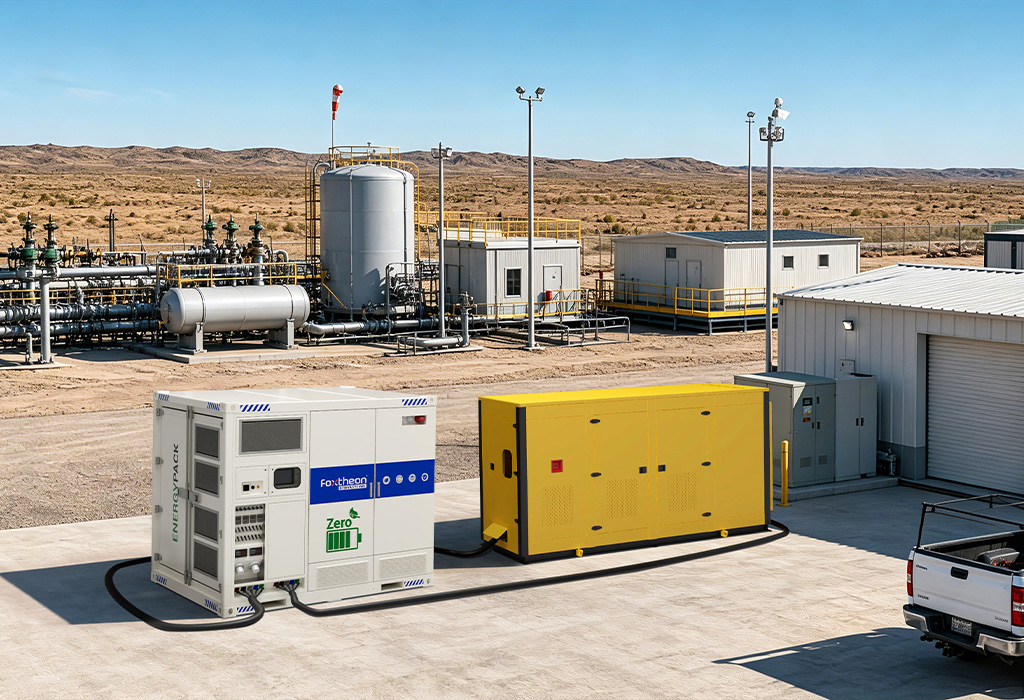
Engine-driven generators perform poorly under low-load conditions; running a diesel generator below 30% of its rated capacity leads to unburned fuel accumulation, commonly called wet stacking, which elevates maintenance requirements. Incorporating hybrid architectures, companies such as Foxtheon design integration solutions where energy storage buffers transient load swings. When demand dips, excess energy generated by synchronous engines charges the battery banks, holding engine loading at optimal efficiency bands. Conversely, when large inductive motors start up, the battery system supplies immediate reactive power, protecting legacy generators from excitation thermal stresses and voltage dips.
The centralized control architecture optimizes real-time operational sequencing. Rather than running three generators at sub-optimal loads during transitional shifts, the control logic coordinates two engines at prime capacity while the battery absorbs peak surges. This dynamic load balancing prolongs the operating life of mechanical generators and stabilizes localized voltage profiles across the entire distribution network.
Procurement, Sizing, and Technical Specifications
Procuring an enterprise-grade industrial energy management system requires clear technical scoping during the Request for Proposal (RFP) stage. Industrial engineers must look beyond user-interface dashboards to confirm the low-level processing hardware and system integration scope.
- Sampling Rate and Processing Speed: Telemetry systems must support high-speed sub-cycle sampling (minimum 10 kHz for power quality monitoring) and sub-second calculation rates for active microgrid balancing routines.
- SCADA and DCS Interfacing: The platform must provide native software connectors to upstream Distributed Control Systems (DCS) such as Honeywell Experion, Siemens PCS 7, or Emerson DeltaV via standardized API structures and OPC interfaces.
- Harmonic Suppression Compliance: The integrated solution must monitor and contribute to facility compliance with IEEE 519 standards, which define acceptable Total Harmonic Distortion (THD) limits for voltage and current at the point of common coupling (PCC).
- Factory Acceptance Testing (FAT): Vendor contracts should stipulate hardware-in-the-loop (HIL) testing during FAT. This simulates real-world power fault scenarios, step-load transients, and comms dropouts before physical delivery to the job site.
Suppliers like Foxtheon provide modular engineering architectures that integrate conversion systems, switchgear interfaces, and microgrid controls. Engineering buyers evaluate vendor proposals based on hardware modularity, availability of regional field support engineers, firmware security updates, and standard compliance ratings, including UL 1741, IEEE 1547, and IEC 62443 cybersecurity designations.
Frequently Asked Questions
Q1: How does an industrial energy management system interact with installed diesel generators?
A1: The management system communicates with generator automatic mains failure (AMF) panels and electronic governors via Modbus or hardwired contacts. It coordinates startup sequences, manages synchronized bus closure, balances active and reactive load sharing, and prevents low-load idling by diverting excess output to battery storage systems.
Q2: What is the functional difference between an EMS and a basic SCADA system?
A2: A SCADA (Supervisory Control and Data Acquisition) system focuses on data acquisition, equipment monitoring, and manual remote operation. An energy management system incorporates advanced optimization algorithms, predictive load modeling, automated peak shaving, dynamic microgrid balancing, and autonomous load shedding without requiring direct operator intervention.
Q3: Can an industrial energy management system operate during a complete utility blackout?
A3: Yes. When coupled with an island-capable microgrid containing grid-forming inverters and onsite generation, the system coordinates black-start sequencing. It manages breaker operations, balances initial inrush currents from large step-up transformers, and incrementally reconnects production loads to preserve system frequency.
Q4: What cybersecurity protections are typical for modern industrial energy deployments?
A4: Industrial deployments follow IEC 62443 guidelines, incorporating role-based access control (RBAC), physical port locking, network segmentation through industrial firewalls, encrypted communication protocols (such as TLS-secured Modbus TCP or HTTPS), and detailed syslog generation for audit trails.
Q5: What physical space constraints exist when retrofitting an EMS into an established facility?
A5: Retrofits typically utilize existing switchgear footprints by deploying DIN-rail mounted edge controllers and split-core CTs within existing cabinet enclosures. If dedicated isolation transformers, control panels, or co-located battery units are added, standard deployments utilize modular external enclosures rated NEMA 3R/4X, occupying compact concrete pad space adjacent to the main electrical room.
Technical Inquiries and System Specification Requests
Submit your electrical single-line diagrams (SLD), steady-state load logs, and facility operational requirements directly to the engineering team. Complete the technical inquiry form below to schedule a preliminary review of your site’s power infrastructure, microgrid synchronization parameters, and automation protocols.
Direct Inquiry Desk: Contact Foxtheon Systems Engineering at https://www.foxtheon.com/ or request an engineering consultation via the energy storage and management division: https://www.foxtheon.com/hybrid-battery-energy-storage-system/.